NASA Goddard Space Flight Center's carbon nanotube manufacturing technology wins Nano 50 Award
November 14, 2007 NASA Goddard Space Flight Center's carbon nanotube manufacturing technology wins Nano 50 Award

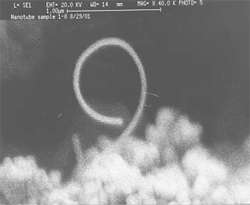
NASA Goddard’s manufacturing process for single-walled carbon nanotubes, such as this one, is less expensive, simpler and safer than other methods. Credit: Innovative Partnerships Program Office, NASA GSFC

NASA Goddard Space Flight Center in Greenbelt, Md. announced that its method for manufacturing high-quality carbon nanotubes (CNT) has been named a winner in the third annual Nanotech Briefs Nano 50 awards in the Technology category. This award will be celebrated at the Nano 50 awards dinner November 14 at the NASA Tech Briefs National Nano Engineering Conference (NNEC 2007) in Boston, Mass.

Judged by a panel of nanotechnology experts, the Nano 50 awards recognize the top 50 technologies, products, and innovators that have significantly impacted (or are expected to impact) the state of the art in nanotechnology. The winners of the Nano 50 awards are the "best of the best"—the innovative people and designs that will move nanotechnology to key mainstream markets.

"My deepest gratitude goes out to the panel of experts at Nanotech Briefs magazine, as well as Goddard’s Innovative Partnership Program (IPP) Office, for recognizing this technology and its future impact," expressed retired Goddard innovator, Jeannette Benavides, who is presenting her award-winning technology at NNEC 2007.

Until recently, CNT use has been limited due to the complex, dangerous, and expensive methods for their production. Benavides’s technology represents a simpler, safer, and much less expensive manufacturing method.

The key innovation in the process patented by NASA Goddard is its ability to produce bundles of CNTs without using a metal catalyst. Most single-walled CNT (SWCNT) manufacturing methods—chemical vapor deposition, laser ablation, microwave, and high-pressure carbon monoxide conversion—use a metal catalyst to encourage carbon to grow in nanotube form without capping. Because Goddard’s process does not use a metal catalyst, no metal particles need to be removed from the final product, yielding a significantly better product in terms of quality and purity at a dramatically lower cost.

Given their level of purity, the high-quality SWCNTs made using Benavides’s discovery are particularly well suited for medical applications, where metal particles cannot be present, as well as applications where high strength and electrical conductivity are desired, since high purity enhances these characteristics. Yet, they can be used in other applications as well. For example, SWCNTs made with this process could be integrated into a polymer to result in a fiberglass-type material that is as strong as steel but with one-sixth the weight.

The commercial impact of this discovery is clearly demonstrated by the market’s significant interest in the technology. Goddard has licensed the technology to Idaho Space Materials, Nanotailor, and E-City NanoTechnologies, all of which were founded specifically to manufacture SWCNTs using Goddard’s technology. Goddard also has licensed the technology to American GFM.

"I'm very excited to see that the IPP Office’s licensing out of my technology is making CNTs more readily available, particularly for academic and other research programs. The fact that they now have access to lower cost CNTs bodes well for the future of nanotechnology," said Benavides.

"Dr. Benavides not only worked hard to develop the technology, but she also was very involved in the technology transfer process," explained the IPP Office’s Darryl Mitchell, who has led the licensing efforts for NASA Goddard. "Her dedication has been essential to the success of the licensing agreements."

Source: Goddard Space Flight Center


print this article email this article download pdf blog this article bookmark this article     Stumble it Digg this share on Facebook retweet share on Reddit add to delicious
Rate this story - 4.2 /5 (9 votes)


November 14, 2007 all stories

Comments: 0

4.2 /5 (9 votes)
  • Stumble this up

  • Digg this

  • share this

  • hide
  • Related Stories

  • 'Firefly' cubesat to study link between lightning and terrestrial gamma ray flashes
    created Nov 17, 2008 | popularity not rated yet | comments 0
  • NASA MidSTAR-1 successful technologies may be revolutionary
    created Feb 19, 2008 | popularity not rated yet | comments 0
  • NASA Tests Shape-Shifting Robot Pyramid for Nanotech Swarms
    created Mar 31, 2005 | popularity not rated yet | comments 0
  • UU Research Pushing Back the Frontiers of Space
    created Dec 04, 2004 | popularity not rated yet | comments 0
  • Novel nano-devices developed by U of T researchers
    created Nov 10, 2009 | popularity not rated yet | comments 0


  • hide
  • Relevant PhysicsForums posts

  • Distortion of Zr2Cu crystal structures?
    created Nov 10, 2009
  • Poynting Effect, more than one meaning?
    created Nov 10, 2009
  • Pipeline Drying
    created Nov 10, 2009
  • Polymer Properties Question
    created Nov 08, 2009
  • More from Physics Forums - Materials & Chemical Engineering

Other News

Understanding mechanical properties of silicon nanowires paves way for nanodevices

Understanding mechanical properties of silicon nanowires paves way for nanodevices

Nanotechnology / Nanomaterials

created 19 hours ago | popularity 4.5 / 5 (2) | comments 0

Silicon nanowires are attracting significant attention from the electronics industry due to the drive for ever-smaller electronic devices, from cell phones to computers. The operation of these future devices, ...


carbon fiber

Ultra-Long Carbon Nanotubes Could Serve as Future Transmission Lines

Nanotechnology / Nanomaterials

created Nov 10, 2009 | popularity 4.8 / 5 (19) | comments 13

(PhysOrg.com) -- When it comes to carbon nanotubes, the majority of research so far has focused on small-scale applications. But now, a team of researchers from Rice University has created carbon nanotubes ...


New Digital 'Electronics' Concept May Continue Moore's Law

New Digital 'Electronics' Concept May Continue Moore's Law

Nanotechnology / Nanophysics

created Nov 05, 2009 | popularity 4.6 / 5 (62) | comments 9

(PhysOrg.com) -- Computers of the future could be operating not on electrons, but on tiny waves traveling through an electron "fluid," if a new proposal is successful. The new circuit design, recently introduced ...


Argonne 'homegrown' hybrid solar cell aims for low-cost power

Argonne 'homegrown' hybrid solar cell aims for low-cost power

Nanotechnology / Nanomaterials

created Nov 10, 2009 | popularity 4 / 5 (9) | comments 3

(PhysOrg.com) -- Scientists at the U.S. Department of Energy’s (DOE) Argonne National Laboratory have refined a technique to manufacture solar cells by creating tubes of semiconducting material and then "growing" ...


Nanoparticles for gene therapy improve

Nanoparticles for gene therapy improve

Nanotechnology / Bio & Medicine

created Nov 06, 2009 | popularity 5 / 5 (5) | comments 3

(PhysOrg.com) -- About five years ago, Professor Janet Sawicki at the Lankenau Institute in Pennsylvania read an article about nanoparticles developed by MIT's Robert Langer for gene therapy, the insertion ...