How to make the brightest supernova ever: Explode, collapse, repeat
November 14, 2007
How to make the brightest supernova ever

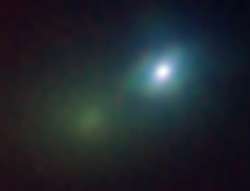
This infrared image of NGC 1260, the galaxy containing the supernova SN 2006gy, was taken using adaptive optics at Lick Observatory. The dimmer source to the lower left is the center of NGC 1260, while the much brighter source to the upper right is SN 2006gy. (Credit: Lick/UC Berkeley/J.Bloom & C.Hansen)

A supernova observed last year was so bright--about 100 times as luminous as a typical supernova--that it challenged the theoretical understanding of what causes supernovae. But Stan Woosley, professor of astronomy and astrophysics at the University of California, Santa Cruz, had an idea that he thought could account for it--an extremely massive star that undergoes repeated explosions. When Woosley and two colleages worked out the detailed calculations for their model, the results matched the observations of the supernova known as SN 2006gy, the brightest ever recorded.

The researchers describe the model in a paper to be published in the November 15 issue of the journal Nature. Woosley's coauthors are Sergei Blinnikov, a visiting researcher at UCSC from the Institute of Theoretical and Experimental Physics in Moscow, and Alexander Heger of Los Alamos National Laboratory.

"This was a stupendously bright supernova, and we think we have the leading model to explain it. It's a new mechanism for making a supernova, and for doing it again and again in the same star," Woosley said. "We usually think of a supernova as the death of a star, but in this case the same star can blow up half a dozen times."

The first explosion throws off the star's outer shell and produces a not-very-bright supernova-like display. The second explosion puts another supernova's worth of energy into a second shell, which expands at high velocity until it collides with the first shell, producing an extraordinarily brilliant display.

"The two shells collide out at a distance such that the full kinetic energy is converted into light, so it is up to 100 times more luminous than an ordinary supernova," Woosley said. "Usually a supernova only converts 1 percent of its kinetic energy into light, because it has to expand so much before the light can escape."

This mechanism requires an extremely massive star, 90 to 130 times the mass of the Sun, he said. As a star this big nears the end of its life, the temperature in the core gets so hot that some of the energy from gamma-ray radiation converts into pairs of electrons and their anti-matter counterparts, positrons. The result is a phenomenon called "pair instability," in which conversion of radiation into electron-positron pairs causes the radiation pressure to drop, and the star begins to contract rapidly.

"As the core contracts it goes deeper into instability until it collapses and begins to burn fuel explosively. The star then expands violently, but not enough to disrupt the whole star," Woosley said. "For stars between 90 and 130 solar masses, you get pulses. It hits this instability, violently expands, then radiates and contracts until it gets hotter and hits the instability again. It keeps going until it loses enough mass to be stable again."

Stars in this size range are very rare, especially in our own galaxy. But they may have been more common in the early universe. "Until recently, we would have said such stars don't exist. But any mechanism that could explain this event requires a very large mass," Woosley said.

Other researchers had suggested pair instability as a possible mechanism for some supernovae, but the idea of repeated explosions--called "pulsational pair instability"--is new. According to Woosley, the new mechanism can yield a wide variety of explosions.

"You could have anywhere from two to six explosions, and they could be weak or strong," he said. "A lot of variety is possible, and it gets even more complicated because what's left behind at the end is still about 40 solar masses, and it continues to evolve and eventually makes an iron core and collapses, so you can end up with a gamma-ray burst. The possibilities are very exciting."

Source: University of California - Santa Cruz

4.6 /5 (28 votes)  

Filter


Move the slider to adjust rank threshold, so that you can hide some of the comments.


Display comments: newest first

dirk_bruere
Nov 14, 2007

Rank: not rated yet
So what's the cycle time?
Quantum_Conundrum
Jan 08, 2008

Rank: not rated yet
I'm curious how a 130 solar mass star-like object supposedly forms without instantly collapsing to a black hole in the first place, or set off an instant chain reaction fusing almost its intire mass to iron instantly.


We're talking surface gravity of at LEAST several dozen x that of the sun. Under that much gravity the matter would be compacting and fusing at an insane rate, and perhaps that is where the instability would come from?

The core could be fusing and contracting so fast that the remainder of the star's mass just can't fall inward fast enough to contain the heat and radiation from the inner reactions.

The cycle time would most likely be inversely proportional to the star's mass within an upper and lower limit, and also depending on its exact composition, i.e. is it "new" and made mostly of hydrogen and helium? or is it "old" and starting to get more metals?


In other words, the greater the mass the smaller the cycle time. The older the star, the longer the cycle time, since the older it gets the more stable it will become.
Rank 4.6 /5 (28 votes)
Tags

Relevant PhysicsForums posts

More news stories

Study shows global glaciers, ice caps, shedding billions of tons of mass annually

Earth's glaciers and ice caps outside of the regions of Greenland and Antarctica are shedding roughly 150 billion tons of ice annually, according to a new study led by the University of Colorado Boulder.

Space & Earth / Earth Sciences

created 2 hours ago | popularity 5 / 5 (1) | comments 2 | with audio podcast

Building mountains in a bottle

(PhysOrg.com) -- Scientists are preparing to launch a 10-year project to study water resources, gas exchange and carbon cycling in three man-made landscapes built in a half-acre laboratory at the University ...

Space & Earth / Environment

created 6 hours ago | popularity 4 / 5 (1) | comments 0 | with audio podcast

VLT takes most detailed infrared image of the Carina Nebula

(PhysOrg.com) -- ESO's Very Large Telescope has delivered the most detailed infrared image of the Carina Nebula stellar nursery taken so far. Many previously hidden features, scattered across a spectacular ...

Space & Earth / Astronomy

created 7 hours ago | popularity 5 / 5 (5) | comments 3 | with audio podcast

NASA looking for more space taxis

NASA is looking for more ways to get astronauts to the International Space Station. The space agency put out a call today for commercial space companies to submit bids as part of the latest round of the Commercial ...

Space & Earth / Space Exploration

created 5 hours ago | popularity 4.3 / 5 (4) | comments 3

When stars play planetary pinball

Many of us remember playing pinball at the local arcade while growing up; it turns out that some stars like it as well. Binary stars can play tug-of-war with an unfortunate planet, flinging it into a wide ...

Space & Earth / Astronomy

created 5 hours ago | popularity 4 / 5 (1) | comments 0


Short fasting cycles work as well as chemotherapy in mice

Man may not live by bread alone, but cancer in animals appears less resilient, judging by a study that found chemotherapy drugs work better when combined with cycles of short, severe fasting.

Physicists build highly efficient 'no-waste' laser

A team of University of California, San Diego researchers has built the smallest room-temperature nanolaser to date, as well as an even more startling device: a highly efficient, "thresholdless" laser that ...

Study shows how DNA finds its match

It's been more than 50 years since James Watson and Francis Crick showed that DNA is a double helix of two strands that complement each other. But how does a short piece of DNA find its match, out of the millions ...

Transparent iron? For the first time, an experiment shows that atomic nuclei can become transparent

At the high-brilliance synchrotron light source PETRA III, a team of DESY scientists headed by Dr. Ralf Röhlsberger has succeeded in making atomic nuclei transparent with the help of X-ray light. At the ...

'Explorers,' who embrace the uncertainty of choices, use specific part of cortex

Life shrouds most choices in mystery. Some people inch toward a comfortable enough spot and stick close to that rewarding status quo. Out to dinner, they order the usual. Others consider their options systematically ...

Scientists delve into the brain roots of hunger and eating

Synaptic plasticity – the ability of the synaptic connections between the brain's neurons to change and modify over time -- has been shown to be a key to memory formation and the acquisition of new learning behaviors. ...