The World’s Fastest Measurements of Molecular Vibrations
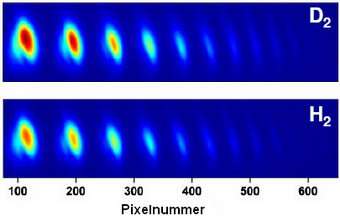
When atoms or molecules are subject to a short, intense laser pulse, they emit high-frequency ultraviolet radiation. If you compare the spectra of isotopes that are of different masses but otherwise similar, you can use this measured radiation to determine the motion of the atoms. The research team used this method -with single, extremely short laser pulses - to make the fastest measurements of how a molecule changes over time.
In the last decades there has been a revolution in measuring time-dependent molecular motion, thanks to improvements in laser technology. One major step forward were femtosecond pulses; they are laser flashes lasting only quadrillionths of a second. Over this time scale, light travels only thousandths of a millimetre. To compare: during the amount of time it takes for a normal camera shutter to go off - 1/60 of a second - light could transverse the distance from Berlin to New York. Nearly 20 years ago, Nobel Prize winner Ahmed Zewail and others used femtosecond pulses to make the first real-time observations of chemical reactions. Their work was based on the pump-probe principle: a laser pulse triggers a reaction (pump); a second pulse takes a snapshot of the molecule (probe). The changes in the molecule can be "filmed" over time. This involves comparing the individual snapshots with various time delays between the pump-pulse and probe-pulse.
Scientists at Imperial College London have now made the fastest measurements ever of molecular dynamics (Blackett Laboratory Laser Consortium, Prof. Jon Marangos, Director). They used a new measurement procedure. Its principles come from a theory developed by Max Planck researchers led by Dr. Manfred Lein. A single femtosecond pulse is sent to the sample. The pulse creates an electric field strong enough to wrest an electron, at specific times, from the molecule. This causes the body of the molecule to come off balance and begin moving. Because the laser pulse field changes direction periodically, it sometimes drives the free electron back to the ion. The electron and the molecule body unite again - and this sends off a high-frequency UV-photon. This series of events - and the intensity of UV emission that comes with it - becomes more and more improbable the further the molecule has travelled from its position at the start time. Or, in the language of quantum mechanics: the recombination probability depends on the overlap between start and end wave function. By measuring the intensity of the UV light, scientists can determine how the molecule changes over time.
The intensity of the UV ray being sent out is, unfortunately, influenced by other factors besides nuclear dynamics; among them, the probability of molecule ionisation. However, the scientist used a trick to get around this: they observed the spectra of two different isotopes. Isotopes have largely identical characteristics; the only way in which they differ is in the mass of the atomic nuclei. Thus, each isotope has atomic movement at differing speeds. The newly-published experiments compare hydrogen molecule spectra with deuterium, which is twice as heavy (see image), as well as the isotopes of methane, CH4 and CD4.
In measuring molecular changes over time, the scientists were able to take advantage of a very useful phenomenon, namely, that a single laser pulse creates a whole spectrum of UV frequencies. These frequencies can be assigned to the duration of time the returning electron spent "freed" from the ion. The highest frequencies are emitted from the electrons freed for the longest time. The exact resolution of the time measurements is determined by the difference between neighbouring UV frequencies, and is in the range of tenths of a femtosecond. The change over time can be reconstructed from the spectra of two different isotopes. This was done, in the case of the hydrogen experiment, using a complicated genetic computer algorithm. The methane isotope data analysis, however, would be considerably more complicated, and how to perform it exactly is still an open question.
Compared to the traditional pump-probe principle, one major advantage of the new method is that a single laser pulse serves to scan an entire interval of delay times. The experiment does not need to be repeated multiple times with various pump-probe intervals. The first author of the original publication, Dr. Sarah Baker, says "We are very excited by these results, not only because we have ‘watched’ motion occurring faster than was previously possible, but because we have achieved this using a compact and simple technique that will make such study accessible to scientists around the world."
Original work: S. Baker, J. Robinson, C.A. Haworth, H. Teng, R. A. Smith, C.C. Chirilă, M. Lein, J.W.G. Tisch, and J.P. Marangos, Probing proton dynamics in molecules on an attosecond timescale, Science Express, March 2, 2006
Source: Max Planck Institute for Nuclear Physics


