Dinosaur from Sahara ate like a 'Mesozoic cow'
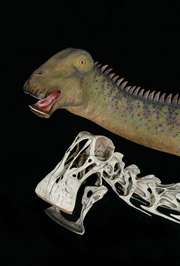
A 110 million-year-old dinosaur that had a mouth that worked like a vacuum cleaner, hundreds of tiny teeth and nearly translucent skull bones will be unveiled Thursday, Nov. 15, at the National Geographic Society.
Found in the Sahara by National Geographic Explorer-in-Residence Paul Sereno, paleontologist and professor at the University of Chicago, the dinosaur is a plant eater known as Nigersaurus taqueti. Originally named by Sereno and his team in 1999 with only a few of its distinctive bones in hand, Nigersaurus has emerged as an anatomically bizarre dinosaur.
Nigersaurus, a younger cousin of the more familiar North American dinosaur Diplodocus, is small for a sauropod, measuring only 30 feet in length. It managed to sustain its elephant-sized body with a featherweight skull armed with hundreds of needle-shaped teeth, said Sereno. Barely able to lift its head above its back, Nigersaurus operated more like a Mesozoic cow than a reptilian giraffe, mowing down mouthfuls of greenery that consisted largely of ferns and horsetails.
Details of the dinosaur’s anatomy and lifestyle will be published Nov. 21, 2007, (available Nov. 15) in PLoS ONE, the online journal from the Public Library of Science, as well as in a cover article in the December 2007 issue of National Geographic magazine, “Extreme Dinosaurs.”
Sereno’s research was partly funded by the National Geographic Society. An exhibit on Nigersaurus, including the original fossils and a reconstructed skeleton and skull of the dinosaur, will open Nov. 15 at the National Geographic Museum at Explorers Hall.
The dinosaur’s oddest feature was a broad, straight-edged muzzle, which allowed its mouth to work close to the ground. Unlike any other plant eater, Nigersaurus had more than 50 columns of teeth, all lined up tightly along the front edge of its squared-off jaw, forming, in effect, a foot-long pair of scissors.
A CT scan of the jaw bones showed up to nine “replacements” stacked behind each cutting tooth, so that when one wore out, another immediately took its place. There were more than 500 teeth in total, with a new tooth in each column joining the scissors edge every month. “Among dinosaurs,” Sereno said, “Nigersaurus sets the Guinness record for tooth replacement.”
Sereno and coauthors write in PLoS ONE that Nigersaurus’ downwardly deflected muzzle may characterize most diplodocoids, such as North America’s Diplodocus. “Some of these unusual sauropods thrived to become the pre-eminent ground-level feeders of the Mesozoic,” said coauthor Jeffrey Wilson, assistant professor at the University of Michigan.
CT scanning allowed Sereno and team to look inside the dinosaur’s braincase. There, small canals of the brain’s balancing organ revealed the habitual pose of the head. Reconstructed from CT scans, these canals showed that the muzzle of Nigersaurus angled directly toward the ground, unlike the forward-pointing snouts of most other dinosaurs. This feature, along with unusual wear facets on the animal’s teeth, led Sereno and colleagues to conclude that Nigersaurus largely fed by cropping plants near the ground.
Coauthor Lawrence Witmer, professor at Ohio University, who imaged the brain and organ of equilibrium, said, “What we have here is the first good look at a sauropod brain, and it has important things to say about this animal’s posture and behavior.”
Jaw design was not Nigersaurus’ only odd characteristic: It had a backbone that was more air than bone. “The vertebrae are so paper-thin that it is difficult to imagine them coping with the stresses of everyday use — but we know they did it, and they did it well,” said Wilson, who was an expedition team member.
The first bones of Nigersaurus were picked up in the 1950s by French paleontologists, though the species was not named. Sereno and his team honored this early work by naming the species after French paleontologist Philippe Taquet. Sereno’s team member Didier Dutheil first spotted the skull bones of Nigersaurus in 1997, and on that expedition and the next, teams collected about 80 percent of the skeleton.
The fossil area, in the present-day nation of Niger, was home to the enormous extinct crocodilian nicknamed SuperCroc as well as the likely fish eater Suchomimus, both found by Sereno and both on the prowl for Nigersaurus some 110 million years ago. Then, the African continent was just beginning to free itself of land connections it inherited as a central part of the ancient supercontinent Pangaea. Nigersaurus’ closest relative has been found recently in Spain.
Source: Public Library of Science


