New European loess map
November 15, 2007
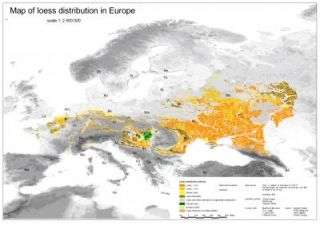
European Loess Map from 2007. Credit: Source: Dagmar Haase/UFZ
A new map showing the distribution of loess sediments in Europe has been published for the first time in 75 years, in digital format. With this map, Dagmar Haase, a geographer at the Helmholtz Centre for Environmental Research (UFZ), has completed the work of various researchers who had begun as far back as the 1970s and 80s to revise the last comprehensive inventory produced by Rudolf Grahmann, which appeared in Mitteilungen der Gesellschaft für Erdkunde in Leipzig in 1932.
Haase and her colleagues have produced the new map with a scale of 1:2,500,000 with the help of modern digital information systems.
Whether they are lime-grey or dark black, loess sediments and the soils derived from them are of special importance for agriculture worldwide because they are some of the most fertile soils there are. In Germany, soil quality is given a rating using an index. The maximum value of 100 was attributed to the loess soil at Eickendorf in the Magdeburger Börde plains.
Loess sediments and their soils cover around one-tenth of the earth. In Europe, loess is a powdery product of glaciations during the Ice Age. During those cold periods, this very fine, light material was swept from bare regions on the edges of the glaciers and deposited in regions with denser vegetation. Loess consists largely of quartz grains and lime. The very fine grains ensure good aeration, water storage and mineral levels. This means that soils derived from loess are very fertile, like the black earth of the Börde plains, but are also particularly susceptible to erosion. It is therefore important to know where exactly these fertile soils so worthy of protection are to be found.
As far back as 1966 the then Loess Commission of the International Union for Quaternary Research (INQUA) decided to draw up a European loess map. Although this resulted in intensive research and new findings in various European countries, a new map for the whole of Europe was never produced and the already outdated map of 1932 remained the only standard work. In 2003, a group of Leipzig-based scientists resumed work on the European loess map, the plans for which had been developed in the 1980s. For this it was necessary to find standardised definitions for the various types of loess sediments.
The idea for the European loess map was born back in 1966. Over the following two decades the analogue dispersal data for loess and loess sediments throughout Europe were collated through collaboration between scientists in Eastern and Western Europe. After the fall of Communism in 1990, the project was put on hold for a few years because of the ‘restructuring’ in Central Eastern Europe. The rich fund of map material from all over Europe and the former Soviet Union that had been collected by about 2000 was then used at the UFZ to produce the European Loess Map 1:2,500,000 using modern GIS technology.
The new European Loess Map is a modern digital information system that links coordinates and factual information. It can be used all over the world and is already in high demand from all parts of the world. "We hope that with this fundamental work we have provided a basis for future landscape models that could help us to take timely action to combat the global problem of soil erosion," says Dagmar Haase. "Our data are also important for the reconstruction of climate history in Europe."
In total, loess soils cover around one fifth of Europe: especially in the Eastern European lowlands, in a belt north of the low mountain range, in the foothills of the Alps and the Danube basin and in various other river basins. The publication of the map in Quaternary Science Reviews marks the completion of a project on which geographers and soil scientists have been working for decades.
http://dx.doi.org/ … .2007.02.003
Source: Helmholtz Association of German Research Centres
-
New sources found for accumulated dust on Chinese Loess Plateau
Nov 14, 2011 |
not rated yet |
0
-
Most plant species important in various and varying ecosystems: study
Aug 10, 2011 |
5 / 5 (2) |
5
-
Wind can keep mountains from growing
Mar 28, 2011 |
4 / 5 (4) |
2
-
Cover crops reduce erosion, runoff
May 18, 2010 |
not rated yet |
0
-
Dating the Bronze Age
Dec 02, 2009 |
4.3 / 5 (4) |
0
-
Engineers build first sub-10-nm carbon nanotube transistor
Feb 01, 2012 |
4.9 / 5 (31) |
30
-
Something old, something new: Evolution and the structural divergence of duplicate genes
Jan 31, 2012 |
4.6 / 5 (7) |
1
-
The hidden nanoworld of ice crystals: Revealing the dynamic behavior of quasi-liquid layers
Jan 30, 2012 |
5 / 5 (3) |
1
-
Stock market network reveals investor clustering
Jan 27, 2012 |
3.9 / 5 (23) |
8
-
Of microchemistry and molecules: Electronic microfluidic device synthesizes biocompatible probes
Jan 26, 2012 |
5 / 5 (1) |
0
-
Scale of the Universe
9 hours ago
-
Titan's lack of impact craters
Feb 09, 2012
-
Real pictures of black hole eating a star?
Feb 08, 2012
-
Hypothetical way to travel faster than light, but not technically exceed lightspeed
Feb 06, 2012
-
How do scientists monitor the Sun's activity?
Feb 05, 2012
-
Search patterns in observational studies
Feb 05, 2012
- More from Physics Forums - General Astronomy
More news stories
Humans may have helped the decline of African rainforests 3000 years ago
(PhysOrg.com) -- Large areas of rainforests in Central Africa mysteriously disappeared over three thousand years ago, to be replaced by savannas. The prevailing theory has been that the cause was a change ...
Could Venus be shifting gear?
(PhysOrg.com) -- ESAs Venus Express spacecraft has discovered that our cloud-covered neighbour spins a little slower than previously measured. Peering through the dense atmosphere in the infrared, the ...
Space & Earth / Space Exploration
17 hours ago |
5 / 5 (7) |
7
|
NASA budget will axe Mars deal with Europe: scientists
US President Barack Obama's budget proposal to be submitted next week for 2013 will cut NASA's budget by 20 percent and eliminate a major partnership with Europe on Mars exploration, scientists said Thursday.
Space & Earth / Space Exploration
20 hours ago |
5 / 5 (2) |
18
Two new moons for Jupiter
Advances in technology have lead to the discovery of new planets outside of our Solar System, and now even new moons in our own backyard.
Space & Earth / Space Exploration
17 hours ago |
4 / 5 (1) |
7
Mars Science Laboratory computer issue resolved
(PhysOrg.com) -- Engineers have found the root cause of a computer reset that occurred two months ago on NASA's Mars Science Laboratory and have determined how to correct it.
Space & Earth / Space Exploration
18 hours ago |
4.7 / 5 (6) |
3
|
Anonymous knocks CIA website offline (Update)
The website of the Central Intelligence Agency was inaccessible on Friday after the hacker group Anonymous claimed to have knocked it offline.
Google users warned of threat to smartphone wallets
Users of Google smartphone wallets were being warned on Friday that there is a way to crack pass codes intended to thwart thieves from going on illicit shopping sprees.
New error-correcting codes guarantee the fastest possible rate of data transmission
Error-correcting codes are one of the triumphs of the digital age. Theyre a way of encoding information so that it can be transmitted across a communication channel such as an optical fiber o ...
New power source discovered
(PhysOrg.com) -- Researchers at the Massachusetts Institute of Technology (MIT) and RMIT University have made a breakthrough in energy storage and power generation.
Small modular reactor design could be a 'SUPERSTAR'
(PhysOrg.com) -- Though most of today's nuclear reactors are cooled by water, we've long known that there are alternatives; in fact, the world's first nuclear-powered electricity in 1951 came from a reactor ...
The power of estrogen -- male snakes attract other males
A new study has shown that boosting the estrogen levels of male garter snakes causes them to secrete the same pheromones that females use to attract suitors, and turned the males into just about the sexiest ...