Pianist blends nanotechnology with music
November 15, 2007 Pianist blends nanotechnology with music

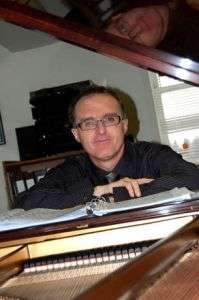
If the hard science of nanotechnology took on the soft curves of classical music, what would it sound like? The two will come together at a concert Friday, under the nimble fingers of pianist Milton Schlosser, a University of Alberta music professor.

Schlosser, based at the U of A's Augustana Faculty in Camrose, is premiering a series of 'nanosonatas' written specifically for him by American composer Frederic Rzewski. The work, entitled Nanosonatas, Volume 1, was commissioned by Schlosser through the U of A's Humanities, Fine Arts and Social Sciences Research grant program.

The composition reflects Rzewski's interest in biomolecular nanomachines. He essentially compresses the form of 20- to 40-minute, 19th-century sonatas into seven three-minute segments which challenge music-lovers in exciting new ways, Schlosser said.

"You are left having to refocus your expectations of what music is. It challenges the notion of art as always pretty," he said. "The melody becomes pin-pointed, and listeners are going to have to remember states of being, moments of sound."

Each tiny piece in the 21-minute work stores a wealth of musical ideas. It is challenging to perform, he admits. Not surprisingly, "every note counts."

The nano-notes are inspired by a friendship Rzewski struck up with a physicist who also happened to be an amateur pianist. Rzewski, who will visit Augustana Campus in February, set out to compose a reflective piece after his physicist friend showed him a video of a rotating nanomotor - a device that is 300 to 500 times smaller than the width of a hair.

"In terms of sound, the music of the first nanosonata imitates the changing pace of the nanomotor," Schlosser said. He describes the entire collection of nanosonatas as avant-garde with a touch of the abstract.

The blending of technology and music bridges the chasm between art and science, Schlosser said. "It also shows on a human level that technology has to have its expression in the arts as well."

Source: University of Alberta


print this article email this article download pdf blog this article bookmark this article     Stumble it Digg this share on Facebook retweet share on Reddit add to delicious
Rate this story - 4 /5 (1 vote)


November 15, 2007 all stories

Comments: 0

4 /5 (1 vote)
  • Stumble this up

  • Digg this

  • share this

  • hide
  • Related Stories

  • Bluebeat to battle EMI over Beatles songs
    created 18 hours ago | popularity not rated yet | comments 0
  • Norway court snubs call to block The Pirate Bay
    created Nov 06, 2009 | popularity not rated yet | comments 0
  • New 'Call of Duty' could set entertainment record
    created Nov 06, 2009 | popularity not rated yet | comments 0
  • Turn On, Tune In, Develop? Researchers Examine How Brain Benefits From Musical Training
    created Nov 06, 2009 | popularity not rated yet | comments 0
  • Windows 7 debut a hit: NPD
    created Nov 06, 2009 | popularity not rated yet | comments 0


  • hide
  • Relevant PhysicsForums posts

Other News

70 million-year-old dinosaur footprints have been found in various locations in New Zealand

Dinosaur prints found on NZealand's South Island

Other Sciences / Archaeology & Fossils

created 19 hours ago | popularity 4 / 5 (2) | comments 0

Scientists have discovered the first evidence that dinosaurs roamed the South Island of New Zealand with 70-million-year-old footprints found in six locations.


Growth in secular attitudes leaves Americans room for belief in God

Other Sciences / Social Sciences

created Oct 31, 2009 | popularity 4 / 5 (5) | comments 110

(PhysOrg.com) -- The nature of the American religious experience is changing as a rising number of people report having no formal religious affiliation, even though the number of Americans who say they pray is increasing, ...


Forest clearances sealed ancient civilisation's downfall

Forest clearances sealed ancient civilisation's downfall

Other Sciences / Archaeology & Fossils

created Nov 02, 2009 | popularity 4.9 / 5 (8) | comments 5

(PhysOrg.com) -- An ancient South American civilisation which disappeared around 1,500 years ago helped to cause its own demise by damaging the fragile ecosystem that held it in place, a study has found. ...


Oscar Pistorius

New study further disputes notion that amputee runners gain advantage from protheses

Other Sciences / Other

created Nov 04, 2009 | popularity 5 / 5 (4) | comments 5

A study by six researchers, including a University of Colorado at Boulder associate professor and his former doctoral student, shows that amputees who use running-specific prosthetic legs have no performance ...


New theory on fairness in economics targets CEO pay

Other Sciences / Economics

created Nov 03, 2009 | popularity 4.3 / 5 (11) | comments 2

(PhysOrg.com) -- Chief executives in 35 of the top Fortune 500 companies were overpaid by about 129 times their "ideal salaries" in 2008, according to a new type of theoretical analysis proposed by a Purdue University researcher ...