UW launches cutting-edge DNA 'fin-printing' project for salmon
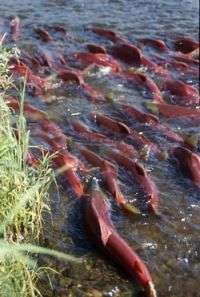
Some salmon make one heck of a commute. The record holder in the Pacific Northwest, for example, is a steelhead that was tagged in the Clearwater River, Idaho, in April 2003. A year and a half later, it was caught off the southern Kuril Islands near Japan. The most direct route between those two points -- as the crow flies, as they say -- is 4,200 miles. Imagine fish that make it that far then turn around and travel back to their home streams in order to spawn.
The ability of salmon to migrate such extraordinary distances makes it hard at a management level to know whose fish are whose and at a biological level to unravel the mystery of their ocean migration.
A $4.1 million effort just launched by the University of Washington's School of Aquatic and Fishery Sciences aims to help by gathering genetic information for thousands upon thousands of Pacific Rim salmon populations and creating open-access databases for managers, treaty-makers and scientists.
Jim and Lisa Seeb, known for their groundbreaking work identifying salmon populations using genetic markers, joined the UW this fall as research professors. Genetic markers are key bits of a fish's DNA that, when compared to the same spots on the DNA of other fish, can reveal if they are from the same population or not.
Genetic markers are being employed to study the human genome. The process, sometimes referred to as DNA fingerprinting in humans, could be called DNA "fin-printing" for fish when a bit of tissue from a fin is used for the analysis.
Prior to genetic markers, fisheries scientists primarily relied on capturing young fish, putting metal or plastic tags on them and then releasing them in hopes they would be caught by a fisherman willing to return the tags to scientists.
Discerning which rivers and lakes salmon came from can be crucial when, for instance, countries negotiate fishing agreements or local managers decide if they should curtail fishing because high numbers of a vulnerable population are found to be part of a run.
Using genetic markers is one of the most rapidly growing fields in fisheries today, Jim Seeb says. Current UW faculty are already leaders in using genetic markers to understand where marine fish and shellfish -- such as cod, abalone and salmon -- spend their lives, how they adapt to their environments and handle effects of human activities and environmental change.
Groups including state and federal agencies in the United States as well as agencies in Russia, Canada and Japan have been developing baseline genetic information for more than 20 years, but coordinating and merging data has been an ongoing challenge.
"The $4.1 million from the Gordon and Betty Moore Foundation to the UW will help promote development of new genetic markers and provide a pathway for these markers to be shared by interested labs in Asia and North America," Lisa Seeb says. One of the project goals is to cement international relationships with the common databases that can be used to track the migration of Pacific salmon in the Pacific Ocean and Bering Sea.
The Seebs, who've been working for the Alaska Department of Fish and Game, are considered leaders in using single nucleotide polymorphism markers, referred to as SNPs and pronounced "snips." Identified by chemically treating a small bit of tissue, SNPs are differences along strands of DNA that roughly match among members of a single population but differ between populations. Salmon hatched in a certain drainage, for example, will share a SNP profile different from that of salmon hatched in other drainages.
A big key to successful databases, the Seebs say, is using a genetic marker that will ensure that instruments in North America and Asia can tell scientists in each place that they are looking at fish from the same population. Each SNP involves just a duo of the chemicals that make up the chains of DNA in animals. This makes using SNPS simpler and easier to standardize than other genetic markers such as microsatellite markers that involve longer portions of DNA.
The UW School of Aquatic and Fishery Sciences already has created a large database on the ranges of high-seas salmon from physical tagging efforts and the new program will work closely with the school's existing High Seas Salmon Project. The school also has a wealth of salmon and environmental data collected as part of its Alaskan Salmon Program, established 60 years ago before Alaska was even a state.
"We feel extremely fortunate to have a chance to build this new program at the School of Aquatic and Fishery Sciences where there are already hugely successful programs in fisheries migration, ecology and genetics," Jim Seeb says.
Source: University of Washington


