Watching Galaxies Grow Old Gracefully
November 15th, 2007 Watching Galaxies Grow Old Gracefully

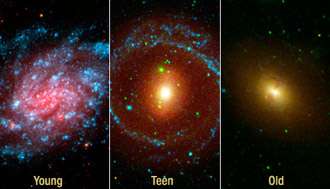
Examples of young, teenage and adult galaxies are shown here from left to right. Image credit: NASA/JPL-Caltech

In the early 1900s, Edwin Hubble made the startling discovery that our Milky Way galaxy is not alone. It is just one of many galaxies, or "island universes," as Hubble dubbed them, swimming in the sea of space.

Now, a century later, NASA's Galaxy Evolution Explorer is helping piece together the evolution of these cosmic species. Since its launch in 2003, the mission has surveyed tens of thousands of galaxies in ultraviolet light across nine billion years of time. The results provide new, comprehensive evidence for the "nurture" theory of galaxy evolution, which holds that the galaxies first described by Hubble – the elegant spirals and blob-like ellipticals -- are evolutionarily linked.

According to this "nurture" theory, a typical young galaxy begins life as a spiral that is actively churning out stars. Over time, the spiral might merge with another spiral or perhaps an irregular-shaped galaxy, before kicking out a few more bursts of newly minted stars. Eventually, the galaxy slows down its production of stars and settles into later life as an elliptical.

"Our data confirm that all galaxies begin life forming stars," said Chris Martin, the principal investigator for the Galaxy Evolution Explorer at the California Institute of Technology in Pasadena, Calif. "Then through a combination of mergers, fuel exhaustion and perhaps suppression by black holes, the galaxies eventually stop producing stars."

When astronomers talk about galaxies today, they tend to refer to them by their color, either blue or red, instead of by their shape. Most blue galaxies are smaller spirals or irregulars, and most red galaxies are larger ellipticals, though there are some exceptions.

Why color-code the galaxies? Their color indicates how actively they are making new stars. Younger stars shine in ultraviolet or blue light, so galaxies that appear blue are busily producing stars. Older stars emit infrared or red light, so galaxies that look red have shut down their star-making factories. Roughly half of all galaxies are blue and half are red.

Scientists have long postulated that blue galaxies grow up to become red. They proposed that something happens to the blue galaxies to cause them to run out of star-making material, or gas, and mature into the passive red ones. For this "nurture" theory to be true, there should be a population of "teenage" galaxies in the process of transitioning from blue to red, or young to old. But such a cosmic metamorphosis should take billions of years. How can astronomers, with a significantly shorter lifespan, study a process that takes that long?

One solution is to look at lots and lots of galaxies. Imagine a hypothetical alien trying to figure out how and if humans age from only a handful of snapshots showing people of different ages. The aliens might assume that little people grow into big ones, but they could better piece together the life of a typical human if they could look through boxes and boxes of photographs.

The Galaxy Evolution Explorer was designed to provide astronomers with just such a massive portfolio of galaxies. Its troves of data have allowed scientists to find a significant number of teenage galaxies – and thus proof that youthful spiral, or blue, galaxies will eventually grow up to become the elderly elliptical, or red, galaxies.

"The nurture theory of galaxy evolution predicted that there would be galaxies in transition," said Martin. "Finding these galaxies required ultraviolet light, because they really stand out at this wavelength. And because they are rare, we had to look at many. The Galaxy Evolution Explorer allowed us to do this."

Visible-light data from the Sloan Digital Sky Survey also helped to establish the age of the teenage galaxies and the rates at which they are running out of star-making fuel. These findings suggest that some of the young galaxies are ripening into old age quickly, while others are leisurely strolling into their golden years.

Evidence for the "nurture" theory of galaxy evolution can be found in a report in the Astrophysical Journal. Martin is the lead author.

Source: NASA/JPL, by Whitney Clavin


print this article email this article download pdf blog this article bookmark this article     Digg this Stumble it share on Facebook share on Reddit add to delicious save to Yahoo! bookmarks
4.7/5 after 18 votes


November 15th, 2007 all stories
Space & Earth / Astronomy

Comments: 0
Rank: 4.7/5 after 18 votes

  • Stumble this up

  • Digg this

  • Share it:
  • share on Facebook
  • share on MySpace
  • share on Slashdot
  • rss-newsfeed
  • share on Google
  • share on Reddit
  • add to delicious
  • save to Yahoo! bookmarks
  • share on Windows Live
  • Add to Mixx!
Rating: 4.7/5 after 18 votes

  • Related Stories

  • New class of black holes discovered
    created Jul 01, 2009 | popularity not rated yet | comments 0
  • Intense heat killed the Universe's would-be galaxies, researchers say
    created Jul 01, 2009 | popularity not rated yet | comments 0
  • Largest ever survey of very distant galaxy clusters completed
    created Jun 30, 2009 | popularity not rated yet | comments 0
  • Herschel Opens Its Infrared Eyes
    created Jun 29, 2009 | popularity not rated yet | comments 0
  • Galaxies coming of age in cosmic blobs
    created Jun 24, 2009 | popularity not rated yet | comments 0

Tags


  • Physicists Demonstrate Quantum Memory with Matter Qubits
    Physicists Demonstrate Quantum Memory with Matter Qubits
    Physics / General Physics
    created 18 hours ago | popularity 4.5 / 5 (11) | comments 1
  • 'Holey' Nanosheets for Wastewater Dye Removal
    Nanotechnology / Nanomaterials
    created Jul 01, 2009 | popularity 5 / 5 (5) | comments 1
  • Jellyfish Robot Swims Like its Biological Counterpart
    Jellyfish Robot Swims Like its Biological Counterpart
    Electronics / Robotics
    created Jun 26, 2009 | popularity 4.4 / 5 (7) | comments 1
  • Could Maxwell's Demon Exist in Nanoscale Systems?
    Could Maxwell's Demon Exist in Nanoscale Systems?
    Physics / General Physics
    created Jun 24, 2009 | popularity 4.4 / 5 (18) | comments 29
  • Living Safely with Robots, Beyond Asimov's Laws
    Living Safely with Robots, Beyond Asimov's Laws
    Electronics / Robotics
    created Jun 22, 2009 | popularity 4.6 / 5 (50) | comments 39
  • Other News

    Global warming tactic cools climate but won’t help corals, say researchers

    Space & Earth / Earth Sciences

    created 15 hours ago | popularity 2.3 / 5 (3) | comments 5

    (PhysOrg.com) -- “Geoengineering” experiments proposed to reduce global warming by blocking sunlight with atmosphere-injected particles may cool the world but still leave carbon dioxide levels dangerously high, Stanford scientists ...


    Coolest spacecraft ever in orbit around L2

    Coolest spacecraft ever in orbit around L2

    Space & Earth / Space Exploration

    created 18 hours ago | popularity 4.8 / 5 (4) | comments 3

    (PhysOrg.com) -- Last night, the detectors of Planck's High Frequency Instrument reached their amazingly low operational temperature of -273°C, making them the coldest known objects in space. The spacecraft ...


    Senator may have won fight over private rocket manufacturing

    Space & Earth / Space Exploration

    created 18 hours ago | popularity 4.5 / 5 (2) | comments 2

    For months, a powerful Republican senator from Alabama has fought the Obama administration to block $150 million that the White House wanted to spend to help private companies build rockets capable of reaching the international ...


    The least sea ice in 800 years

    The least sea ice in 800 years

    Space & Earth / Earth Sciences

    created Jul 01, 2009 | popularity 4.3 / 5 (57) | comments 43

    New research, which reconstructs the extent of ice in the sea between Greenland and Svalbard from the 13th century to the present indicates that there has never been so little sea ice as there is now. The ...


    Gas around young galaxy

    Intense heat killed the Universe's would-be galaxies, researchers say

    Space & Earth / Astronomy

    created Jul 01, 2009 | popularity 3.1 / 5 (18) | comments 23

    (PhysOrg.com) -- Our Milky Way galaxy only survived because it was already immersed in a large clump of dark matter which trapped gases inside it, scientists led by Durham University's Institute for Computational ...