A new window on the universe
Using new tools to look at the universe, says Patrick Brady, often has led to discoveries that change the course of science. History is full of examples.
“Galileo was the first person to use the telescope to view the cosmos,” says Brady, a UWM professor of physics. “His observations with the new technology led to the discovery of moons orbiting Jupiter and lent support to the heliocentric model of the solar system.”
Just such an opportunity exists today with a unique observatory that is scanning the skies, searching for one of Einstein’s greatest predictions – gravitational waves.
Gravitational waves are produced when massive objects in space move violently. The waves carry the imprint of the events that cause them. Scientists already have indirect evidence that gravitational waves exist, but have not directly detected them.
UWM researchers, backed by considerable funding from the National Science Foundation, are taking a leadership role in the quest.
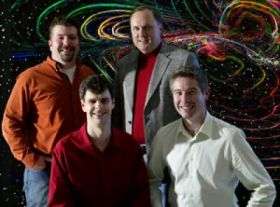
It is an epic undertaking involving about 500 scientists worldwide, including Brady and other members of UWM’s Center for Cosmology and Gravitation: associate professors Alan Wiseman and Jolien Creighton, and assistant professor Xavier Siemens.
Two UWM adjunct physicists, who work at the Max Planck Institute in Germany, also are involved – former UWM professor Bruce Allen and scientist Maria Alessandra Papa.
“It’s an unimaginable opportunity to be on the forefront of scientific discovery,” says Creighton.
The Laser Interferometer Gravitational-wave Observatory, or LIGO, consists of detectors at two U.S. sites managed by the California Institute of Technology (Caltech) and Massachusetts Institute of Technology (MIT).
UWM’s physicists are analyzing the data generated by the LIGO facilities.
The project is supported with a sizable investment of grant money from both federal and UWM sources.
Last year, UWM’s LIGO group brought in $3 million in grant funding. Since 1999, UWM has received more than $9 million for the project, with much of it going toward a supercomputer called Nemo that operates unobtrusively on the second floor of the Physics Building.
Stretching and squeezing
The LIGO observatories use lasers to accurately monitor the distance between a central station and mirrors suspended three miles away along perpendicular arms. When a gravitational wave, a traveling ripple in space-time, passes by, the mirror in one arm will move closer to the central station, while the other mirror will move away.
The change in distance caused by stretching and squeezing is what LIGO is designed to measure, says Wiseman.
Those changes will be inconceivably tiny. LIGO can record distortions at a scale so small, it is comparable in distance to a thousandth of the size of an atomic nucleus.
LIGO records a series of numbers – lots of them – and feeds them to several supercomputer clusters around the country, including UWM’s Nemo cluster.
Think of a modern hard disk on a desktop computer, which stores about 100 gigabytes. LIGO fills up about 10 of those at Nemo in a single day, says Brady.
The computer’s job is to sort out the numerical patterns representing gravitational waves buried in ambient noise produced by lots of other vibrations – from internal vibrations of the equipment itself, to magnetic fluctuations from lightning storms, to seismic vibrations from trains rolling along the tracks a few miles from the observatory, or from earthquakes on the other side of the world.
“There are thousands or even millions of different signals that could be emitted from space,” says Wiseman. “So you have to take each segment of data individually. That turns out to be a formidable computational problem.”
Nemo performs many billions of calculations per second in its search for these signals.
Space sounds
The strings of numbers from LIGO are like tracks on a compact disk, says Brady. That means, once detected, gravitational-wave signals can be converted into sound.
In fact, scientists have already simulated, based on mathematical predictions, what certain events in space will sound like.
When two black holes are merging, for example, you might expect to hear a “chirp” that represents the spiraling together of the black holes just before they collide. “The spiral can go on for tens of thousands of years,” says Brady. “The sound is the identifying signal of the last few seconds of the process!”
Those analyzing the data from space could actually listen to the data. Instead, scientists look for the signals using computers like Nemo.
To augment the computing capacity, UWM is hosting a way for anyone with a computer and a high-speed Internet connection to join the astrophysical treasure hunt. Called “Einstein@Home, the program borrows computer power available when participants are not using it, and pool those resources to aid in filtering the massive amounts of data from LIGO.
Possible secrets
Scientists concede that the current LIGO facilities will need to be improved to increase the chances of detecting gravitational waves. More NSF funding to do that is requested in the 2009 U.S. budget currently winding its way through the approval process.
For now, the best hope is to detect events relatively close to Earth.
So what is the likelihood of success?
“The events we are looking for may only happen once every million years in our galaxy,” says Wiseman, “but if your instrument is sensitive enough to see such events in, say, one million galaxies, then the probability of detecting something is much larger.”
Gravitational waves may hold secrets to the nature of black holes, the unknown properties of nuclear material, and maybe even how the universe began.
“We’ve only been able to find out about the universe since it became cool,” says Siemens. “But with gravitational waves, we’ll see the universe when it was much younger – and hotter.”
But then again, scientists don’t really know.
“I think we’re in for a surprise,” says Siemens. “We have all these ideas about what we think we will find, but it could be something completely different.”
Source: University of Wisconsin - Milwaukee


