Remote-control nanoparticles deliver drugs directly into tumors
November 16th, 2007 Remote-control nanoparticles deliver drugs directly into tumors

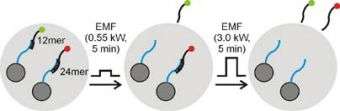
Here, dark gray nanoparticles carry different drug payloads (one red, one green). A remotely generated five-minute pulse of a low-energy electromagnetic field releases the green drug but not the red. A five-minute pulse of a higher-energy electromagnetic field releases the red drug, which had been tethered using a DNA strand twice as long as the green tether, as measured in base pairs. Image courtesy / Bhatia/von Maltzahn, MIT. Derfus, UCSD

MIT scientists have devised remotely controlled nanoparticles that, when pulsed with an electromagnetic field, release drugs to attack tumors. The innovation, reported in the Nov. 15 online issue of Advanced Materials, could lead to the improved diagnosis and targeted treatment of cancer.

In earlier work the team, led by Sangeeta Bhatia, M.D.,Ph.D., an associate professor in the Harvard-MIT Division of Health Sciences & Technology (HST) and in MIT's Department of Electrical Engineering and Computer Science, developed injectable multi-functional nanoparticles designed to flow through the bloodstream, home to tumors and clump together. Clumped particles help clinicians visualize tumors through magnetic resonance imaging (MRI).

With the ability to see the clumped particles, Bhatia's co-author in the current work, Geoff von Maltzahn, asked the next question: “Can we talk back to them?”

The answer is yes, the team found. The system that makes it possible consists of tiny particles (billionths of a meter in size) that are superparamagnetic, a property that causes them to give off heat when they are exposed to a magnetic field. Tethered to these particles are active molecules, such as therapeutic drugs.

Exposing the particles to a low-frequency electromagnetic field causes the particles to radiate heat that, in turn, melts the tethers and releases the drugs. The waves in this magnetic field have frequencies between 350 and 400 kilohertz-the same range as radio waves. These waves pass harmlessly through the body and heat only the nanoparticles. For comparison, microwaves, which will cook tissue, have frequencies measured in gigahertz, or about a million times more powerful.

The tethers in the system consist of strands of DNA, “a classical heat sensitive material,” said von Maltzahn, a graduate student in HST. Two strands of DNA link together through hydrogen bonds that break when heated. In the presence of the magnetic field, heat generated by the nanoparticles breaks these, leaving one strand attached to the particle and allowing the other to float away with its cargo.

One advantage of a DNA tether is that its melting point is tunable. Longer strands and differently coded strands require different amounts of heat to break. This heat-sensitive tuneability makes it possible for a single particle to simultaneously carry many different types of cargo, each of which can be released at different times or in various combinations by applying different frequencies or durations of electromagnetic pulses.

To test the particles, the researchers implanted mice with a tumor-like gel saturated with nanoparticles. They placed the implanted mouse into the well of a cup-shaped electrical coil and activated the magnetic pulse. The results confirm that without the pulse, the tethers remain unbroken. With the pulse, the tethers break and release the drugs into the surrounding tissue.

The experiment is a proof of principal demonstrating a safe and effective means of tunable remote activation. However, work remains to be done before such therapies become viable in the clinic.

To heat the region, for example, a critical mass of injected particles must clump together inside the tumor. The team is still working to make intravenously injected particles clump effectively enough to achieve this critical mass.

“Our overall goal is to create multifunctional nanoparticles that home to a tumor, accumulate, and provide customizable remotely activated drug delivery right at the site of the disease,” said Bhatia.

Co-authors on the paper are Austin M. Derfus, a graduate student at the University of California at San Diego; Todd Harris, an HST graduate student; Erkki Ruoslahti and Tasmia Duza of The Burnham Institute in La Jolla, CA; and Kenneth S. Vecchio of the University of San Diego.

Source: MIT


print this article email this article download pdf blog this article bookmark this article     Digg this Stumble it share on Facebook share on Reddit add to delicious save to Yahoo! bookmarks
4.6/5 after 27 votes


November 16th, 2007 all stories
Nanotechnology / Bio & Medicine

Comments: 0
Rank: 4.6/5 after 27 votes

  • Stumble this up

  • Digg this

  • Share it:
  • share on Facebook
  • share on MySpace
  • share on Slashdot
  • rss-newsfeed
  • share on Google
  • share on Reddit
  • add to delicious
  • save to Yahoo! bookmarks
  • share on Windows Live
  • Add to Mixx!
Rating: 4.6/5 after 27 votes

  • Related Stories

  • Computer-Guided Nanoparticle Therapy Destroys Tumors
    created Jun 29, 2009 | popularity not rated yet | comments 0
  • Targeting tumors using tiny gold particles
    created May 04, 2009 | popularity not rated yet | comments 0
  • Hollow gold nanospheres show promise for biomedical and other applications
    created Mar 22, 2009 | popularity not rated yet | comments 0
  • Paper electrified by copper particles
    created Mar 16, 2009 | popularity not rated yet | comments 0
  • Iowa State researchers developing clean, renewable energy for ethanol industry
    created Mar 09, 2009 | popularity not rated yet | comments 0

Tags


  • Physicists Demonstrate Quantum Memory with Matter Qubits
    Physicists Demonstrate Quantum Memory with Matter Qubits
    Physics / General Physics
    created Jul 03, 2009 | popularity 4.4 / 5 (17) | comments 1
  • 'Holey' Nanosheets for Wastewater Dye Removal
    Nanotechnology / Nanomaterials
    created Jul 01, 2009 | popularity 5 / 5 (5) | comments 1
  • Jellyfish Robot Swims Like its Biological Counterpart
    Jellyfish Robot Swims Like its Biological Counterpart
    Electronics / Robotics
    created Jun 26, 2009 | popularity 4.4 / 5 (8) | comments 1
  • Could Maxwell's Demon Exist in Nanoscale Systems?
    Could Maxwell's Demon Exist in Nanoscale Systems?
    Physics / General Physics
    created Jun 24, 2009 | popularity 4.4 / 5 (18) | comments 29
  • Living Safely with Robots, Beyond Asimov's Laws
    Living Safely with Robots, Beyond Asimov's Laws
    Electronics / Robotics
    created Jun 22, 2009 | popularity 4.6 / 5 (52) | comments 40
  • Other News

    A 'quantum of sol' -- how nanotechnology could hold the key to a solar-powered future

    A 'quantum of sol' -- how nanotechnology could hold the key to a solar-powered future

    Nanotechnology / Nanomaterials

    created Jun 30, 2009 | popularity 3.9 / 5 (15) | comments 17

    (PhysOrg.com) -- A new generation of 'nano-structured' millimetre-sized solar cells that could convert the sun's energy to electricity more than twice as efficiently as current technology, is the subject of ...


    Australian researchers are set to begin human trials of a tiny nano-cell that acts as a "Trojan horse" against cancer

    Hi-tech 'Trojan horse' can kill cancer cells: researchers

    Nanotechnology / Bio & Medicine

    created Jun 29, 2009 | popularity 4.7 / 5 (12) | comments 7

    Australian researchers are set to begin human trials of a tiny nano-cell that acts as a "Trojan horse" against cancer cells, a breakthrough they say may curb the need for debilitating chemotherapy.


    'Holey' Nanosheets for Wastewater Dye Removal

    Nanotechnology / Nanomaterials

    created Jul 01, 2009 | popularity 5 / 5 (5) | comments 1

    (PhysOrg.com) -- Researchers have discovered that extremely thin sheets of nickel oxide with hexagonally shaped holes can absorb hazardous dyes from wastewater nearly as well as the best traditional methods, but are recyclable. ...


    Harnessing Nanoparticles To Track Cancer Cell Changes

    Nanotechnology / Bio & Medicine

    created Jul 03, 2009 | popularity not rated yet | comments 1

    The more dots there are, the more accurate a picture you get when you connect them. Cancer researchers adopting that philosophy have developed a new imaging technology that could give scientists the ability to simultaneously ...


    Computer-Guided Nanoparticle Therapy Destroys Tumors

    Nanotechnology / Bio & Medicine

    created Jun 29, 2009 | popularity 4.9 / 5 (12) | comments 0

    Gold nanoshells are among the most promising new nanoscale therapeutics being developed to kill tumors, acting as antennas that turn light energy into heat that cooks cancer to death. Now, a multi-institutional research team ...