Environment shapes dolphin noises
November 19, 2007 Environment shapes dolphin noises

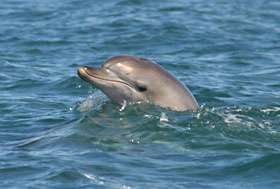
A wild dolphin in Moreton Bay. Photo: Melinda Rekdahl

Dolphins appear to change their vocalisations depending on their physical and social environments and level of human interaction, new research shows.

University of Queensland student Melinda Rekdahl has studied dolphin behaviour and communication for her Honours degree with the School of Integrative Biology.

Her results are the first to show that physical and social environments can alter dolphin communication during different activities such as feeding.

Miss Rekdahl studied about 120 dolphins from groups of wild dolphins in Moreton Bay, captive dolphins at Seaworld and provisioned (wild but handfed once a day) at Tangalooma Wild Dolphin Resort.

“Captive and provisioned dolphins whistled more than the wild dolphins while feeding with captive dolphins showing the highest rate of whistles,” Miss Rekdahl said.

“Feeding was the behaviour most influenced by humans in the captive and provisioned environment.

“Human interaction through the provisioned feeding environment may lead to different vocalisations being used.”

Miss Rekdahl spent two weeks with each dolphin group and recorded hundreds of hours of dolphin noises such as burst pulses and clicks and 10 hours' of whistles.

She recorded the rates, types and frequency of whistles amongst the groups during feeding, socialising and milling.

Dolphin whistles and pulses are mainly used for social communication while their eco clicks are used for feeding and navigation.

Miss Rekdahl will present her dolphin research at the International Marine Mammal Conference later this month in Cape Town.

Source: University of Queensland


print this article email this article download pdf blog this article bookmark this article     Stumble it Digg this share on Facebook retweet share on Reddit add to delicious
Rate this story - 4.3 /5 (15 votes)


November 19, 2007 all stories

Comments: 0

4.3 /5 (15 votes)
  • Stumble this up

  • Digg this

  • share this

  • hide
  • Related Stories

  • Getting a leg up on whale and dolphin evolution
    created Sep 24, 2009 | popularity not rated yet | comments 0
  • Blue whales disturbed by seismic surveys: scientists
    created Sep 23, 2009 | popularity not rated yet | comments 0
  • Evidence Points to Conscious 'Metacognition' in Some Nonhuman Animals
    created Sep 14, 2009 | popularity not rated yet | comments 0
  • Human language and dolphin movement patterns show similarities in brevity
    created Jul 30, 2009 | popularity not rated yet | comments 0
  • Triangles Go Underwater and Supersonic
    created Jun 30, 2009 | popularity not rated yet | comments 0


Other News

Beyond sunlight: Explorers census 17,650 ocean species between edge of darkness and black abyss

Beyond sunlight: Explorers census 17,650 ocean species between edge of darkness and black abyss (w/ Video)

Biology / Plants & Animals

created 12 hours ago | popularity 5 / 5 (7) | comments 0

Census of Marine Life scientists have inventoried an astonishing abundance, diversity and distribution of deep sea species that have never known sunlight - creatures that somehow manage a living in a frigid ...


Rare Charles Darwin book found on toilet bookshelf (AP)

Rare Charles Darwin book found on toilet bookshelf

Biology / Other

created 11 hours ago | popularity 4.5 / 5 (2) | comments 1

(AP) -- An auction house says it is selling a rare first edition of Charles Darwin's "On the Origin of Species" found in a family's guest lavatory in southern England.


Bigger not necessarily better, when it comes to brains

Bigger not necessarily better, when it comes to brains

Biology / Plants & Animals

created Nov 17, 2009 | popularity 4.5 / 5 (19) | comments 11

(PhysOrg.com) -- Tiny insects could be as intelligent as much bigger animals, despite only having a brain the size of a pinhead, say scientists at Queen Mary, University of London.


Extinct goat Myotragus balearicus

Extinct goat was cold-blooded

Biology / Plants & Animals

created Nov 18, 2009 | popularity 4.9 / 5 (34) | comments 10

(PhysOrg.com) -- An extinct goat that lived on a barren Mediterranean island survived for millions of years by reducing in size and by becoming cold-blooded, which has never before been discovered in mammals.


Right-handed chimpanzees provide clues to the origin of human language

Biology / Plants & Animals

created Nov 16, 2009 | popularity 2.5 / 5 (2) | comments 7

Most of the linguistic functions in humans are controlled by the left cerebral hemisphere. A study of captive chimpanzees at the Yerkes National Primate Research Center (Atlanta, Georgia), reported in the January 2010 issue ...