Researchers present new solution for miniaturized organic lasers
November 19, 2007
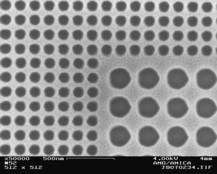
Scanning electron micrograph of tantalum pentoxide photonic feedback structures
AMO GmbH, Aachen and IBM Research GmbH, Rüschlikon were able to realize and characterize optimized photonic feedback structures for miniaturized organic lasers.
Efficient organic lasers with small footprint structures demonstrate the key components of future integrated photonic devices for both, communication and sensing applications. Furthermore, they offer an attractive packaging possibility for light-emitting arrays coupled to high-density optical interconnects.
AMO, IBM and the University of Wuppertal investigated mixed-order two dimensional photonic crystal laser structures in combination with a high-gain organic polymer in terms of lasing threshold and device footprints. Based on a thin film of high-index tantalum pentoxide (Ta2O5), mixed-order structures were identified as superior compared to second-order structures. By combining first-order and second-order photonic crystal structures, losses occurring at the edge of the second order structure could be reduced dramatically, leading to a lower laser threshold and to a much smaller footprint of the laser.
Owing to their excellent optical properties and their huge potential for display, sensing, and solar-cell applications, organic semiconductor materials have attracted increasing interest in recent years. These materials exhibit low lasing thresholds and a spectrally broad gain enabling the emission wavelength to be tuned across the entire visible spectrum.
The research activities of the project partners are based on the 6 FP project OLAS (Organic electrically pumped LASer by engineering of heterojunctions in field-effect devices). The project aims at achieving foundational research on Organic Electrically Pumped Laser.
First results have been published in Applied Physics Letters.
Citation: Kristian Baumann, “Organic mixed-order photonic crystal lasers with ultrasmall footprint”, Applied Physics Letters 91, 2007.
Source: AMO GmbH
-
Engineers build first sub-10-nm carbon nanotube transistor
Feb 01, 2012 |
4.9 / 5 (33) |
30
-
Something old, something new: Evolution and the structural divergence of duplicate genes
Jan 31, 2012 |
4.6 / 5 (7) |
1
-
The hidden nanoworld of ice crystals: Revealing the dynamic behavior of quasi-liquid layers
Jan 30, 2012 |
5 / 5 (4) |
1
-
Stock market network reveals investor clustering
Jan 27, 2012 |
3.9 / 5 (23) |
8
-
Of microchemistry and molecules: Electronic microfluidic device synthesizes biocompatible probes
Jan 26, 2012 |
5 / 5 (2) |
0
-
Help with snow Crystals
2 hours ago
-
Doubts about surface plasmons
Feb 11, 2012
-
excited U-236 decay time in the U235 fission chain
Feb 09, 2012
-
Polar catastrophe?
Feb 09, 2012
-
Large scale field sonication
Feb 09, 2012
-
states and energy of paired electrons in BCS
Feb 08, 2012
- More from Physics Forums - Atomic, Solid State, Comp. Physics
More news stories
Explained: Sigma
It's a question that arises with virtually every major new finding in science or medicine: What makes a result reliable enough to be taken seriously? The answer has to do with statistical significance -- but ...
Feb 09, 2012 |
5 / 5 (20) |
78
Quantum physicist explains $100K offer for proof scaled-up quantum computing is impossible
(PhysOrg.com) -- MIT researcher Scott Aaronson has certainly riled the physics community with his offer this past Friday, of $100,000 to anyone who can prove that scaled-up quantum computing is impossible. ...
Diamond light, brighter than the sun
Its the size of five football pitches and generates light 10 billion times brighter than the sun. As the Diamond Light Source celebrates its tenth anniversary this year, Penny Bailey visits one of the ...
Feb 07, 2012 |
4.1 / 5 (10) |
18
|
Physicists 'record' magnetic breakthrough
An international team of scientists has demonstrated a revolutionary new way of magnetic recording which will allow information to be processed hundreds of times faster than by current hard drive technology.
Feb 07, 2012 |
4.6 / 5 (43) |
15
|
Hints of the Higgs - papers are submitted
Back in December 2011, the ATLAS and CMS experiments at CERN presented some exciting results that provided tantalising hints of the Higgs boson.
Feb 08, 2012 |
4.3 / 5 (8) |
10
Scientists discover molecular secrets of 2,000-year-old Chinese herbal remedy
For roughly two thousand years, Chinese herbalists have treated Malaria using a root extract, commonly known as Chang Shan, from a type of hydrangea that grows in Tibet and Nepal. More recent studies suggest that halofuginone, ...
New method to examine batteries -- MRI from the inside
There is an ever-increasing need for advanced batteries for portable electronics, such as phones, cameras, and music players, but also to power electric vehicles and to facilitate the distribution and storage of energy derived ...
A mitosis mystery solved: How chromosomes align perfectly in a dividing cell
Although the process of mitotic cell division has been studied intensely for more than 50 years, Whitehead Institute researchers have only now solved the mystery of how cells correctly align their chromosomes during symmetric ...
Google might launch Drive for cloud storage soon
(PhysOrg.com) -- Google's next big move, according to the Wall Street Journal, is a cloud storage service called Drive. Hardly first to the plate, Google is simply catching up to introducing its cloud reposi ...
Lab study raises questions over nano-particle impact
Tests involving chickens have raised questions about the impact on health from engineered nano-particles, the ultra-fine grains commonly used in drugs and processed foods, scientists said on Sunday.
Starve a virus, feed a cure? Findings show how some cells protect themselves against HIV
A protein that protects some of our immune cells from the most common and virulent form of HIV works by starving the virus of the molecular building blocks that it needs to replicate, according to research published online ...