Tiny Silicone Hotel Reveals How Bacteria Control Crowds
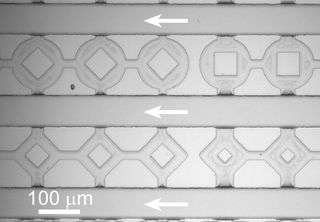
Using a device composed of microscopic rooms and hallways that was designed and fabricated at the University of California, San Diego, a team of researchers from four institutions has determined how bacteria self-organize during the early stages of colony formation. The findings may lead to more effective ways to treat or prevent persistent infections.
The microchamber device, described in the November issue of the journal Public Library of Science Biology, restricted bacterial colonies to grow in two dimensions and made it possible to track the movements of individual cells. The researchers report that the bacterial crowd control they observed may be important in the formation of biofilms. Biofilms play a role in many bacterial invasions, including those associated with cystic fibrosis, infections of the urinary tract and middle ear, and the colonization of contact lenses, artificial heart valves and joint prostheses. These films often resist antibiotics.
“The device we constructed consists of a series of microscopic chambers machined in a piece of silicone rubber,” explained Alex Groisman, an assistant professor of physics at U.C. San Diego, whose team designed and fabricated the microchamber device. “The chambers are so shallow that bacteria align themselves just one cell deep. This is the first time it has been possible to study monolayers of bacteria over many generations under controlled conditions. The advantage is that seeing cells one-by-one makes it much easier to connect cause and effect and conduct a computational analysis to determine how bacteria maximize self-organization.”
“There is a perception that single-celled organisms are asocial, but that is misguided,” said Andre Levchenko, an associate professor of biomedical engineering in The Johns Hopkins University’s Whiting School of Engineering and an affiliate of the university's Institute for NanoBioTechnology, in whose laboratory the experiments on bacteria were performed and analyzed. “When bacteria are under stress—which is the story of their lives—they team up and form this collective called a biofilm. If you look at naturally occurring biofilms, they have very complicated architecture. They are like cities with channels for nutrients to go in and waste to go out.”
A biomedical engineering doctoral student in Levchenko’s laboratory, Hojung Cho, was the lead author on the paper. Cho videotaped the self-organization of actively dividing bacteria within the microchamber device over a 24-hour period. To make it easier to visualize individual bacterial cells and check their nutritional status, Ann Steven’s laboratory at Virginia Polytechnic Institute created E. coli bacteria containing green fluorescent protein.
Like partygoers spreading from room to room as the first rooms become crowded, the bacteria spread into successive chambers as their numbers increased. However, unlike the increasingly disorganized groups formed by revelers as their numbers grow over time, the bacteria became progressively more ordered, aligning themselves with their long axes in the direction toward the nearest chamber exit.
The high degree of organization facilitated the escape of cells from the crowded chambers and prevented stampedes that could block the exits. It was also conducive to increasing the flow of nutrients into the chambers and the flow of waste out of it. Therefore, the bacteria organized themselves to make the best of the environmental conditions.
After analyzing the results of a computational model developed in a collaboration between Levchenko’s laboratory and Henrik Jönsson’s laboratory at Lund University in Sweden, the researchers concluded that it is the mechanical stresses induced by the growth of the colonies and their confinement to the chambers that cause the alignment of the bacterial cells. Moreover, the researchers discovered that the shape of the E. coli bacteria is nearly optimal to maximize self-organization in the growing colony and to prevent exit stampedes. Therefore, the shape might have evolved to facilitate laying the foundation for a highly structured mature biofilm.
The researchers say that the technology and procedures they developed in this study have many potential biotechnological applications. For example, they can also be used to screen for chemicals that prevent the formation of biofilms.
“The device we developed provides a nice platform for studies of the responses of bacterial colonies to drugs, at a single cell resolution,” said Groisman. “We can look at different stages of crowding in the microchambers to see how crowding affects resistance to drugs.”
Other contributors to the study were Kyle Campbell at UCSD, Pontus Melke at the University of Lund, Joshua Williams at Virginia Polytechnic Institute and Bruno Jedynak at Johns Hopkins.
Source: UCSD, By Sherry Seethaler


