Researchers Create Robot Driven by Moth's Brain
November 19, 2007 Researchers Create Robot Driven by Moth's Brain

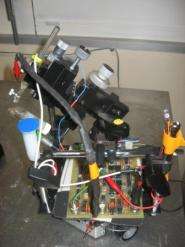
Robo-Moth: UA robot driven by moth's brain.

In a notion taken from science fiction afficionados, University of Arizona researchers presented a robot that moves by using the brain impulses of a moth at the 37th annual Society for Neuroscience meeting in San Diego.

Charles M. Higgins, UA associate professor of electrical and computer engineering, and doctoral student Timothy Melano presented their findings and outlined the mechanics behind the robot’s movements.

The robot’s motion is guided by a tiny electrode implanted in the moth’s brain, Higgins said, specifically to a single neuron that is responsible for keeping the moth’s vision steady during flight. The neuron transmits electrical signals which are then amplified in the robot's base and through a mathematical formula, a computer translates the signals into action, making the robot move.

The moth is immobilize inside a plastic tube mounted atop the 6-inch-tall wheeled robot. To get the moth to imitate flight, Higgins and his team placed the moth in its apparatus on a circular platform surrounded by a 14-inch-high revolving wall painted with vertical stripes. The moth's neuron reacts to the movement of the stripes and the process begins.

The brain of a moth is about the size of a grain of rice. Although small, “its compact size and simplicity allows for an efficient way to do brain research,” Higgins said.

'The underlying point in the creation of the robo-moth is the notion of advancing neuroscience," he said.

The Society for Neuroscience meets annually to show advances made by scientists who work to study the architecture of the brain and use that knowledge in the design of new machines.

“Combining the study of machines and the mechanics of the human body has led to great advances that have direct health benefits such as the development of the mechanical heart. Unfortunately, we are nowhere as advanced in our study of the brain as we are in the study of the heart,” Higgins added.

“Scientists have reached a frustrating point in understanding the brain - we know how it operates, to an extent but don’t know how to stop brain damage or repair it when it occurs.” Higgins said. But that may change in the future. Higgins has thus far been able to have robo-moth turn left or right but not forward or backward. The longest recorded movement has been 88 seconds.

Higgins' work is funded through grants from the National Institutes of Health and the U.S. Air Force. Both agencies granted funding to help gain an understanding of human visual operations. Higgins' research is a step toward a future in brain engineering that will help repair damage or replace lost brain functionality.

Source: University of Arizona, By Rebecca Ruiz-McGill


print this article email this article download pdf blog this article bookmark this article     Stumble it Digg this share on Facebook retweet share on Reddit add to delicious
Rate this story - 4.5 /5 (44 votes)

Rank Filter

Move the slider to adjust rank threshold, so that you can hide some of the comments.


Display comments: newest first

  • NeilFarbstein - Nov 19, 2007
    • Rank: 4 / 5 (1)
    The moth-er's of invention!
  • zbarlici - Nov 19, 2007
    • Rank: 5 / 5 (1)
    thats the best one ive heard in moths, neil. This achievement will allow the japanese to finally develop giant neurogically-controlled battle space robots. I want in.

November 19, 2007 all stories

Comments: 2

4.5 /5 (44 votes)
  • Stumble this up

  • Digg this

  • share this

  • hide
  • Related Stories


  • hide
  • Relevant PhysicsForums posts

  • Swine flu vaccination
    created 20 hours ago
  • Improving the brain through chemistry
    created Nov 07, 2009
  • Sleep / REM Sleep and homeostasis
    created Nov 07, 2009
  • The Biceps Reflex
    created Nov 05, 2009
  • More from Physics Forums - Medical Sciences

Other News

Snoring sounds may hold the key to a good night's sleep

Medicine & Health / Diseases

created 2 hours ago | popularity not rated yet | comments 0

(PhysOrg.com) -- Hours of analysing snoring sounds have paid off for a group of researchers from The University of Queensland and Brisbane's Princess Alexandra Hospital.


curly hair

Single gene may cause curly hair

Medicine & Health / Genetics

created 17 hours ago | popularity 4.8 / 5 (6) | comments 0

(PhysOrg.com) -- Scientists in Australia have identified a single gene that strongly influences whether you have curly or straight hair.


The Link Between Birdsong And Human Language

The Link Between Birdsong And Human Language

Medicine & Health / Neuroscience

created 9 hours ago | popularity 4.8 / 5 (5) | comments 0

Scientists studying how Bengalese finches use sets of syllables to communicate are a step closer to understanding how humans develop and use vocabulary. After studying the neural networks in finch brains, ...


Good food nation

Good food nation: Researchers think America's obesity epidemic can be reversed via 'foodsheds'

Medicine & Health / Health

created 6 hours ago | popularity not rated yet | comments 0

(PhysOrg.com) -- In the last three decades, childhood obesity in the United States has become a massive public-health problem. According to the Centers for Disease Control, between 1980 and 2006 the percentage ...


Drug shrinks lung cancer tumors in mice

Medicine & Health / Cancer

created 12 hours ago | popularity 4.8 / 5 (6) | comments 0

A potential new drug for lung cancer has eliminated tumours in 50% of mice in a new study published today in the journal Cancer Research. In the animals, the drug also stopped lung cancer tumours from growing and becoming resist ...