Research could lead to new treatments for brain injuries
November 20, 2007 Research could lead to new treatments for brain injuries

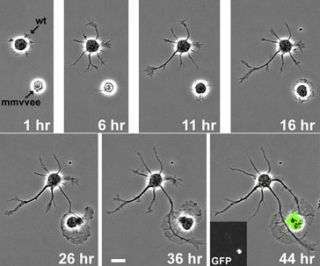
These time lapse frames show development of a normal neuron (top) and a mutated neuron that does not express the Ena/VASP proteins. Image / Erik Dent and Frank Gertler, courtesy Neuron

MIT researchers have identified a family of proteins key to the formation of the communication networks critical for normal brain function. Their research could lead to new treatments for brain injury and disease.

The team, led by MIT biology professor Frank Gertler, found that a certain family of proteins is necessary to direct the formation of axons and dendrites, the cellular extensions that facilitate communication between neurons.

The work focuses on cellular outgrowths called neurites, which are the precursors to axons and dendrites. Understanding how neurites form could eventually lead to therapies involving stimulation of neurite growth, said Gertler.

“You could use these insights to help repair injuries to the top of the spinal column, or treat brain injuries or neurodegenerative disorders,” he said.

The researchers developed the first model that allows for study of the effects of this protein family, known as the Ena/VASP proteins. The team reported aspects of their work in the Nov. 11 issue of Neuron and the Nov. 18 online edition of Nature Cell Biology.

The majority of neurons in the cerebral cortex have a single axon—a long, thin extension that relays information to other cells—and many shorter dendrites, which receive messages from other cells. The interconnection of these axons and dendrites is essential to create a functional neural circuit.

In their study, the researchers found that mice without the three Ena/VASP proteins did produce brain cells, but those neurons were unable to extend any axons or dendrites.

It was already known that Ena/VASP proteins are involved in axon navigation, but the researchers were surprised to find that they are also critical for neurite formation, Gertler said.

Ena/VASP proteins are located in the tips of a neurite’s filopodia, which are short extensions that receive environmental signals and translate them into instructions for the cell. Those instructions tell the cell whether to continue extending the filopodia by lengthening actin protein filaments, or to stop growth.

Without the Ena/VASP proteins, neurites cannot form, and no connections are made between neurons.

The researchers believe that Ena/VASP proteins control the growth of filopodia by regulating actin filaments’ interactions with microtubules in the cell (which form part of the cell skeleton). One theory is that the microtubules might be delivering materials or sending signals to the filopodia through the actin filaments, Gertler said.

Source: Massachusetts Institute of Technology


print this article email this article download pdf blog this article bookmark this article     Stumble it Digg this share on Facebook retweet share on Reddit add to delicious
Rate this story - 4.7 /5 (3 votes)


November 20, 2007 all stories

Comments: 0

4.7 /5 (3 votes)
  • Stumble this up

  • Digg this

  • share this

  • hide
  • Related Stories

  • New suppressor of common liver cancer
    created 6 hours ago | popularity not rated yet | comments 0
  • Muscling in on a mystery protein: Study of brawny pigs reveals key player in the genome
    created 7 hours ago | popularity not rated yet | comments 0
  • Scientists uncover protective mechanism against liver cancer
    created 22 hours ago | popularity not rated yet | comments 0
  • Nanoprobes hit targets in tumors, could lessen chemo side effects
    created 23 hours ago | popularity not rated yet | comments 0
  • Scientists isolate new antifreeze molecule in Alaska beetle
    created Dec 14, 2009 | popularity not rated yet | comments 0


  • hide
  • Relevant PhysicsForums posts

  • Inflamed trapezius muscle
    created Dec 11, 2009
  • Nociceptors
    created Dec 05, 2009
  • Nanomaterials destroy cancer!
    created Nov 30, 2009
  • Nuclear Medicine
    created Nov 30, 2009
  • More from Physics Forums - Medical Sciences

Other News

Home-based child care meeting nutritional standards; widespread use of TV a concern

Medicine & Health / Health

created 4 minutes ago | popularity not rated yet | comments 0

A large study of family child care providers shows that while nutrition standards are often met, most children ages 2 to 5 are not getting enough physical activity and are exposed to the television for most of the day.


Further spread of Rhodesian sleeping sickness in Uganda likely due to livestock movements

Medicine & Health / Diseases

created 43 minutes ago | popularity not rated yet | comments 0

The northwards spread of human Rhodesian sleeping sickness in Uganda is likely due to the movement of infected livestock, according to new findings from an interdisciplinary research group including members from the Centre ...


Parents encouraged to avoid purchasing lottery tickets as gifts for minors

Medicine & Health / Psychology & Psychiatry

created 32 minutes ago | popularity not rated yet | comments 0

(PhysOrg.com) -- In the flurry of activity before the holidays, some well-meaning family members consider buying lottery tickets and scratch cards as affordable, colourful, and potentially promising gift options for the children ...


New findings show how human movement may have brought Chagas disease to urban Peru

Medicine & Health / Diseases

created 13 minutes ago | popularity not rated yet | comments 0

New research shows how the migration and settlement patterns associated with the rapid urbanization of Peru may link to Chagas disease transmission. The study, published December 15 in the open-access journal PLoS Neglected Tr ...


Biological catch-22 prevents induction of antibodies that block HIV

Medicine & Health / HIV & AIDS

created 4 hours ago | popularity 5 / 5 (1) | comments 1

Scientists seeking to understand how to make an AIDS vaccine have found the cause of a major roadblock. It turns out that the immune system can indeed produce cells with the potential to manufacture powerful HIV-blocking ...