Bees are the new silkworms
November 20, 2007 Bees are the new silkworms

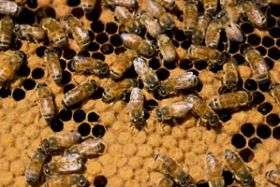
Honey bees with pupal brood cells. Honeybee larvae produce silk to reinforce the wax cells in which they pupate. Image credit – Nick Pitsas, CSIRO

Moths and butterflies, particularly silkworms, are well known producers of silk. And we all know spiders use it for their webs. But they are not the only invertebrates who make use of the strength and versatility of silk.

Dr Tara Sutherland and her group from CSIRO Entomology are looking at silks produced by other insects and the results of their recent work have been published in Molecular Biology and Evolution, in the paper Conservation of Essential Design Features in Coiled Coil Silks.

“Most people are unaware that bees and ants produce silk but they do and its molecular structure is very different to that of the large protein, sheet structure of moth and spider silk. The cocoon and nest silks we looked at consist of coiled coils - a protein structural arrangement where multiple helices wind around each other. This structure produces a light weight, very tough silk,” she says.

“We had already identified the honeybee silk genes,” says Dr Sutherland, “and now we have identified and sequenced the silk genes of bumblebees, bulldog ants and weaver ants, and compared these to honeybee silk genes. This let us identify the essential design elements for the assembly and function of coiled coil silks”.

“To do this, we identified and compared the coiled coil proteins from cocoon and nest silks from species which span the evolutionary tree of the social Hymenoptera (bees, ants and wasps),” she says.

Bees and ants produce high-performance silk and, although the silks in all these species are produced by the larvae and by the same glands, they use them differently.

Honeybee larvae produce silk to reinforce the wax cells in which they pupate, bulldog ant larvae spin solitary cocoons for protection during pupation, bumblebee larvae spin cocoons within wax hives (the cocoons are reused to store pollen and honey), and weaver ants use their larvae as ‘tools’ to fasten fresh plant leaves together to form large communal nests..

These groups of insects have evolved silks that are very tough and stable in comparison to the classical sheet silks and it is probable that the evolution of this remarkable material has underpinned the success of the social Hymenoptera.

Coiled coil silks are common in aculeate social insects i.e. those that have stings but not in aculeate parasitic wasps. These social insects are higher up the evolutionary tree and the coiled coil silks appear to have evolved about 155 million years ago.

Source: CSIRO


print this article email this article download pdf blog this article bookmark this article     Stumble it Digg this share on Facebook retweet share on Reddit add to delicious
Rate this story - 4.4 /5 (12 votes)


November 20, 2007 all stories

Comments: 0

4.4 /5 (12 votes)
  • Stumble this up

  • Digg this

  • share this

  • hide
  • Related Stories

  • New thread in fabric of insect silks
    created Sep 10, 2009 | popularity not rated yet | comments 0
  • Silk-based optical waveguides meet biomedical needs
    created Aug 31, 2009 | popularity not rated yet | comments 0
  • Power thrust for spider silk
    created Apr 24, 2009 | popularity not rated yet | comments 0
  • 'Edible optics' could make food safer
    created Aug 07, 2008 | popularity not rated yet | comments 0
  • A new species of predatory bagworm from Panama's tropical forest
    created Jul 29, 2008 | popularity not rated yet | comments 0


Other News

Computational microscope peers into the working ribosome

Computational microscope peers into the working ribosome (w/ Video)

Biology / Cell & Microbiology

created 17 hours ago | popularity 4.9 / 5 (8) | comments 0

Two new studies reveal in unprecedented detail how the ribosome interacts with other molecules to assemble new proteins and guide them toward their destination in biological cells. The studies used molecular ...


Spider secrets decoded in world-first database

Biology / Plants & Animals

created 11 hours ago | popularity not rated yet | comments 0

(PhysOrg.com) -- Queensland scientists have developed a world-first database that catalogues the venom components from hundreds of spiders.


New chameleon species discovered in East Africa

New chameleon species discovered in East Africa (w/ Podcast)

Biology / Plants & Animals

created 19 hours ago | popularity 5 / 5 (1) | comments 0

A new species of chameleon has been discovered in Tanzania by a team of scientists.


Indian engineer invents device to stop rampaging elephants

Biology / Plants & Animals

created 22 hours ago | popularity 4.3 / 5 (3) | comments 0

An Indian inventor has created a device to stop rampaging elephants in their tracks, amid concern about human injuries and deaths when they run amok, his company said Monday.


A year after discovery, Congo's 'mother lode' of gorillas remains vulnerable

A year after discovery, Congo's 'mother lode' of gorillas remains vulnerable

Biology / Plants & Animals

created 15 hours ago | popularity 5 / 5 (1) | comments 0

A new study by the Wildlife Conservation Society says that western lowland gorillas living in a large swamp in the Republic of Congo—part of the "mother lode" of more than 125,000 gorillas discovered last ...