Secrets in rare cartography
Whales were the economic drivers of the 1850s. So important was this resource that the founder of the U.S. Oceanographic Office, Matthew Fontaine Maury, created a map showing the worldwide distribution of sperm and right whales in 1851.
“Whale oil then was like petroleum is today,” says Christopher Baruth. “This is a graphic device that showed where the whales were located by type and season.”
Baruth is curator of the American Geographical Society (AGS) Library, where a copy of the whale map is one of thousands of rare cartographical materials and geographical photographs.
Quietly housed at the University of Wisconsin-Milwaukee (UWM) since 1978, the AGS Library contains more than a million items, half of which are maps and charts, some dating to 15th century, and some that aren’t available anywhere else, even at the Library of Congress.
The value of the items in the AGS collections is compounded by their connection to the society. AGS is the oldest national geographical society in the United States, founded in 1851 in New York City.
Explorer-members, such as Charles Lindbergh, Robert Peary and Theodore Roosevelt, are among those who donated items associated with their exploits to the society over the years. Materials in the collection have been consulted not only by scholars, but also by the U.S. government during and at the end of both world wars. Today, it attracts scholars from as far away as Uzbekistan.
“It’s a national treasure,” says Robert McColl, professor emeritus of geography and East Asian studies at the University of Kansas, who in 2000 donated to AGSL his own geographical library, one of the best personal collections of Chinese materials in the world.
Stories of intrigue
McColl is one of the many travelers and scholars who, in addition to the famous, have helped build the collection.
“I went to China early enough that I found some items that are terribly unique, that might have disappeared otherwise,” says McColl. Through his contacts in China, he found many works and maps that might have been produced in limited quantities or pulled off the market.” He also found rare books, sometimes bound in silk, in flea markets. “People were selling them for food,” he says.
It’s like that with the contents of the AGSL, says Baruth. Each piece testifies to the adventurers, rare circumstances and history behind them – with as much intrigue as any work of fiction found in the other stacks of the UWM Libraries.
Notable contents include a wide range of materials, from black-and-white renderings done by hand to digital spatial data, from turn-of-the-century photographs of arctic exploration to charts used by Charles Lindbergh to fly from New York to Paris in 1927.
Chicago Festival of Maps
When asked to choose a “Top 10” from the collection, Baruth shakes his head slowly and replies, “That’s like asking you to rank your children.”
But three of the library’s possessions are on view (http://www.uwm.edu/Libraries/AGSL/festivalmaps.html) at the Field Museum in Chicago, where the World Festival of Maps is hosting what many consider to be one of the greatest map exhibits of the century, “Maps: Finding Our Place in the World.” In addition to the whale map described above, two more AGS holdings stand alongside cartographic gems from around the world at the exhibit, which runs through Jan. 27, 2008.
One is a unique manuscript map from about 1910 of the Belcher Islands in Hudson Bay. It was drawn from memory on the back of a missionary lithograph by an Inuit named Wetalltok, and given to Robert J. Flaherty, who created the film “Nanook of the North.” It is the most accurate map of the islands then extant.
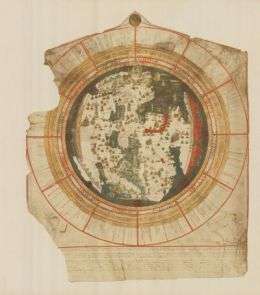
The other item on loan is the Mappamundi, the oldest original map in the AGSL holdings, produced in 1452 by the Venetian cartographer Giovanni Leardo. The circular map, considered the finest example of a medieval wall map in the Western Hemisphere, shows the known world consisting of only Europe, Asia and Africa, a configuration Baruth calls a T-O map. (“Imagine a capital ‘ T’ inside a circle separating the three continents.”)
As in many medieval maps, Jerusalem is situated in the center of the Mappamundi, and the names of regions were copied from those of a second-century geographer named Claudius Ptolemy. As the Age of Discovery advanced, Ptolemy’s original work was filled in and expanded by explorers, spawning new editions called “novae tabulae.”
AGSL has many such editions of these “Ptolemys,” including a rare original from 1478 that was printed on vellum (animal skin).
Catalog incomplete
In the mid-1970s the AGS could no longer afford to archive its holdings and chose UWM to house the collection after a national search. It took nearly five years to orchestrate the move and surmount the legal challenges.
And Baruth concedes that riches may still lie hidden in the holdings.
In the library’s more recent history, Baruth unearthed two prizes from the wall-length bookshelf in his own office: a first-edition copy of “Moby-Dick” by Herman Melville and a travel book given to the AGS by a young Teddy Roosevelt. Neither was found in the catalog at the time.
UWM Professor Bruce Fetter began specializing in both cartography and demography soon after UWM acquired the collection to better make use of the resource. He has been teaching a class on how to use the collection for 26 years.
“This material is essential because it affects how we see the world,” says Fetter. “It is a wonderful way of getting a picture of the past.”
Source: University of Wisconsin - Milwaukee


