Digging biblical history, or the end of the world
November 20, 2007
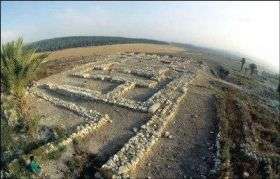
At the Megiddo Dig: The Assyrian palace of Stratum III. Credit: AFTAU
Some come to dig the Tel Aviv University-directed archeological site at Tel Megiddo because they are enchanted by ancient stories of King Solomon. Others come because they believe in a New Testament prophecy that the mound of dirt will be the location of a future Judgment Day apocalyptic battle. Hence the second, rather more chilling name for the site: "Armageddon."
Tel Megiddo has been the subject of a number of decisive battles in ancient times (among the Egyptian, Hebrew and Assyrian peoples) and today it holds a venerated place in archaeology, explains site co-director and world-renowned archeologist Prof. Israel Finkelstein.
Says Prof. Finkelstein, from the Department of Archaeology and Ancient Near Eastern Cultures at Tel Aviv University, "Megiddo is one of the most interesting sites in the world for the excavation of biblical remains. Now volunteers and students from around the world can participate in the dig which lets them uncover 3,000 years worth of history -- from the late 4th millennium B.C.E. to the middle of the first millennium C.E."
Prof. Finkelstein, who belongs to the Sonia and Marco Nadler Institute of Archaeology at Tel Aviv University, has been co-directing the site with Prof. David Ussishkin, also of Tel Aviv University, since 1994.
Prof. Finkelstein has co-authored a best-selling book on archaeology and biblical history (The Bible Unearthed, 2001). Earlier this month he released a book (written with A. Mazar) that contains surprising commentary on biblical archaeology and history, The Quest for Biblical Archeology, published by the Society of Biblical Literature in the United States. He is also the recipient of the prestigious international Dan David Prize in the category of Past Dimension (2005).
Likened to a "lightening rod" by the journal Science (2007), Prof. Finkelstein is famous for his unconventional way of interpreting biblical history: he puts emphasis on the days of the biblical authors in the 7th century B.C.E. and theorizes that ancient rulers such as David and Solomon, who lived centuries earlier, were "tribal chieftains ruling from a small hill town, with a modest palace and royal shrine."
Yet, "new archaeological discoveries should not erode one's sense of tradition and identity," he states.
Prof. Ze’ev Herzog, who heads the archaeology institute at Tel Aviv University, says, "There has been an important revolution in biblical history in the last decades. We are now uncovering the difference between myth and history, and between reality and ideology of the ancient authors. This is the role of our generation of archaeologists -- to unearth the real historical reality to find out why and how the biblical records were written."
The archeologists aren't the only ones looking for answers. More than one hundred volunteers come from all corners of the world to dig Megiddo alongside Prof. Finkelstein every year. They are teachers, journalists, actors, construction workers, professors and housewives, as well as archaeology, history and divinity students who dig for credit.
The Megiddo dig is offered as a three-week, four-week or seven-week program. As part of the experience, volunteers live in a nearby kibbutz and are exposed to lectures and debates about their findings. The dig is partnered with the George Washington University, represented by Prof. Eric Cline, the American associate director of the dig. This makes it an ideal stomping ground for Americans who want a hands-on education in archaeology.
"Team and staff members come from all around the world for many reasons: the adventure of foreign travel in a safe yet educational environment, intellectual stimulation, and -- yes -- even a love of digging in the dirt,” notes Prof. Finkelstein.
And those with no prior knowledge or degrees are welcome, he stresses. "We cater to all of the volunteers' backgrounds and teach them field methods, archeological techniques as well as the history of biblical archeology. It is truly a wonderful experience."
Source: American Friends of Tel Aviv University
-
Engineers build first sub-10-nm carbon nanotube transistor
Feb 01, 2012 |
4.9 / 5 (33) |
30
-
Something old, something new: Evolution and the structural divergence of duplicate genes
Jan 31, 2012 |
4.6 / 5 (7) |
1
-
The hidden nanoworld of ice crystals: Revealing the dynamic behavior of quasi-liquid layers
Jan 30, 2012 |
5 / 5 (4) |
1
-
Stock market network reveals investor clustering
Jan 27, 2012 |
3.9 / 5 (23) |
8
-
Of microchemistry and molecules: Electronic microfluidic device synthesizes biocompatible probes
Jan 26, 2012 |
5 / 5 (2) |
0
-
Factors affecting beet root cell membrane
16 hours ago
-
Stem cell question.
Feb 10, 2012
-
Protease cleavage
Feb 10, 2012
-
Pertubance in a model
Feb 10, 2012
-
Cancer drugs and Alzheimer's, Oh my!
Feb 09, 2012
-
Squishing cells
Feb 09, 2012
- More from Physics Forums - Biology
More news stories
A frank discussion of the power law and linking correlation to causation
(PhysOrg.com) -- Michael Stumpf a mathematics professor at Imperial College in London, and Mason Porter a lecturer at Oxford have teamed together to write and publish a perspective piece in Science regarding the in ...
US workers are 'giving away the store,' costing firms billions
Nearly 70 percent of the nation's service employees give away free goods and services from hamburgers to cable TV costing companies billions of dollars a year, according to a groundbreaking study.
Other Sciences / Economics & Business
Feb 09, 2012 |
3 / 5 (5) |
11
Employers feel no love for unscrupulous practice of 'service sweethearting'
A new study led by two Florida State University marketing professors finds that some frontline service employees who are rewarded for hikes in customer loyalty and satisfaction also may engage in "service ...
Other Sciences / Economics & Business
Feb 10, 2012 |
3.3 / 5 (3) |
10
New insights into how to correct false knowledge
The abundance of false information available on the Internet, in movies and on TV has created a big challenge for educators.
Other Sciences / Social Sciences
Feb 07, 2012 |
4.9 / 5 (7) |
9
|
Neanderthal demise due to many influences, including cultural changes: study
As an ice age crept upon them thousands of years ago, Neanderthals and modern human ancestors expanded their territory ranges across Asia and Europe to adapt to the changing environment.
Other Sciences / Archaeology & Fossils
Feb 07, 2012 |
4.4 / 5 (5) |
8
|
Scientists discover molecular secrets of 2,000-year-old Chinese herbal remedy
For roughly two thousand years, Chinese herbalists have treated Malaria using a root extract, commonly known as Chang Shan, from a type of hydrangea that grows in Tibet and Nepal. More recent studies suggest that halofuginone, ...
New method to examine batteries -- MRI from the inside
There is an ever-increasing need for advanced batteries for portable electronics, such as phones, cameras, and music players, but also to power electric vehicles and to facilitate the distribution and storage of energy derived ...
A mitosis mystery solved: How chromosomes align perfectly in a dividing cell
Although the process of mitotic cell division has been studied intensely for more than 50 years, Whitehead Institute researchers have only now solved the mystery of how cells correctly align their chromosomes during symmetric ...
Google might launch Drive for cloud storage soon
(PhysOrg.com) -- Google's next big move, according to the Wall Street Journal, is a cloud storage service called Drive. Hardly first to the plate, Google is simply catching up to introducing its cloud reposi ...
Lab study raises questions over nano-particle impact
Tests involving chickens have raised questions about the impact on health from engineered nano-particles, the ultra-fine grains commonly used in drugs and processed foods, scientists said on Sunday.
Starve a virus, feed a cure? Findings show how some cells protect themselves against HIV
A protein that protects some of our immune cells from the most common and virulent form of HIV works by starving the virus of the molecular building blocks that it needs to replicate, according to research published online ...
Nov 20, 2007
Rank: not rated yet
... So... in the face of evidence one shouldn't change one's mind?