Clean Room Classic: Vacuum Evaporator Purchased 50 Years Ago Still Going Strong
November 20, 2007 Clean Room Classic: Vacuum Evaporator Purchased 50 Years Ago Still Going Strong

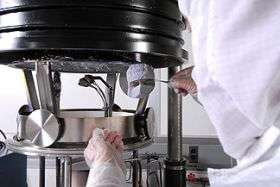
Carefully maintained and updated, a 50-year-old vacuum evaporator is still applying coatings in a Georgia Tech Research Institute clean room. Photo: Gary Meek, Georgia Tech

A 1957 classic sits in the Georgia Tech Research Institute (GTRI) clean room. It’s not a Chevy, but a Veeco vacuum evaporator more than six feet tall and five feet wide.

The evaporator, still in use today, deposits thin films necessary for microfabrication processes. Applications include creating the reflective or anti-reflective coatings on optics and building up layers of insulators, semiconductors and conductors to form integrated electronic circuits.

“It’s a very rugged machine and it’s gotten better with age,” said Mike Harris, a principal research engineer in GTRI's Electro-Optical Systems Lab. Harris first used the Model 775 evaporator in 1972 as a student.

The system operates by evaporating a source material, such as a metal, in a high vacuum, allowing vapor particles to travel directly to a target object, such as a semiconductor, where they condense back to a solid state and form a thin film of the source material.

Harris attributes the machine’s longevity to its design and documentation – and to the skills of GTRI technicians and engineers. “The operator and maintenance manuals are excellent, with exploded views of the various piece parts, making it very easy for our technicians and engineers to repair it when we have problems,” he explained.

In addition to repairing the system, GTRI engineers have upgraded and modified the evaporator several times since it was purchased.

First, they changed the high vacuum pump from a diffusion pump to a more modern cryogenic pump in 2002. The diffusion pump generated a high speed jet of vapor by boiling fluid and directing the vapor in the pump throat down into the bottom of the pump and out the exhaust. The newer cryogenic pump traps gases and vapors by condensing them on a cold surface.

To increase the uniformity of results, GTRI researchers added a planetary substrate fixture that rotates inside the evaporation chamber.

In addition, the original system was designed with a tungsten filament that was heated to a high enough temperature so that the source material placed in a crucible on the filament evaporated. GTRI engineers changed this to an electron beam evaporator that fires a high-energy beam from an electron gun to boil a small spot of material, allowing lower vapor pressure materials to be deposited.

Since the 1957 system still runs and remains optimal for numerous applications, Harris sees no reason to buy a new one. “New systems like this probably cost between $700,000 and $1 million,” he added. “And the new systems are designed primarily for throughput and that’s not necessarily best for a research environment.”

Source: Georgia Institute of Technology, by Abby Vogel


print this article email this article download pdf blog this article bookmark this article     Stumble it Digg this share on Facebook retweet share on Reddit add to delicious
Rate this story - 4.4 /5 (12 votes)

Rank Filter

Move the slider to adjust rank threshold, so that you can hide some of the comments.


Display comments: newest first

  • hudres - Nov 20, 2007
    • Rank: 5 / 5 (1)
    While this may seem impressive, by replacing the high vacuum pump and adding the planetary fixture, they upgraded it to a more or less current configuration. Big deal! All this proves is that a glass bell jar doesn't leak after all this time. I have many old system in my lab. They get upgraded and are essentially like new. Now, what is really impressive is the 1903 vacuum tube in my collection that still has its original vacuum and works as well as the day to was built. No rebuilds, just a simple chemical getter pump and really good processing when the tube was built. I gave it a 5 anyway
  • quantum_flux - Nov 20, 2007
    • Rank: not rated yet
    There are still functioning Ford Model T's and Model A's in the world, but they aren't owned by the government. The real achievement here is building a machine that can survive for long periods of time in a beauracracy.

November 20, 2007 all stories

Comments: 2

4.4 /5 (12 votes)
  • Stumble this up

  • Digg this

  • share this

  • hide
  • Related Stories


  • hide
  • Relevant PhysicsForums posts

  • two-dimensional collision
    created 1hour ago
  • I Need Help Selecting a Good Text Book to Learn the Basics
    created 3 hours ago
  • The acceleration of mass using light
    created 3 hours ago
  • Badminton
    created 4 hours ago
  • More from Physics Forums - General Physics

Other News

In the Brain, Seven Is A Magic Number

In the Brain, Seven Is A Magic Number

Physics / General Physics

created 7 hours ago | popularity 4.3 / 5 (15) | comments 4

Having a tough time recalling a phone number someone spoke a few minutes ago or forgetting items from a mental grocery list is not a sign of mental decline; in fact, it's natural.


Scientists react as they stand in front of a screen at CERN

First atoms reported smashed in Large Hadron Collider (Update)

Physics / General Physics

created 9 hours ago | popularity 4.8 / 5 (16) | comments 6

Two circulating beams on Monday produced the first particle collisions in the world's biggest atom smasher, the Large Hadron Collider (LHC), three days after its restart, scientists announced.


Visual assistance for cosmic blind spots

Visual assistance for cosmic blind spots

Physics / General Physics

created 10 hours ago | popularity 4 / 5 (2) | comments 0

A bit of imagination on the part of a measuring instrument wouldn't be a bad thing. It could help to add data from areas where the instrument is unable to measure. However, it must do so constructively. In ...


A mechanical model of vocalization

Physics / General Physics

created 6 hours ago | popularity not rated yet | comments 0

When people speak, sing, or shout, they produce sound by pushing air over their vocal folds -- bits of muscle and tissue that manipulate the air flow and vibrate within it. When someone has polyps or some other problem with ...


Big Bang atom smasher sends beams in 2 directions (AP)

Large Hadron Collider sends beams in 2 directions

Physics / General Physics

created 13 hours ago | popularity 4.9 / 5 (9) | comments 0

(AP) -- The world's largest atom smasher made another leap forward Monday by circulating beams of protons in opposite directions at the same time in the $10 billion machine after more than a year of repairs, ...