Astronomers Say Moons Like Ours Are Uncommon
November 20th, 2007 Astronomers Say Moons Like Ours Are Uncommon

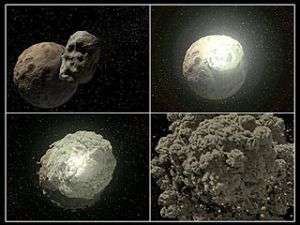
This artist's animation shows bodies as big as mountain ranges smashing together. Such collisions form the basis of the planet-building process. An even bigger collision between Earth and a body the size of Mars is thought to have created our moon. Image credit: NASA/JPL/Caltech

The next time you take a moonlit stroll, or admire a full, bright-white moon looming in the night sky, you might count yourself lucky. New observations from NASA's Spitzer Space Telescope suggest that moons like Earth's - that formed out of tremendous collisions - are uncommon in the universe, arising at most in only 5 to 10 percent of planetary systems.

"When a moon forms from a violent collision, dust should be blasted everywhere," said Nadya Gorlova of the University of Florida, Gainesville, lead author of a new study appearing Nov. 20 in the Astrophysical Journal. "If there were lots of moons forming, we would have seen dust around lots of stars - but we didn't."

It's hard to imagine Earth without a moon. Our familiar white orb has long been the subject of art, myth and poetry. Wolves howl at it, and humans have left footprints in its soil. Life itself might have evolved from the ocean to land thanks to tides induced by the moon's gravity.

Scientists believe the moon arose about 30 to 50 million years after our sun was born, and after our rocky planets had begun to take shape. A body as big as Mars is thought to have smacked into our infant Earth, breaking off a piece of its mantle. Some of the resulting debris fell into orbit around Earth, eventually coalescing into the moon we see today. The other moons in our solar system either formed simultaneously with their planet or were captured by their planet's gravity.

Gorlova and her colleagues looked for the dusty signs of similar smash-ups around 400 stars that are all about 30 million years old - roughly the age of our sun when Earth's moon formed. They found that only 1 out of the 400 stars is immersed in the telltale dust. Taking into consideration the amount of time the dust should stick around, and the age range at which moon-forming collisions can occur, the scientists then calculated the probability of a solar system making a moon like Earth's to be at most 5 to 10 percent.

"We don't know that the collision we witnessed around the one star is definitely going to produce a moon, so moon-forming events could be much less frequent than our calculation suggests," said George Rieke of the University of Arizona, Tucson, a co-author of the study.

In addition, the observations tell astronomers that the planet-building process itself winds down by 30 million years after a star is born. Like our moon, rocky planets are built up through messy collisions that spray dust all around. Current thinking holds that this process lasts from about 10 to 50 million years after a star forms. The fact that Gorlova and her team found only 1 star out of 400 with collision-generated dust indicates that the 30-million-year-old stars in the study have, for the most part, finished making their planets.

"Astronomers have observed young stars with dust swirling around them for more than 20 years now," said Gorlova. "But those stars are usually so young that their dust could be left over from the planet-formation process. The star we have found is older, at the same age our sun was when it had finished making planets and the Earth-moon system had just formed in a collision."

For moon lovers, the news isn't all bad. For one thing, moons can form in different ways. And, even though the majority of rocky planets in the universe might not have moons like Earth's, astronomers believe there are billions of rocky planets out there. Five to 10 percent of billions is still a lot of moons.

Other authors of the paper include: Zoltan Balog, James Muzerolle, Kate Y. L. Su and Erick T. Young of the University of Arizona, and Valentin D. Ivanov of the European Southern Observatory, Chile.

Source: Jet Propulsion Laboratory, by Whitney Clavin


print this article email this article download pdf blog this article bookmark this article     Digg this Stumble it share on Facebook share on Reddit add to delicious save to Yahoo! bookmarks
4.2/5 after 38 votes

Rank Filter

Move the slider to adjust rank threshold, so that you can hide some of the comments.


Display comments: newest first

  • seanpu - Nov 21, 2007
    • Rank: 3.5 / 5 (2)
    you can tell its an artists impression. the smaller rock explodes!!! hehe then the debris flies out like its moving through a gas!! nonsense images like artists impressions should never be used to describe reality on a science website.

November 20th, 2007 all stories
Space & Earth / Astronomy

Comments: 1
Rank: 4.2/5 after 38 votes

  • Stumble this up

  • Digg this

  • Share it:
  • share on Facebook
  • share on MySpace
  • share on Slashdot
  • rss-newsfeed
  • share on Google
  • share on Reddit
  • add to delicious
  • save to Yahoo! bookmarks
  • share on Windows Live
  • Add to Mixx!
Rating: 4.2/5 after 38 votes

  • Related Stories

  • IBEX spacecraft detects fast neutral hydrogen coming from the moon
    created Jun 18, 2009 | popularity not rated yet | comments 0
  • ESA to launch two large observatories to look deep into space and time
    created May 07, 2009 | popularity not rated yet | comments 0
  • Saturn has small moon hidden in ring
    created Mar 03, 2009 | popularity not rated yet | comments 0
  • STAR TRAK for November
    created Nov 03, 2008 | popularity not rated yet | comments 0
  • Phoenix probe lands on Mars (Update 4)
    created May 25, 2008 | popularity not rated yet | comments 0

Tags


  • Physicists Demonstrate Quantum Memory with Matter Qubits
    Physicists Demonstrate Quantum Memory with Matter Qubits
    Physics / General Physics
    created Jul 03, 2009 | popularity 4.4 / 5 (17) | comments 1
  • 'Holey' Nanosheets for Wastewater Dye Removal
    Nanotechnology / Nanomaterials
    created Jul 01, 2009 | popularity 5 / 5 (5) | comments 1
  • Jellyfish Robot Swims Like its Biological Counterpart
    Jellyfish Robot Swims Like its Biological Counterpart
    Electronics / Robotics
    created Jun 26, 2009 | popularity 4.4 / 5 (8) | comments 1
  • Could Maxwell's Demon Exist in Nanoscale Systems?
    Could Maxwell's Demon Exist in Nanoscale Systems?
    Physics / General Physics
    created Jun 24, 2009 | popularity 4.4 / 5 (18) | comments 29
  • Living Safely with Robots, Beyond Asimov's Laws
    Living Safely with Robots, Beyond Asimov's Laws
    Electronics / Robotics
    created Jun 22, 2009 | popularity 4.6 / 5 (52) | comments 40
  • Other News

    Forty years ago man first walked on the moon

    Space & Earth / Space Exploration

    created 10 hours ago | popularity 5 / 5 (2) | comments 0

    Forty years ago on July 20, 1969, American astronaut Neil Armstrong realized the oldest dream of human civilizations when he became the first man to walk on the moon.


    The least sea ice in 800 years

    The least sea ice in 800 years

    Space & Earth / Earth Sciences

    created Jul 01, 2009 | popularity 4.3 / 5 (59) | comments 52

    New research, which reconstructs the extent of ice in the sea between Greenland and Svalbard from the 13th century to the present indicates that there has never been so little sea ice as there is now. The ...


    Gas around young galaxy

    Intense heat killed the Universe's would-be galaxies, researchers say

    Space & Earth / Astronomy

    created Jul 01, 2009 | popularity 3.2 / 5 (19) | comments 27

    (PhysOrg.com) -- Our Milky Way galaxy only survived because it was already immersed in a large clump of dark matter which trapped gases inside it, scientists led by Durham University's Institute for Computational ...


    Scientists' Drill Hits Magma: Only Third Time on Record

    Scientists' Drill Hits Magma: Only Third Time on Record

    Space & Earth / Earth Sciences

    created Jun 29, 2009 | popularity 4.7 / 5 (20) | comments 19

    (PhysOrg.com) -- Scientists drilling a borehole deep into Iceland’s rocky crust to explore new methods of using geothermal energy hit a major roadblock on Thursday: Their drill ran into molten rock at a depth ...


    NASA manager pitches a cheaper return-to-moon plan

    Space & Earth / Space Exploration

    created Jun 30, 2009 | popularity 4 / 5 (7) | comments 18

    (AP) -- Like a car salesman pushing a luxury vehicle that the customer no longer can afford, NASA has pulled out of its back pocket a deal for a cheaper ride to the moon.