UD researchers set new chemical world record
November 21, 2007
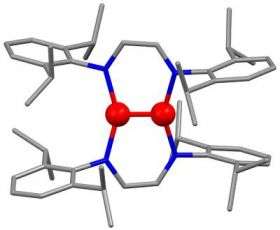
This graphic depicts the bond between two atoms of chromium that has set a new record for the shortest chemical bond ever found between two metals. Credit: Klaus Theopold
Chemists from the University of Delaware, in collaboration with a colleague at the University of Wisconsin, have set a new world record for the shortest chemical bond ever recorded between two metals, in this case, two atoms of chromium.
The distance? A minuscule 1.803 Ångstroms, which is on the order of a billionth of the thickness of a human hair.
The chemists weren't driven by the Guinness Book of World Records or even a friendly bet. As is often the case in science, they discovered the molecule, which has a quintuple (i.e., fivefold) bond, quite by accident.
“Sometimes things like this just happen,” said Klaus Theopold, professor and chairperson of the UD Department of Chemistry and Biochemistry.
Theopold and Kevin Kreisel, who graduated with his doctorate from UD in August and is now a postdoctoral researcher at the University of Wisconsin, made the finding, working with research associate Glenn Yap and postdoctoral fellow Olga Dmitrenko, both from UD, and Clark Landis, a colleague from the University of Wisconsin.
The research was reported in the Journal of the American Chemical Society.
Theopold has been researching the chemistry of chromium for a long time. The metal is an important industrial catalyst for making plastics such as polyethylene.
“We discovered this interesting looking molecule and realized that it had an extremely short distance between the metal atoms,” Theopold said.
Using an analytical technique called X-ray diffraction, the scientists were able to look directly at the atomic structure of the new molecule and measure the distance between the chromium atoms.
A rule-of-thumb in chemistry, Theopold said, is that bond length and bond strength go together, so it's likely that the metal-metal bond is a strong one, although Theopold said no one knows for sure.
“This molecule is probably not practically useful. We're not going to get a patent here or cure cancer,” Theopold noted. “Records define the range in which things can exist. It's just an interesting molecule from a fundamental scientific standpoint.”
And those teeny-tiny bonds do mark a new world record for chemistry.
Before the UD discovery, Theopold said, the last record, achieved by researchers at Texas A&M University, stood for nearly 30 years.
Source: University of Delaware
-
New study makes key finding in stem cell self-renewal
9 hours ago |
4.7 / 5 (3) |
0
-
Copper + love chemical = big sulfur stink
6 hours ago |
4 / 5 (2) |
0
-
Smallest tools could give biggest results in bone repair
5 hours ago |
not rated yet |
0
-
Researchers discover key to immune cell's 'internal guidance' system
Feb 05, 2012 |
5 / 5 (6) |
1
-
Chemists develop faster, more efficient protein labeling
Feb 05, 2012 |
5 / 5 (1) |
0
-
Engineers build first sub-10-nm carbon nanotube transistor
Feb 01, 2012 |
4.9 / 5 (33) |
30
-
Something old, something new: Evolution and the structural divergence of duplicate genes
Jan 31, 2012 |
4.6 / 5 (7) |
1
-
The hidden nanoworld of ice crystals: Revealing the dynamic behavior of quasi-liquid layers
Jan 30, 2012 |
5 / 5 (4) |
1
-
Stock market network reveals investor clustering
Jan 27, 2012 |
3.9 / 5 (23) |
8
-
Of microchemistry and molecules: Electronic microfluidic device synthesizes biocompatible probes
Jan 26, 2012 |
5 / 5 (2) |
0
More news stories
Scientists discover molecular secrets of 2,000-year-old Chinese herbal remedy
For roughly two thousand years, Chinese herbalists have treated Malaria using a root extract, commonly known as Chang Shan, from a type of hydrangea that grows in Tibet and Nepal. More recent studies suggest that halofuginone, ...
3 hours ago |
5 / 5 (10) |
4
|
New method to examine batteries -- MRI from the inside
There is an ever-increasing need for advanced batteries for portable electronics, such as phones, cameras, and music players, but also to power electric vehicles and to facilitate the distribution and storage of energy derived ...
Chemistry / Analytical Chemistry
3 hours ago |
5 / 5 (4) |
0
|
Hydrogen from acidic water: Researchers develop potential low cost alternative to platinum for splitting water
A technique for creating a new molecule that structurally and chemically replicates the active part of the widely used industrial catalyst molybdenite has been developed by researchers with the Lawrence Berkeley ...
Feb 09, 2012 |
4.8 / 5 (16) |
21
|
Fool's gold may prove an unlikely alternative to overexploited catalytic materials
Catalytic materials, which lower the energy barriers for chemical reactions, are used in everything from the commercial production of chemicals to catalytic converters in car engines. However, with current catalytic materials ...
Feb 10, 2012 |
4.4 / 5 (8) |
8
|
Research provides octagonal window of opportunity for carbon capture
(PhysOrg.com) -- Filtering carbon dioxide, a greenhouse gas, from factory smokestacks is a necessary, but expensive part of many manufacturing processes. However, a collaborative research team from the National ...
Feb 08, 2012 |
5 / 5 (2) |
5
|
Overeating may double risk of memory loss
New research suggests that consuming between 2,100 and 6,000 calories per day may double the risk of memory loss, or mild cognitive impairment (MCI), among people age 70 and older. The study was released today and will be ...
Google might launch Drive for cloud storage soon
(PhysOrg.com) -- Google's next big move, according to the Wall Street Journal, is a cloud storage service called Drive. Hardly first to the plate, Google is simply catching up to introducing its cloud reposi ...
Lab study raises questions over nano-particle impact
Tests involving chickens have raised questions about the impact on health from engineered nano-particles, the ultra-fine grains commonly used in drugs and processed foods, scientists said on Sunday.
Injured boomers beware: Know when to see doctor
(AP) -- It happened to nurse Jane Byron years after an in-line skating fall, business owner Haralee Weintraub while doing "men's" push-ups, and avid cyclist Gene Wilberg while lifting a heavy box.
A mitosis mystery solved: How chromosomes align perfectly in a dividing cell
Although the process of mitotic cell division has been studied intensely for more than 50 years, Whitehead Institute researchers have only now solved the mystery of how cells correctly align their chromosomes during symmetric ...
Starve a virus, feed a cure? Findings show how some cells protect themselves against HIV
A protein that protects some of our immune cells from the most common and virulent form of HIV works by starving the virus of the molecular building blocks that it needs to replicate, according to research published online ...