Remains of ancient synagogue with unique mosaic floor found in Galilee
Remains of an ancient synagogue from the Roman-Byzantine era have been revealed in excavations carried out in the Arbel National Park in the Galilee under the auspices of the Hebrew University of Jerusalem.
The excavations, in the Khirbet Wadi Hamam, were led by Dr. Uzi Leibner of the Hebrew University’s Institute of Archaeology and Scholion – Interdisciplinary Research Center in Jewish Studies.
Dr. Leibner said that the synagogue’s design is a good example of the eastern Roman architectural tradition. A unique feature of the synagogue is the design of its mosaic floor, he said.
The synagogue ruins are located at the foot of the Mt. Nitai cliffs overlooking the Sea of Galilee, amidst the remains of a large Jewish village from the Roman-Byzantine period. The first season of excavations there have revealed the northern part of the synagogue, with two rows of benches along the walls. The building is constructed of basalt and chalk stone and made use of elements from an earlier structure on the site.
Archaeologists differ among themselves as to which period the ancient Galilean synagogues belong. The generally accepted view is that they can be attributed to the later Roman period (second to fourth centuries C.E.), a time of cultural and political flowering of the Jews of the Galilee. Recently, some researchers have come to believe that these synagogues were built mainly during the Byzantine period (fifth and sixth centuries C.E.), a time in which Christianity rose to power and, it was thought, the Jews suffered from persecution. Dr. Leibner noted that this difference of scholarly opinion has great significance in perhaps redrawing the historical picture of Jews in those ancient times.
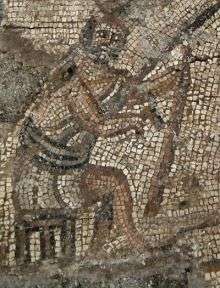
The excavators were surprised to find in the eastern aisle of the synagogue a mosaic decoration which to date has no parallels -- not in other synagogues, nor in art in Israel in general from the Roman-Byzantine period. The mosaic is made of tiny stones (four mm. in size) in a variety of colors. The scene depicted is that of a series of woodworkers who are holding various tools of their trade. Near these workers is seen a monumental structure which they are apparently building. According to Dr. Leibner, since Biblical scenes are commonly found in synagogue art, it is possible that what we see in this case is the building of the Temple, or Noah’s ark, or the tower of Babel. The mosaic floor has been removed from the excavation site and its now in the process of restoration.
The archaeologists at the site are also attempting, though their excavations, to gain a clearer picture of rural Jewish village life in Roman-era Galilee. In addition to excavating the synagogue, they also are involved in uncovering residential dwellings and other facilities at the site, such as a sophisticated olive oil press and solidly-built two-story homes.
“There are those who tend to believe that the rural Jewish villagers of that era lived in impoverished houses or in huts and that the magnificent synagogues existed in contrast to the homes that surrounded them,” said Dr. Leibner. ‘While it is true that the synagogues were built of a quality that exceeded the other structures of the village, the superior quality private dwellings here testify to the impressive economic level of the residents.”
Source: Hebrew University of Jerusalem


