Mars' Molten Past

November 21, 2007 Mars

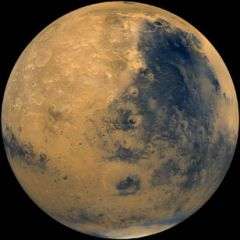
Mars. Credit: NASA

Mars was covered in an ocean of molten rock for about 100 million years after the planet formed, researchers from the Lunar and Planetary Institute in Houston, Texas, UC Davis, and NASA's Johnson Space Center have found. The work is published in the journal Nature on Nov. 22.

The formation of the solar system can be dated quite accurately to 4,567,000,000 years ago, said Qing-Zhu Yin, assistant professor of geology at UC Davis and an author on the paper. Mars' metallic core formed a few million years after that. Previous estimates for how long the surface remained molten ranged from thousands of years to several hundred million years.

The persistence of a magma ocean on Mars for 100 million years is "surprisingly long," Yin said. It implies that at the time, Mars must have had a thick enough atmosphere to insulate the planet and slow down cooling, he said.

Vinciane Debraille, a postdoctoral researcher at the Lunar and Planetary Institute, Alan Brandon at the Johnson Space Center, Yin and UC Davis graduate student Benjamin Jacobsen inferred the early history of Mars in the distant past by studying meteorites that fell on Earth.

Meteorites called shergottites document volcanic activities in Mars between 470 million and 165 million years ago. These rocks were later thrown out of Mars' gravity field by asteroid impacts and delivered to Earth -- a free "sample return mission" accomplished by nature.

By precisely measuring the ratios of different isotopes of neodymium and samarium, the researchers could measure the age of the meteorites, and then use them to work out what the crust of Mars was like billions of years before that.

Planets form in three stages, Yin said. First, dust collects into objects tens of miles across. In the second phase, gravity pulls these planetisimals into bigger objects, roughly the size of Mars or the moon. Finally, these small planets collide to form three or four larger terrestrial planets, such as the Earth -- which is about 10 times the mass of Mars.

The giant collisions in this final phase would have released huge amounts of energy with nowhere to go except back into the new planet. The rock would have turned to molten magma and heavy metals sank to the core of the planet, releasing additional energy. The molten silicate mantle eventually cooled to form a solid crust on the surface of Mars.

Source: UC Davis


print this article email this article download pdf blog this article bookmark this article     Stumble it Digg this share on Facebook retweet share on Reddit add to delicious
Rate this story - 3.8 /5 (21 votes)


November 21, 2007 all stories

Comments: 0

3.8 /5 (21 votes)
  • Stumble this up

  • Digg this

  • share this

  • hide
  • Related Stories


  • hide
  • Relevant PhysicsForums posts

  • The shape of our solar system's orbits.
    created Nov 07, 2009
  • Above or Below the Line of Nodes
    created Nov 07, 2009
  • Supernova vs. Nova?
    created Nov 07, 2009
  • Supernova's Gamma Rays and Comets
    created Nov 06, 2009
  • More from Physics Forums - General Astronomy

Other News

Planetary Society plans new 'solar sail'

Space & Earth / Space Exploration

created 1hour ago | popularity not rated yet | comments 0

(AP) -- Four years after its first solar sail ended up in the ocean instead of orbit, The Planetary Society announced Monday that by the end of 2010 it will try again to launch a spacecraft that will be propelled by the ...


L-R: Chiwetel Ejiofor, Amanda Peet and John Cusack at the premiere of "2012"

NASA on crusade to debunk 2012 apocalypse myths

Space & Earth / Space Exploration

created 7 hours ago | popularity not rated yet | comments 0

The world is not coming to an end on December 21, 2012, the US space agency insisted Monday in a rare campaign to dispel widespread rumors fueled by the Internet and a new Hollywood movie.


Antarctica glacier retreat creates new carbon dioxide store

Antarctica glacier retreat creates new carbon dioxide store

Space & Earth / Earth Sciences

created 11 hours ago | popularity 3.5 / 5 (4) | comments 0

Large blooms of tiny marine plants called phytoplankton are flourishing in areas of open water left exposed by the recent and rapid melting of ice shelves and glaciers around the Antarctic Peninsula. This ...


NASA satellites make a movie and get rainfall, wind info on Ida

NASA satellites make a movie and get rainfall, wind info on Ida (w/ Video)

Space & Earth / Earth Sciences

created 7 hours ago | popularity not rated yet | comments 0

NASA satellites are amazing examples of technology. The TRMM satellite peers into tropical cyclones and can tell how much rain is falling per hour and where. QuikScat uses microwave technology to measure Ida's ...


The GOES-12 satellite sees Large Hurricane Ida nearing landfall

The GOES-12 satellite sees Large Hurricane Ida nearing landfall

Space & Earth / Earth Sciences

created 8 hours ago | popularity 5 / 5 (1) | comments 0

Residents of the U.S. Gulf coast thought they were getting a break this hurricane season until Ida showed up. Today, November 9, Ida is a hurricane and is headed for a landfall in the western Florida Panhandle ...