Oldest case of impacted wisdom teeth found
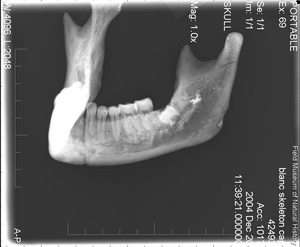
The earliest recorded case of impacted wisdom teeth belongs to the renowned "Magdalenian Girl," a nearly complete 13,000- to 15,000-year-old skeleton excavated in France in 1911and acquired by The Field Museum in 1926.
For years this rare, early anatomically modern human skeleton was thought to be that of a girl because her wisdom teeth had not erupted, an event that typically occurs between 18 and 22 years of age. New analysis of Magdalenian Girl's bones, however, has lead Field Museum scientists to conclude that she was not a girl but actually a 25- to 35-year-old woman at the time of her death.
Examination of new high-quality digital X-rays revealed that the wisdom teeth were, in fact, impacted, and had thus failed to erupt at the normal time. This is significant because impacted wisdom teeth are thought to be the result of dietary changes associated with later developments in human cultures.
Impaction was unknown during the stone ages, scientists say, due to the coarse diet of the period. This coarse diet would have required more chewing and higher bite forces, which could have stimulated growth of the jawbone and thereby created more room for the wisdom teeth to erupt.
"Finding impacted wisdom teeth 15,000 years ago indicates that the human diet might have already changed, some would say 'deteriorated,' earlier than previously thought," said Robert D. Martin, Field Museum provost and primatologist.
Wisdom teeth are the common name for the third molars. There are usually four wisdom teeth (one in each row of teeth), and they grow in behind the second molars – provided they are properly aligned and there is enough room for them.
Martine, together with William Pestle, Field Museum Collection Manager and bone specialist, and Drs. Michael Colvard and Richard Jurevic of the College of Dentistry at the University of Illinois at Chicago, determined that Magdalenian Girl was a woman by employing new tools and technologies in an ongoing reanalysis of the specimen The determination that the wisdom teeth were, in fact, impacted allowed the researchers to make sense of a number of other indicators in the skeleton that suggested an age significantly older than 18-21.
"There had always been some tension between the young age suggested by the state of dental development and the much older age suggested by a number of developmental and degenerative changes in the rest of the skeleton," Pestle said.
Other tests currently underway include an analysis of tooth structures to confirm the age-at-death; computed tomography (CT) scans to study pathologies and the structure of the bones; stable isotope analysis to reconstruct the prehistoric diet; and DNA analysis.
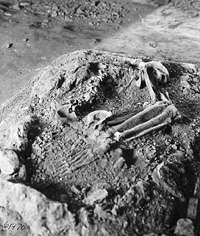
The skeleton of the Magdalenian Girl, which is the most complete Upper Paleolithic skeleton available for study in North America, was discovered in 1911 near Laussel in southwestern France. The skeleton was found in the Cap Blanc rock shelter, famous for its magnificent decorative stone frieze of sculpted horses, bison and deer that is still visited by tourists today. Several years ago, The Field Museum created a cast of the skeleton for exhibition at Cap Blanc in France.
The original skeleton will be placed on permanent display as part of Evolving Planet, The Field Museum's stunning new permanent exhibit depicting the story of life on Earth. The exhibit opens to the public on March 10. For the first time, Magdalenian Girl's skeletal remains will be exhibit in the "fetal" position in which the specimen was discovered almost 100 years ago.
Martin, Pestle and other scientists will be on hand at the media preview of Evolving Planet on March 7 (see the information below for details) to discuss the new research findings relating to Magdalenian Girl, as well as other significant scientific news, such as the first exhibition of recently described dinosaur species.
When Henry Field, then curator of Physical Anthropology at The Field Museum, acquired Magdalenian Girl in 1926, it was hailed as one of the most significant acquisitions the museum ever made. On the first day the precious specimen was exhibited, tens of thousands of visitors flocked to the museum to see it.
Magdalenian Girl, also known as the Cap Blanc skeleton, continues to reveal significant information about our early human relatives – and she may not be done yet.
"Magdalenian Girl has once again proven the value of museum collections, which often contain unexpected secrets that are only revealed as new methods and techniques emerge," Pestle said.
Source: Field Museum


