Bats Have Complex Skills to Deal with 'Clutter'
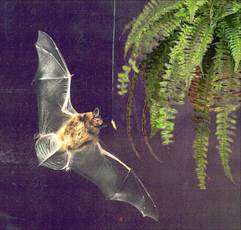
A little clutter on the way to the refrigerator might mean taking a few extra seconds to navigate your way to a late night snack. For a bat flying around in the dark searching for a meal of insects, the “clutter” of things like leaves and trees could mean missing out on a tasty morsel of dinner altogether.
A bat finds its way around with sound rather than sight. Using a sensory process called echolocation, the bat emits ultrasonic pulses that hit objects like leaves, trees and insects, and bounce back to the bat to tell it what’s in the vicinity. When an echo returns from “clutter” at the same time a sound bounces back from an insect, the bat has a real challenge figuring out where the bug is.
In an article in the March 6 issue of PLoS Biology, University of Maryland psychology professor Cynthia Moss reports on her new research that shows bats have methods for echolocating food in “clutter” that may be more complex than scientists have thought.
“We have found that bats adjust the timing of their sounds when they encounter clutter, and they seem to ‘strobe’ the world with sound,” says Moss.
Moss also found that, contrary to the long held belief that a bat’s sonic pulse output is tied only to its respiration and wingbeat, bats, in fact, adjust their sonic pulse output to respond to information they receive from echolocation.
The research is the latest of several recent studies by the Moss lab that are adding detailed new information to scientists’ understanding of how acoustic signals drive bat behavior.
Hidden in the Clutter
In its hunt for prey, a bat flies around at high speeds, emitting pulses of varying pitches and speeds. As the bat gets closer to what could be an insect, it sends out an array of quick repetitive pulses, called sonar strobe groups. Finally, when it has locked onto the bug, right before scooping it up, the bat shoots a rapid fire series of sounds called the final buzz. This study concentrated on sonar strobe groups emitted by Big Brown Bats.
“This species of bat has been observed capturing insects near the ground and vegetation, which suggests they have a wider repertoire of sonar-guided behavior than previously recognized,” says Moss. “We thought the sonar strobe groups might be well suited to helping the bat distinguish a small object from the more complex background you would find in the wild.”
Using an array of high-speed infrared cameras and strategically placed microphones in the “Batlab,” Moss’s team was able to match slowed video and audio recordings of the bat’s echolocation activity and corresponding movement as it pursued an insect tethered to a string.
Aborted Hunt
When nothing was blocking the insect, the bats made quick work of locating and capturing their prey. They attempted and succeeded at capture each time, with a small amount of strobing and a strong final buzz. The effort took only two seconds.
Then the researchers cluttered the hunting area by adding a plant. Dinner suddenly became harder to come by. The bats’ incidence of strobing was higher and the hunt times longer, the closer the bug was placed to the plant. And the bat flew alongside the plant instead of going right for the insect.
When the plant was closest to the bug – 10 centimeters – the bats went for the prey only half of the time and usually failed. It took the bats an average of almost a minute and half to abort or fail. When the plant was moved farther away from the bug, the success rate went up and the hunt time started back down. At a 20-centimeter distance, the attempt and success rate shot back up, to 80 percent, with a hunt time of only a few seconds.
“In each case we found that the bats spent more time strobing when the insect was positioned near a plant, a strong indication that they used sonar strobe groups to try to distinguish the insect from the background clutter,” Moss says. “They also varied the intervals between pulses in the strobe group, depending on the distance between the prey and clutter.”
Overriding Wingbeat
Moss’s team also discovered that the bat’s sonar pulsing is not based strictly to its wingbeat cycle, as has been thought. The wingbeat cycle is tied to the bat’s breathing – it inhales on the downstroke and exhales on the upstroke.
“Breaks in the sonar strobe groups would be expected to occur during a particular phase of the downstroke if wingbeat and respiration were strictly driving the production of sound groups,” says Moss. “But we found that the sound groups occur across all phases of the wingbeat cycle, and definitely through the entire final buzz. This suggests that the bat’s vocal control can override the wingbeat-respiration cycle.
“Most importantly,” says Moss, “the results of this study clearly show that bats control the timing of their calls to directly influence the patterns of echoes used for perception.”
Source: University of Maryland


