Liquid crystal phases of tiny DNA molecules point up new scenario for first life on Earth
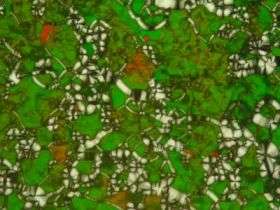
A team led by the University of Colorado at Boulder and the University of Milan has discovered some unexpected forms of liquid crystals of ultrashort DNA molecules immersed in water, providing a new scenario for a key step in the emergence of life on Earth.
CU-Boulder physics Professor Noel Clark said the team found that surprisingly short segments of DNA, life’s molecular carrier of genetic information, could assemble into several distinct liquid crystal phases that “self-orient” parallel to one another and stack into columns when placed in a water solution. Life is widely believed to have emerged as segments of DNA- or RNA-like molecules in a prebiotic “soup” solution of ancient organic molecules.
A paper on the subject was published in the Nov. 23 issue of Science. The paper was authored by Clark, Michi Nakata and Christopher Jones from CU-Boulder, Giuliano Zanchetta and Tommaso Bellini of the University of Milan, Brandon Chapman and Ronald Pindak of Brookhaven National Laboratory and Julie Cross of Argonne National Laboratory. Nakata died in September 2006.
Since the formation of molecular chains as uniform as DNA by random chemistry is essentially impossible, Clark said, scientists have been seeking effective ways for simple molecules to spontaneously self-select, “chain-up” and self-replicate. The new study shows that in a mixture of tiny fragments of DNA, those molecules capable of forming liquid crystals selectively condense into droplets in which conditions are favorable for them to be chemically linked into longer molecules with enhanced liquid crystal-forming tendencies, he said.
“We found that even tiny fragments of double helix DNA can spontaneously self-assemble into columns that contain many molecules,” Clark said. “Our vision is that from the collection of ancient molecules, short RNA pieces or some structurally related precursor emerged as the molecular fragments most capable of condensing into liquid crystal droplets, selectively developing into long molecules.”
Liquid crystals -- organic materials related to soap that exhibit both solid and liquid properties -- are commonly used for information displays in computers, flat-panel televisions, cell phones, calculators and watches. Most liquid crystal phase molecules are rod-shaped and have the ability to spontaneously form large domains of a common orientation, which makes them particularly sensitive to stimuli like changes in temperature or applied voltage.
RNA and DNA are chain-like polymers with side groups known as nucleotides, or bases, that selectively adhere only to specific bases on a second chain. Matching, or complementary base sequences enable the chains to pair up and form the widely recognized double helix structure. Genetic information is encoded in sequences of thousands to millions of bases along the chains, which can be microns to millimeters in length.
Such DNA polynucleotides had previously been shown to organize into liquid crystal phases in which the chains spontaneously oriented parallel to each other, he said. Researchers understand the liquid crystal organization to be a result of DNA’s elongated molecular shape, making parallel alignment easier, much like spaghetti thrown in a box and shaken would be prone to line up in parallel, Clark said.
The CU-Boulder and University of Milan team began a series of experiments to see how short the DNA segments could be and still show liquid crystal ordering, said Clark. The team found that even a DNA segment as short as six bases, when paired with a complementary segment that together measured just two nanometers long and two nanometers in diameter, could still assemble itself into the liquid crystal phases, in spite of having almost no elongation in shape.
Structural analysis of the liquid crystal phases showed that they appeared because such short DNA duplex pairs were able to stick together “end-to-end,” forming rod-shaped aggregates that could then behave like much longer segments of DNA. The sticking was a result of small, oily patches found on the ends of the short DNA segments that help them adhere to each other in a reversible way -- much like magnetic buttons -- as they expelled water in between them, Clark said.
A key characterization technique employed was X-ray microbeam diffraction combined with in-situ optical microscopy, carried out with researchers from Argonne and Brookhaven National Laboratories. The team using a machine called the Argonne Advanced Photon Source synchrotron that enabled probing of the “nano DNA” molecular organization in single liquid crystal orientation domains only a few microns in size. The experiments provided direct evidence for the columnar stacking of the nano DNA pieces in a fluid liquid crystal phase.
“The key observation with respect to early life is that this aggregation of nano DNA strands is possible only if they form duplexes,” Clark said. “In a sample of chains in which the bases don’t match and the chains can’t form helical duplexes, we did not observe liquid crystal ordering.”
Subsequent tests by the team involved mixed solutions of complementary and noncomplementary DNA segments, said Clark. The results indicated that essentially all of the complementary DNA bits condensed out in the form of liquid crystal droplets, physically separating them from the noncomplementary DNA segments.
“We found this to be a remarkable result,” Clark said. “It means that small molecules with the ability to pair up the right way can seek each other out and collect together into drops that are internally self-organized to facilitate the growth of larger pairable molecules.
“In essence, the liquid crystal phase condensation selects the appropriate molecular components, and with the right chemistry would evolve larger molecules tuned to stabilize the liquid crystal phase. If this is correct, the linear polymer shape of DNA itself is a vestige of formation by liquid crystal order.”
Source: University of Colorado at Boulder


