Transporting gold across physical boundaries
Achieving the desired effect is often only a question of the right place and the right moment - and this also applies to drugs. In order to be transported in the bloodstream, they need to be water-soluble. However, in order to get past cell membranes, they have to be fat-soluble. Scientists at the Max Planck Institute of Colloids and Interfaces have now developed a method with which they can channel nanoparticles originating from gold atoms from a water solution into an oil. The water and oil system serves as a model for the boundary between the bloodstream and tissue.
The researchers are able to overcome this boundary in a targeted manner, as they are able to coat the particles with a polymer whose solubility they can influence. (Angewandte Chemie Online, November 2007)
Gold is quite choosey with regard to its chemical partners, but it is very amenable to being coated with some combinations of polymers. This creates nanoparticles which can combine some carefully chosen biological functions. A team of researchers from the Max Planck Institute of Colloids and Interfaces has now succeeded in creating gold nanoparticles with a diameter of 2-14 nanometers, which cross the boundary between oil and water in a targeted manner. As a result, it is now possible to channel medically active ingredients through biological membranes in our bodies that have been impassable to date.
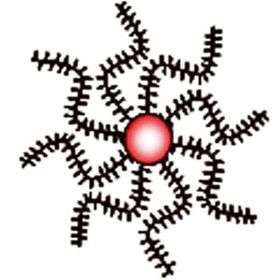
In their investigations, the scientists used a polymer that had been developed at the neighbouring Fraunhofer Institute for Applied Polymer Research in Potsdam. It is a chain of methylacrylate units on which branches of polyethylene glycol hang. These chains are similar in form to dishwashing brushes that attach themselves to the gold particles. The scientists can control the properties of the polymer brushes to suit their requirements.
"In water, the brush structures use hydrogen atoms to form bridges to the water molecules," says Dayang Wang, Head of the Group for Non-Planar Surfaces at the Max Planck Institute in Potsdam. "That makes the nanoparticles particularly water-soluble." The scientists then add a salt to the solution (it is almost completely irrelevant which salt this is) and at the same time increase the temperature, thereby weakening the hydrogen bridges. The polymer chains then turn their fat-soluble sections outwards so that the nanoparticles dissolve effectively in organic solvents such as toluene. If the particles are situated on a boundary between water and oil, they move spontaneously, that is without the need for any more energy, into the oil layer.
In further experiments, the researchers developed a technique which reverses the process. To accomplish this, they lowered the salt concentration in the water phase again and added citric acid to it. The citric acid creates new hydrogen bridges between the polymers and the water molecules, rendering the nanoparticles water soluble again. Salt, temperature and citric acid thereby act as switches controlling the movement between water and oil.
A boundary between water and oil, such as that used by the researchers, serves as a model for biological membranes. "If a water-soluble particle is injected into blood, it is first transported in the bloodstream," explains Wang. "However, if it has to go into the tissue, it needs to dissolve in fat, as the cell membranes consist of fat molecules." The blood-brain barrier is an example of a biological membrane of this kind. "Our next step is to examine cell systems which replicate the blood-brain barrier," says Wang. In future, the researchers will be able to structure the surface of inorganic nanoparticles so that they transport therapeutic substances across biological barriers of this nature.
According to Wang, the modification of catalysts is another application of the process. To create a catalytic reaction in aqueous medium, chemists can combine the agents in a solution with a layer of toluene floating on it. "It might be enough to increase the temperature to interrupt the reaction," he says. "The catalyst then moves into the toluene layer."
Citation: Edwards, E. W., Chanana, M., Wang, D.Y. and Möhwald, H., Stimuli-Responsive Transport of Nanoparticles Across Water-Oil Interfaces, Angewandte Chemie, Online publication, 15th November 2007
Source: Max Planck Institute of Colloids and Interfaces


