Columbus Poised for Research Breakthroughs
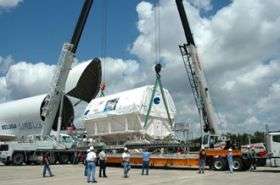
The research capacity of the International Space Station is set to double during a December NASA mission that is a milestone for European spaceflight.
The European Space Agency's Columbus laboratory packed inside space shuttle Atlantis' payload bay is the culmination of years of design and engineering work aimed at creating Europe's primary component for the space station.
At 23 feet long and 15 feet in diameter, the cylindrical segment is designed to host specialized experiments examining how humans react to microgravity and the effect of space on various fluids and objects such as crystals.
There are two stands bolted to the outside of the module that can be used for research on materials and for unfiltered views of space.
All this adds up to a high-flying laboratory that European scientists hope to use throughout the next decade.
"This is, for us, the opportunity to have long-term access (to space)," said Gregor Woop, product assurance manager for the European Space Agency. "It provides an opportunity for science institutes to send experiments on board and to run experiments."
Columbus will join NASA's Destiny lab which was taken into orbit in 2001. Next year, a series of space shuttle missions will carry the components of a Japanese laboratory into orbit. Together, the three research units are expected to provide a cutting-edge platform for space science.
The European Space Agency, a consortium made up of 17 member nations, also built a data center to manage the research aboard Columbus and collect its results. The Columbus Control Centre in Oberpfaffenhofen, Germany, will join a global network of other space station associated control centers including NASA sites in Houston and Huntsville, Ala., and the Russian mission control center near Moscow.
Although the Columbus module is considered the most sophisticated space station module the European Space Agency has built, it is not the first space research element ESA developed.
Space shuttles used Spacelabs as research centers in space between 1983 and 1998. Two of the reusable modules were built to fit in a shuttle's cargo bay. Unlike Columbus, which will stay in space permanently, the Spacelabs remained inside a shuttle throughout a mission, with the shuttle crew conducting research during the course of two-week flights.
Like Spacelab, Columbus was designed to support astronauts. Columbus is full of wiring and plumbing to keep life support systems running inside the module and host the science experiments it was built for.
"What we have is a mini space station," Woop said.
Engineering a segment to host men, women and experiments was a challenge for designers because the space was limited.
"It's a very organized laboratory," said Alessio Festa, ESA's mechanical system manager on Columbus.
The key is a design that calls for experiments and equipment to be carried inside racks that are about the size of refrigerators. The racks can be changed by astronauts in space because they don't weigh anything. On Earth, the racks can be loaded with special equipment and set up for the astronauts to operate or to run automatically.
Columbus can hold 10 experiment racks inside, but will launch with five in place. Other racks will be ferried aboard future missions.
After its construction in Italy and outfitting in Germany, Columbus flew aboard a large cargo aircraft across the Atlantic Ocean to NASA's Kennedy Space Center in Florida for final preparations and a leak test.
Source: by Steven Siceloff, NASA's John F. Kennedy Space Center


