Illuminating Study Reveals How Plants Respond to Light
November 23rd, 2007 Illuminating Study Reveals How Plants Respond to Light

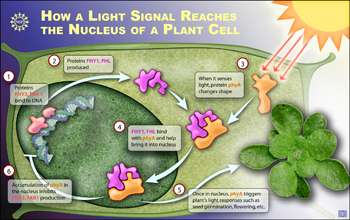
Two proteins known as FHY3 and FAR1 bind to DNA in a plant cell and cause production of two other proteins known as FHY1 and FHL. When hit with far red light, a light-sensitive protein called phytochrome A (phyA) changes its shape. This shape change allows it to bind to FHY1 and FHL. FHY1 and FHL then carry the activated phyA into the cell nucleus. From there, phyA is able to initiate the plant's developmental responses to light such as growth, flowering and straining towards the light. Credit: Zina Deretsky, National Science Foundation

Most of us take it for granted that plants respond to light by growing, flowering and straining towards the light, and we never wonder just how plants manage to do so. But the ordinary, everyday responses of plants to light are deceptively complex, and much about them has long stumped scientists.

Now, a new study "has significantly advanced our understanding of how plant responses to light are regulated, and perhaps even how such responses evolved," says Michael Mishkind, a program director at the National Science Foundation (NSF). This study, which was funded by NSF, will be published in the November 23, 2007 issue of Science.

By conducting experiments with Arabidopsis--a small flowering plant widely used as a model organism--the researchers discovered that the plant prepares to respond to light while it is still in the dark, even before it is exposed to light. This preparation involves producing a pair of closely related proteins (known as FHY3 and FAR1) that increase production of another pair of closely related proteins (known as FHY1 and FHL) that had been identified in previous studies as critical participants in the plant's light response.

Haiyang Wang, a member of the research team from Boyce Thompson Institute for Plant Research, says that the plant probably stockpiles these proteins needed for light responses in the dark for the same reason that a traveler fills his car's gas tank the night before a morning journey: in order to be able to get going, without delay, at first light.

With a plant so primed in the dark, it detects and responds to light via the following steps:

-- Light-sensing pigment proteins known as phytochrome A located in the cytoplasm of plants cells detect the light in the far-red end of the spectrum.

-- The phytochrome A is activated through a change in shape that allows it to bind to FHY1 and FHL.

-- The binding of FHY1 and FHL to phytochrome A results in the accumulation of phytochrome A in the cell nucleus, possibly by helping to import phytochrome A into the nucleus.

-- The activated phytochrome A changes the activity of genes located in the cell nucleus that govern plant growth and development.

-- Resulting changes in gene expression produce the plant's developmental responses to light, such as growth, flowering and straining towards the light.

Although these steps had been identified in previous studies, the discovery of how FHY3 and FAR1 regulate plant responses to light adds an important new dimension to our understanding of them.

Moreover, the researchers also discovered the existence of a negative feedback loop between accumulations of phytochrome A in the cell nucleus and the FHY3 and FAR1 proteins that prime the plant's light response system: the more phytochrome A accumulates in the nucleus, the less FHY3 and FAR1 proteins are produced, and so less phytochrome A is imported into the nucleus. "This feedback loop serves as a built-in brake that limits the flow of light responses," says Wang.

"I can't explain why nature created such a complex process to trigger a plant's light responses," says Wang with a sigh. Among the process's complexities is a resemblance between FHY3 and FAR1 proteins and certain enzymes produced by some mobile DNA elements or so-called "jumping genes." (Jumping genes are so named because they can move between various positions in a cell's genetic code.) "This resemblance initially puzzled the research team when we were trying to identify the molecular function of the proteins," says Wang.

Nevertheless, the resemblance between the FHY3 and FAR1 proteins and jumping gene enzymes may represent a biological blessing in disguise. Why? Because the researchers now believe that they have built a convincing case that FHY3 and FAR1 may have evolved from the jumping gene material. If indeed the proteins did so, this important chapter in evolution may have helped make possible the establishment of flowering plants on earth, says Wang.

Source: NSF


print this article email this article download pdf blog this article bookmark this article     Digg this Stumble it share on Facebook share on Reddit add to delicious save to Yahoo! bookmarks
4.6/5 after 50 votes

Rank Filter

Move the slider to adjust rank threshold, so that you can hide some of the comments.


Display comments: newest first

  • HenisDov - Nov 25, 2007
    • Rank: 4 / 5 (1)
    My elsewhere comment re Origin of Circadian Rhythm applies neatly here, too. The mechanism involved in the absorption of energy by the archae genes is the life-source, the energy contents of the package, the living gene.

    It all boils down to comprehending that genes-genomes are living organisms:

    Origin Of Circadian Rhythm:

    Innate Gene-Genome Characteristic...

    Re Genes-Genome "Oscillating" see

    http://www.physor...572.html

    But circadian rhythm may be innate gene-genome characteristic, inborn/brought-about at the energetic conditions during the genesis of genes in the process of phasing from chemical olygomer to replicating life, genes, base life energy packages .....

    See

    http://blog.360.y...Q--?cq=1&p=372

    Chapter I, G. Life's Drive and Purpose

    "1. If one accepts, intuitively and logically, Pasteur's observation that all life must come from previously existing life, then the answer to "what makes a mono- and poly-cell life-form a Life" is the answer to "what makes some molecular associations in cells LIVES", and vice versa. It is the "lifehood" of genes that makes us and all other forms of life on Earth living organisms, and evolution has been the route of Life's ever more complexing progress since the first replication of the first gene."

    Respectfully,

    Dov Henis
  • arlene - Nov 25, 2007
    • Rank: not rated yet
    that's an interesting read, I guess Ill share this information with my Poulsbo florist.

November 23rd, 2007 all stories
Biology /

Comments: 2
Rank: 4.6/5 after 50 votes

  • Stumble this up

  • Digg this

  • Share it:
  • share on Facebook
  • share on MySpace
  • share on Slashdot
  • rss-newsfeed
  • share on Google
  • share on Reddit
  • add to delicious
  • save to Yahoo! bookmarks
  • share on Windows Live
  • Add to Mixx!
Rating: 4.6/5 after 50 votes

  • Related Stories

  • Expression of infrared fluorescence engineered in mammals
    created May 07, 2009 | popularity not rated yet | comments 0
  • New Breakthrough in Global Warming Plant Production
    created Mar 30, 2009 | popularity not rated yet | comments 0
  • Harnessing Nanoparticles To Track Cancer Cell Changes
    created Jul 03, 2009 | popularity not rated yet | comments 0
  • Salamanders, regenerative wonders, heal like mammals, people
    created Jul 01, 2009 | popularity not rated yet | comments 0
  • Some Eczema Sufferers More Prone to Smallpox and Other Viruses
    created Jun 30, 2009 | popularity not rated yet | comments 0

Tags


  • Physicists Demonstrate Quantum Memory with Matter Qubits
    Physicists Demonstrate Quantum Memory with Matter Qubits
    Physics / General Physics
    created Jul 03, 2009 | popularity 4.4 / 5 (17) | comments 1
  • 'Holey' Nanosheets for Wastewater Dye Removal
    Nanotechnology / Nanomaterials
    created Jul 01, 2009 | popularity 5 / 5 (5) | comments 1
  • Jellyfish Robot Swims Like its Biological Counterpart
    Jellyfish Robot Swims Like its Biological Counterpart
    Electronics / Robotics
    created Jun 26, 2009 | popularity 4.4 / 5 (8) | comments 1
  • Could Maxwell's Demon Exist in Nanoscale Systems?
    Could Maxwell's Demon Exist in Nanoscale Systems?
    Physics / General Physics
    created Jun 24, 2009 | popularity 4.4 / 5 (18) | comments 29
  • Living Safely with Robots, Beyond Asimov's Laws
    Living Safely with Robots, Beyond Asimov's Laws
    Electronics / Robotics
    created Jun 22, 2009 | popularity 4.6 / 5 (52) | comments 40
  • Other News

    California water plan aims to save Puget Sound orcas

    Biology / Ecology

    created 1hour ago | popularity not rated yet | comments 0

    A plan to restore salmon runs on California's Sacramento River also could help revive killer whale populations 700 miles to the north in Puget Sound, as federal scientists struggle to protect endangered species in a complex ...


    Scientists 'rebuild' giant moa using ancient DNA

    Biology / Plants & Animals

    created Jul 01, 2009 | popularity 5 / 5 (10) | comments 12

    (PhysOrg.com) -- Scientists have performed the first DNA-based reconstruction of the giant extinct moa bird, using prehistoric feathers recovered from caves and rock shelters in New Zealand.


    Pacific Giant Salamander (Dicamptodon tenebrosus)

    Salamanders, regenerative wonders, heal like mammals, people

    Biology / Microbiology

    created Jul 01, 2009 | popularity 4.9 / 5 (19) | comments 10

    The salamander is a superhero of regeneration, able to replace lost limbs, damaged lungs, sliced spinal cord -- even bits of lopped-off brain. But it turns out that remarkable ability isn't so mysterious after ...


    Genetically modified trees

    Anti-biotech groups obstruct forest biotechnology

    Biology / Biotechnology

    created Jun 30, 2009 | popularity 3.7 / 5 (7) | comments 5

    The potential of forest biotechnology to help address significant social and environmental issues is being "strangled at birth" by the rigid opposition of some groups and regulations that effectively preclude ...


    Super-sleepers could help super-sizers!

    Super-sleepers could help super-sizers!

    Biology / Plants & Animals

    created Jun 29, 2009 | popularity 5 / 5 (2) | comments 4

    Burrowing frogs can survive buried for several years without food or water. Scientists have discovered that the metabolism of their cells changes radically during the dormancy period allowing the frogs to ...