Quantum physics 'rules' -- Australian scientists create world's most accurate 'ruler'
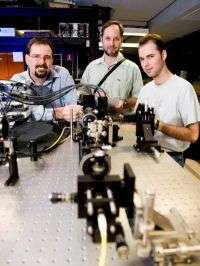
NEVER try telling a quantum physicist that near enough is good enough – Australian researchers have invented a technique that, for the first time, measures lengths as accurately as the laws of physics allow.
In a paper published in leading international science journal Nature the research team revealed a system that uses individual photons – single particles of light – as a ruler for microscopic distances. The experiment was performed in the laboratory of Dr Geoff Pryde at Griffith University's Centre for Quantum Dynamics, by him and his PhD student Brendon Higgins. Centre Director, Professor Howard Wiseman, developed the theory, together with University of Sydney's Dr Stephen Bartlett and Macquarie University's Dr Dominic Berry.
Pryde’s apparatus used single photons, with each photon making a number of passes through the sample being measured.
Using just 36 photons making a total of 378 passes, the team was able to measure length differences less than one ten thousandth of the width of a human hair.
“This is an incredibly small amount of light.” said Pryde. “For comparison, scanning a barcode uses quadrillions of photons. Even the dim standby light on your DVD player shines out many trillions of photons a second.”
"Similar schemes based on interferometry – a technique using waves of electromagnetic radiation such as light – have been used for centuries to measure length, and other properties of objects, with great accuracy." said Wiseman.
"The key difference is we have done it in a way that gets as much information out of each pass of a photon through the sample as is allowed by Heisenberg's uncertainty principle. In this sense, it’s the best measurement possible – something that’s never been done before."
"The obvious applications are in making accurate measurements using less light than was previously thought possible. This is particularly important in fields such as medical research, as passing light through a biological sample can damage it," said Pryde.
So why do we need to measure with such accuracy?
"Measurement underpins all science, and through history we've seen that advances in precision measurement lead to unexpected scientific discoveries, which in turn lead to new technologies and applications," Pryde said.
"Old-style interferometers taught us that the Earth wasn’t moving through a mysterious substance called 'aether', but actually through a vacuum. This ultimately led to Einstein’s theory of relativity. We don’t know yet where this new technique will lead us.”
The team's next goal is to use more single photons and passes to get an even finer measurement.
"In principle this is possible, but there are some technological hurdles to overcome first!” said Pryde.
In the strange world of quantum physics, a photon can simultaneously take two different paths to the same destination. Where the photon goes next depends on the difference between the lengths of the two paths. If the length of one path is known, this allows scientists to measure the length of the other path with great accuracy. The novel feature of the Griffith experiment is to make the photon retrace the paths many times before detecting it. This amplifies the effect of the difference in path lengths. The same idea can also be applied to measuring other quantities like speed, frequency, and time.
The technique combined concepts from research in quantum computers (through Australia’s Centre for Quantum Computer Technology), in quantum control, and in quantum communication. “This is a great example of ideas coming together from different directions to make something new and exciting,” said Bartlett.
Source: Research Australia


