Scientists melt million-year-old ice in search of ancient microbes
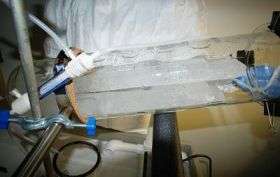
Researchers from the University of Delaware and the University of California at Riverside have thawed ice estimated to be at least a million years old from above Lake Vostok, an ancient lake that lies hidden more than two miles beneath the frozen surface of Antarctica.
The scientists will now examine the eons-old water for microorganisms, and then through novel genomic techniques, try to figure out how these tiny, living “time capsules” survived the ages in total darkness, in freezing cold and without food and energy from the sun.
The research, which is sponsored by the National Science Foundation and is part of the International Polar Year, is designed to provide insight into how organisms adapted to live in extreme environments.
“It's some of the coolest stuff I have ever worked on,” said Craig Cary, professor of marine biosciences at UD. “We are going to gain access to the genetics of organisms isolated for possibly as long as 15 million years.”
The collaborative research team includes Cary and doctoral student Julie Smith from UD's College of Marine and Earth Studies; project leader Brian Lanoil, assistant professor of environmental sciences at the University of California at Riverside, and doctoral student James Gosses; and Philip Hugenholtz and postdoctoral fellows Victor Kunin and Brian Rabkin at the U.S. Department of Energy's Joint Genome Institute.
Last week in Lanoil's laboratory in California, segments of a tube-like ice core were thawed under meticulous, “clean lab” conditions to prevent accidental contamination, a process that required nearly a year of preparation.
“It was very exciting to see the Vostok ice, knowing how old it is and how much it took to get that ice to the lab,” Smith said. “The ice core itself was incredibly clear and glasslike, reflecting the light like a prism.”
The segments of ice were cut from an 11,866-foot ice core drilled in 1998 through a joint effort involving Russia, France and the United States. The core was taken from approximately two miles below the surface of Antarctica and 656 feet (200 meters) above the surface of Lake Vostok and has since been stored at -35 degrees C at the National Ice Core Laboratory in Denver.
“This ice was once water in the lake that refroze onto the bottom of the ice sheet,” Cary explained. “We have no direct samples of the lake itself, only this indirect sampling of the refrozen ice above it because drilling into the lake without taking extensive precautions could lead to the lake's contamination. The borehole made to collect the ice is filled with a mixture of jet fuel, kerosene, and CFCs to keep it from closing,” Cary noted. “Since the lake has not had direct contact with the surface world for at least 15 million years, this would be a contamination of one of the most pristine environments on Earth,” he said.
Cary said the decontamination procedure was “the most complicated and complete ever attempted,” requiring the use of an isolation chamber for the actual melting, concentration of the meltwater through a special filtering system, use of bleaching solutions for the destruction of any contaminating bacteria or DNA from the outside of the core, and the wearing of sterile jump suits for all of the laboratory personnel, among other measures.
Although other scientific projects have identified the microorganisms living in the Vostok water, they have not revealed what these little one-celled organisms do or how they have become adapted to an environment that is eternally dark, cold and so isolated that food and energy sources are likely rare and hard to come by.
“This research is important because it will give us insight into how microbes can survive in a very energy-limited system,” Smith said. She intends to pursue a career in academia after she completes her doctorate at UD's College of Marine and Earth Studies.
“Most of our planet is permanently cold and dark, so it makes sense that we should study how life exists under these conditions. In addition, enzymes produced by these microorganisms may be useful in industrial applications down the road,” Smith noted.
The Vostok water contains only between 10-100 microbes per milliliter compared to approximately 1 million microbes per milliliter for most lakes, Cary said.
Novel “whole genome amplification” techniques will be applied, which provide insight into the genetic diversity of a community of organisms when only small numbers of organisms are available.
A veteran of research expeditions around the globe, Cary is an expert on “extremophiles”--organisms that thrive in the harshest environments on the planet, ranging from the dry, frigid desert of Antarctica, to geyser-like hydrothermal vents spewing toxic chemicals from the ocean floor.
In the case of Lake Vostok, scientists speculate that it stays in a liquid state underneath miles of ice due to one of the Earth's natural “furnaces”--hydrothermal vents. Superheated water erupts from these cracks in the seafloor which form where the plates that form the Earth's crust pull apart.
“We hope that by being so isolated for millions of years, these microorganisms from Vostok will be able to tell us about their life and conditions through the ages,” Cary said.
Source: University of Delaware


