Environmental monitoring goes high-tech in Switzerland
How can we prepare for the natural hazards that will result from environmental change" How can we predict the effect of climate change on the Alps and other regions of Switzerland" How can we assess whether the use of natural resources is sustainable? By bringing the way we measure and model the environment firmly into the 21st century.
Today marks the official kickoff of the Swiss Experiment, an ambitious, next-generation approach to environmental monitoring. With this project, Switzerland takes a leading position worldwide in connecting important advances in data collection, management and communications technology to on-the-ground environmental research and monitoring efforts.
In the Alps, the evidence of global warming is clear: glaciers are retreating and winter snow cover is disappearing from lower altitudes. But quantifying and predicting these changes is difficult because the mountain environment is so variable. The Swiss Experiment, an interdisciplinary consortium bringing together the expertise of researchers in a wide array of domains, will tackle this challenge with an innovative approach at several levels.
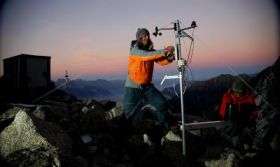
“One problem,” says EPFL professor Marc Parlange, “is that the scales of interest range from kilometers down to centimeters, and we just don’t have enough data to build accurate models.” The solution: tap into the deep well of technology that has already been developed for use in wireless networking, data management and communications technology. Thanks to recent rapid progress in these areas, hundreds of measurements can be gathered where even obtaining a single data point has proven challenging in the past. In a pilot study this fall, two wireless, autonomous sensor networks were successfully deployed in the Swiss Alps.
The Swiss Experiment also breaks new ground in its approach to data management and analysis. “Today’s science is data-driven. However for scientists it becomes increasingly difficult to handle the multitude of data sources and data analysis tools in order to share and consolidate their findings,” says Karl Aberer, Director of the National Competence Center in Mobile Information and Communications Systems. The Swiss Experiment addresses this problem by creating a shared IT infrastructure – a common storage, management and analysis platform, dedicated to environmental data -- that will be made available to research groups across Switzerland.
The winner in all this is the public, because a variety of environmental projects at various sites across Switzerland will be able to use this data infrastructure to improve models that predict natural hazards such as floods, avalanches, and landslides, as well as to document environmental degradation and change. For example, in another pilot project, snowfall detected by existing weather stations around Switzerland automatically triggers models that calculate snow cover, generating a real-time analysis of snowpack stability. “Being able to handle the data this way is a real advance for us,” says WSL/SLF researcher Michael Lehning. “It will improve our forecast ability, and thus ultimately the safety of people in Alpine regions.”
Research and results must take into account the socio-political context of environmental problems and issues. The Swiss Experiment will address this important consideration with a variety of activities to inform and involve the local populations near experiment sites, including educational programs, and by collaborating closely with Cantonal authorities. In addition, participants will work closely and integrate with established monitoring programs and national services to develop the monitoring strategies of the future; in particular, in cooperation with MeteoSuisse, the Federal Office for the Environment, the Swiss Federal Institute for Forest, Snow and Landscape Research (WSL/SLF) and the Swiss Seismological Service.
“This is an extraordinary cross-institutional and cross-disciplinary project,” says Domenico Giardini, Director of the Competence Center Environment and Sustainability (CCES) of the ETH domain, where the project was initiated. “With this collaborative approach and the IT expertise involved, we can all take our research to a new level.”
Participating institutions include the two Federal Institutes of Technology EPFL and ETHZ, the CCES, the National Center of Competence in Research Mobile Information and Communication Systems (NCCR-MICS), the Swiss Federal Institute of Aquatic Science and Technology (EAWAG), the WSL/SLF, the Swiss National Science Foundation (SNF) and the Microsoft Corporation.
"Microsoft Research is supporting the Swiss Experiment project to help find a solution for the problem of global warming through the application of emerging sensor network technologies and the creation of a platform where valuable sensor information can be shared," said Tony Hey, corporate vice president for External Research, Microsoft Research. "Our goal is to provide tools to help researchers address some of the toughest environmental issues facing the world today."
Source: Ecole Polytechnique Fédérale de Lausanne


