New T-ray source could improve airport security, cancer detection
Going through airport security can be such a hassle. Shoes, laptops, toothpastes, watches and belts all get taken off, taken out, scanned, examined, handled and repacked. But "T-rays", a completely safe form of electromagnetic radiation, may reshape not only airport screening procedures but also medical imaging practices.
Scientists at the U.S. Department of Energy's Argonne National Laboratory, along with collaborators in Turkey and Japan, have created a compact device that could lead to portable, battery-operated sources of T-rays, or terahertz radiation. By doing so, the researchers, led by Ulrich Welp of Argonne's Materials Science Division, have successfully bridged the "terahertz gap" – scientists' name for the range of frequencies between microwaves (on the lower side) and infrared (on the higher side) of the electromagnetic spectrum.
While scientists and engineers have produced microwave radiation using conventional electric circuits for more than 50 years, Welp said, terahertz radiation could not be generated that way because of the physical limitations of the semiconducting circuit components.
"Right around 1 terahertz, you have a range of frequencies where there have never been any good solid-state sources," he added. "You can make those frequencies if you are willing to put together a whole table full of expensive equipment, but now we've been able to make a simple, compact solid-state source."
Unlike far more energetic X-rays, T-rays do not have sufficient energy to "ionize" an atom by knocking loose one of its electrons. This ionization causes the cellular damage that can lead to radiation sickness or cancer. Since T-rays are non-ionizing radiation, like radio waves or visible light, people exposed to terahertz radiation will suffer no ill effects. Furthermore, although terahertz radiation does not penetrate through metals and water, it does penetrate through many common materials, such as leather, fabric, cardboard and paper.
These qualities make terahertz devices one of the most promising new technologies for airport and national security. Unlike today's metal or X-ray detectors, which can identify only a few obviously dangerous materials, checkpoints that look instead at T-ray absorption patterns could not only detect but also identify a much wider variety of hazardous or illegal substances.
T-rays can also penetrate the human body by almost half a centimeter, and they have already begun to enable doctors to better detect and treat certain types of cancers, especially those of the skin and breast, Welp said. Dentists could also use T-rays to image their patients' teeth.
The new T-ray sources created at Argonne use high-temperature superconducting crystals grown at the University of Tsukuba in Japan. These crystals comprise stacks of so-called Josephson junctions that exhibit a unique electrical property: when an external voltage is applied, an alternating current will flow back and forth across the junctions at a frequency proportional to the strength of the voltage; this phenomenon is known as the Josephson effect.
These alternating currents then produce electromagnetic fields whose frequency is tuned by the applied voltage. Even a small voltage – around two millivolts per junction – can induce frequencies in the terahertz range, according to Welp.
Since each of these junctions is tiny – a human hair is roughly 10,000 times as thick – the researchers were able to stack approximately 1,000 of them on top of each other in order to generate a more powerful signal. However, even though each junction would oscillate with the same frequency, the researchers needed to find a way to make them all radiate in phase.
"That's been the challenge all along," Welp said. "If one junction oscillates up while another junction oscillates down, they'll cancel each other out and you won't get anything."
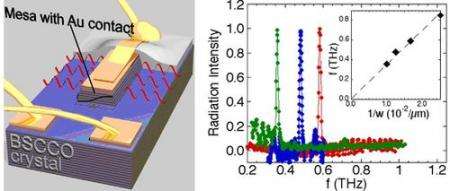
In order to synchronize the signal, Argonne physicist Alexei Koshelev suggested that the stacks of Josephson junctions should be shaped into resonant cavities, which visiting scientist Lufti Ozyuzer of the Izmir Institute of Technology, Turkey, and graduate student Cihan Kurter then fashioned. When the width of the cavities was precisely tuned to the frequencies set by the voltage, the natural resonances of the structure synchronized the oscillations and thus amplified the T-ray output, in a method similar to the production of light in a laser.
"Once you apply the voltage," Welp said, "some junctions will start to oscillate. If those have the proper frequency, an oscillating electric field will grow in the cavity, which will pull in more and more and more of the other junctions, until in the end we have the entire stack synchronized."
By keeping the length and thickness of the cavities constant while varying their width between 40 and 100 micrometers, the researchers were able to generate frequencies from 0.4 to 0.85 terahertz at a signal power of up to 0.5 microwatts. Welp hopes to expand the range of available frequencies and to increase the strength of the signal by making the Josephson cavities longer or by linking them in arrays.
"The more power you have, the easier it is to adopt this technology for all sorts of applications," he said. "Our data indicate that the power stored in the resonant cavities is significantly larger than the detected values, though we need to improve the extraction efficiency. If we can get the signal strength up to 1 milliwatt, it will be a great success."
Source: Argonne National Laboratory


