Secondhand smoke damages lungs, MRIs show
November 26, 2007
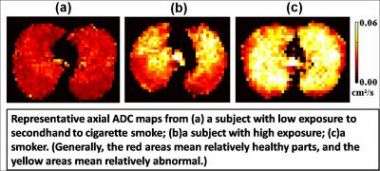
The apparent diffusion coefficient (ADC) measures lung injury, indicated by different colors. Credit: The Children's Hospital of Philadelphia and the University of Virginia
It’s not a smoking gun, but it’s smoking-related, and it’s there in bright medical images: evidence of microscopic structural damage deep in the lungs, caused by secondhand cigarette smoke. For the first time, researchers have identified lung injury to nonsmokers that was long suspected, but not previously detectable with medical imaging tools.
The researchers suggest that their findings may strengthen public health efforts to restrict secondhand smoke.
“We used a special type of magnetic resonance imaging to find these structural changes in the lungs,” said study leader Chengbo Wang, Ph.D., a magnetic resonance physicist in the Department of Radiology at The Children’s Hospital of Philadelphia. “Almost one-third of nonsmokers who had been exposed to secondhand cigarette smoke for a long time developed these structural changes.” Formerly at the University of Virginia, Wang collaborated with radiology researchers at that institution, where they acquired the MRIs from adult smokers and nonsmokers.
Wang presented the team’s findings in Chicago at the annual meeting of the Radiological Society of North America. Although the participants in the research study were adults, Wang said the results have implications for the 35 percent of American children who live in homes where regular smoking occurs.
The researchers studied 60 adults between ages 41 and 79, 45 of whom had never smoked. The 45 non-smokers were divided into groups with low and high exposure to secondhand smoke; the high-exposure subjects had lived with a smoker for at least 10 years, often during childhood. The 15 current or former smokers formed a positive control group.
The research team prepared an isotope of helium called helium-3 by polarizing it to make it more visible in the MRI. Researchers diluted the helium in nitrogen and had research subjects inhale the mixture. Unlike ordinary MRIs, this MRI machine measured diffusion, the movement of helium atoms, over 1.5 seconds. The helium atoms moved a greater distance than in the lungs of normal subjects, indicating the presence of holes and expanded spaces within the alveoli, tiny sacs within the lungs.
The researchers found that almost one-third of the non-smokers with high exposure to secondhand smoke had structural changes in their lungs similar to those found in the smokers. “We interpreted those changes as early signs of lung damage, representing very mild forms of emphysema,” said Wang. Emphysema, a lung disease that is a major cause of death in the U.S., is commonly found in heavy smokers.
The researchers also found a seemingly paradoxical result among two-thirds of the high-exposure group of non-smokers—diffusion measurements that were lower than those found in the low-exposure group. Although these findings require more study, said Wang, they may reflect a narrowing in airways caused by early stages of another lung disease, chronic bronchitis.
“To our knowledge, this is the first imaging study to find lung damage in non-smokers heavily exposed to secondhand smoke,” said Wang. “We hope our work strengthens the efforts of legislators and policymakers to limit public exposure to secondhand smoke.”
Source: Children's Hospital of Philadelphia
-
Engineers build first sub-10-nm carbon nanotube transistor
Feb 01, 2012 |
4.9 / 5 (31) |
30
-
Something old, something new: Evolution and the structural divergence of duplicate genes
Jan 31, 2012 |
4.6 / 5 (7) |
1
-
The hidden nanoworld of ice crystals: Revealing the dynamic behavior of quasi-liquid layers
Jan 30, 2012 |
5 / 5 (3) |
1
-
Stock market network reveals investor clustering
Jan 27, 2012 |
3.9 / 5 (23) |
8
-
Of microchemistry and molecules: Electronic microfluidic device synthesizes biocompatible probes
Jan 26, 2012 |
5 / 5 (1) |
0
-
We the immaterial soul
5 hours ago
-
Is Everyday Technology Killing Us?
Feb 08, 2012
-
Exercise and weight loss
Feb 08, 2012
-
Why do we have head aches? Our brains can't feel anything.
Feb 07, 2012
-
"The end of diseases" by David Agus, interview from Daily Show with Jon Stewart
Feb 04, 2012
-
Oncolytic adenovirus
Feb 04, 2012
- More from Physics Forums - Medical Sciences
More news stories
Study finds that anti-diabetic medication can prevent the long-term effects of maternal obesity
In a study to be presented today at the Society for Maternal-Fetal Medicine's annual meeting, The Pregnancy Meeting, in Dallas, Texas, researchers will report findings that show that short therapy with the anti-diabetic medication ...
23 hours ago |
5 / 5 (1) |
1
FDA-approved drug rapidly clears amyloid from the brain, reverses Alzheimer's symptoms in mice
Neuroscientists at Case Western Reserve University School of Medicine have made a dramatic breakthrough in their efforts to find a cure for Alzheimer's disease. The researchers' findings, published in the journal Science, show t ...
Medicine & Health / Neuroscience
Feb 09, 2012 |
4.9 / 5 (53) |
21
|
Green tea found to reduce disability in the elderly
(Medical Xpress) -- A lot of research has been done over the past several years looking into the health benefits of green tea. As a result, scientists have found that regular consumption of the beverage leads ...
Teen school drop-outs three times as likely to be on benefits in later life
Teen school drop-outs are almost three times as likely to be on benefits in later life as their peers who complete their schooling, indicates research published online in the Journal of Epidemiology and Community Health.
Feb 06, 2012 |
not rated yet |
11
Amateur football players not always keen on returning to play after ACL injuries
Despite the known success rates of reconstructive Anterior Cruciate Ligament (ACL) surgery, the number of high school and collegiate football players returning to play may not be as high as anticipated, say researchers presenting ...
23 hours ago |
not rated yet |
0
Google might launch Drive for cloud storage soon
(PhysOrg.com) -- Google's next big move, according to the Wall Street Journal, is a cloud storage service called Drive. Hardly first to the plate, Google is simply catching up to introducing its cloud reposi ...
Latin America mining boom clashes with conservation
Latin America is experiencing a mining boom as prices rise fuelled by a hike in global demand, but the region is also being hit by a wave of violent protests, strikes and rallies by environmentalists.
Walney offshore wind farm is world's biggest (for now)
(PhysOrg.com) -- The Walney wind farm on the Irish Sea--characterized by high tides, waves and windy weather--officially opened this week. The farm is treated in the press as a very big deal as the Walney ...
Love a click away in Indonesia's Twitter Republic
He was a geeky kid from Yogyakarta, she a glamorous city girl in Jakarta. In a country with one of the world's most vibrant social networking scenes they fell in love on Twitter.
GPS court ruling leaves US phone tracking unclear
A US Supreme Court decision requiring a warrant to place a GPS device on the car of a criminal suspect leaves unresolved the bigger issue of police tracking using mobile phones, legal experts say.
Europeans protest controversial Internet pact
Tens of thousands of people marched in protests in more than a dozen European cities Saturday against a controversial anti-online piracy pact that critics say could curtail Internet freedom.
Nov 26, 2007
Rank: not rated yet
I don't think scientists should focus on awareness anymore - seems silly - we know smoking and other unhealthful activities (excessive alcohol, drugs, unprotected promiscuity, unhealthy diet, etc) are all bad...
Better to spend money on treatments and prevention than awareness...
I know, I know, everyone going to blast me and say not every city has the smoking ban yet... this maybe is true and they should, but I personally wish someone would crusade against people who go out in public with damn flu/cold/other infectious diseases, because those bastards make me more upset than the smokers.