Wearing technology on your sleeve
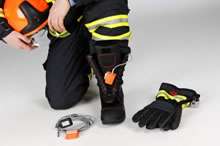
You think the switch from typewriter to computer was a revolution? The next stage could see many of us interacting with computers inserted into our very clothes. A new project is exploring a range of applications where wearable technology could significantly improve productivity and even help save lives.
Assimilate, assimilate!” You trekkies out there will recognise the Borg mantra for the bloodcurdling ‘assimilation’ of humans by machines. On the other side of the sci-fi divide, many may recall Star Wars’ recently revived Darth Vader, the half-man, half-machine dark lord of intergalactic evil.
From science fiction to science fact, the pairing of man and machine has always been at the forefront of our fears of what the technological future might have in store. But it has also been the basis of many of our conceptions for dealing with the challenges of the future: efficient multi-medial communications, improved ecologically friendly transport and revolutionary medical applications. After all, for every space villain there is a light sabre ready to be used to chop his head off.
Today’s instances of the association between man and technology are perhaps not as impressive to the jaded cinemagoer, but just as ambitious for the impact they could have on our daily lives. The focus, though, is perhaps not so much on assimilation as it is on integration and usability European researchers have been carrying out wide-ranging testing of new wearable technology with applications in a variety of fields and with the potential of protecting and even saving lives. The vital innovation is that the technology facilitates a new form of human-computer interaction comprising small, easily accessible body-worn computers that are always on and always responsive.
If you have a desktop application, then there is always a screen, a keyboard and a computer unit, but if you have a wearable computing solution, then it can be completely different,” says Michael Lawo, technical manager of the wearIT(at)work project. “You can have speech control in one instance, gesture control in another, though the application should always be the same,” he says. The Open Wearable Computing Framework being developed essentially comprises a central, easily wearable and hardware-independent computing unit which gives access to an ICT environment. Some of the basic components include wireless communication, positioning systems, speech recognition, interface devices, and low-level software platforms or toolboxes allowing these features to work together.
New paradigm
The pattern of this EU-funded project is woven as much out of applications as it is technology. It uses a number of commercial, off-the-shelf components and brings them together to create a new tool with the potential to revolutionise the way we work.
“Wearable computing is a completely new working paradigm,” says Lawo. “It is a technology which can support you in a particular environment. Instead of working at the computer, you are directly supported by the technology, a bit like when you are driving a car and you get information from the navigation system supporting you in your primary tasks.”
WearIT(at)work, the largest civilian wearable computing effort worldwide, is currently being tested in four different fields. These include aircraft maintenance, emergency response, car production and healthcare. Pilot projects in the areas of bush-fire prevention, e-inclusion and cultural heritage have also recently been launched.
In most cases, the technology is being applied to people who are not accustomed to using computers at the workplace, such as blue-collar workers. “The basic idea was to make the technology available to the workers and directly improve productivity,” says Lawo.
“We address fields where there are no similar applications today. Take the example of an aircraft technician. There is a person doing paperwork who has to find the relevant documentation on a computer. He has to find the aircraft maintenance manual and the parts manual, and produce a printout. These documents are handed over to the technician who then goes to the aircraft to do his work. He then has to write a report on a sheet of paper. And that is the way things work today. What we are doing is giving the worker support and direct access to the ICT system from the workplace. We get rid of the paper.”
Working with fire
With a considerable number of applications potentially possible, perhaps the most challenging test case for the project is the one involving emergency response teams, in collaboration with the Paris Fire Brigade. The technology helps support the communication, collaboration and information processes of rescue forces.
The efficiency and safety of firemen can be considerably improved by a number of light, easy-to-use and resistant devices, such as biosensors monitoring their physiological condition and improved localisation of hazards, personnel and retreat paths.
The technology has largely been well received by workers. “They recognise that this is a new technology where you can monitor working activities, but they do not hesitate to use it, and they see the advantage of it,” says Lawo.
Difficulties might nonetheless emerge in the future. “As soon as you come to the actual introduction of the technology and start negotiating with the unions, privacy will undoubtedly be an issue,” says Lawo.
WearIT(at)work already has some 42 partners, including IT giants Microsoft, Hewlett-Packard and Siemens, but Lawo says the project is always on the lookout for new ventures.
“Research will continue for components or for positioning systems. There is a lot of further research that can be carried out, but you can basically already do quite a lot with the application and with the technology that already exist,” he confirms.
Testing is due to continue until mid-2008 and will be followed by an initial 12-month period where the focus will shift to exploitation. “What we really want to do is introduce the system into everyday working methods,” says Lawo.
Source: ICT Results


