Gene study supports single main migration across Bering Strait
Did a relatively small number of people from Siberia who trekked across a Bering Strait land bridge some 12,000 years ago give rise to the native peoples of North and South America?
Or did the ancestors of today’s native peoples come from other parts of Asia or Polynesia, arriving multiple times at several places on the two continents, by sea as well as by land, in successive migrations that began as early as 30,000 years ago?
The questions – featured on magazine covers and TV specials – have agitated anthropologists, archaeologists and others for decades.
University of Michigan scientists, working with an international team of geneticists and anthropologists, have produced new genetic evidence that’s likely to hearten proponents of the land bridge theory. The study, published online in PLoS Genetics, is one of the most comprehensive analyses so far among efforts to use genetic data to shed light on the topic.
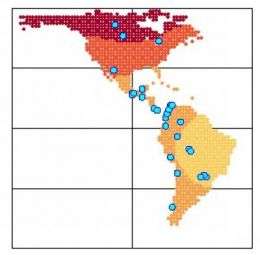
The researchers examined genetic variation at 678 key locations or markers in the DNA of present-day members of 29 Native American populations across North, Central and South America. They also analyzed data from two Siberian groups. The analysis shows:
-- genetic diversity, as well as genetic similarity to the Siberian groups, decreases the farther a native population is from the Bering Strait – adding to existing archaeological and genetic evidence that the ancestors of native North and South Americans came by the northwest route.
-- a unique genetic variant is widespread in Native Americans across both American continents – suggesting that the first humans in the Americas came in a single migration or multiple waves from a single source, not in waves of migrations from different sources. The variant, which is not part of a gene and has no biological function, has not been found in genetic studies of people elsewhere in the world except eastern Siberia.
The researchers say the variant likely occurred shortly prior to migration to the Americas, or immediately afterwards.
“We have reasonably clear genetic evidence that the most likely candidate for the source of Native American populations is somewhere in east Asia,” says Noah A. Rosenberg, Ph.D., assistant professor of human genetics and assistant research professor of bioinformatics at the Center for Computational Medicine and Biology at the U-M Medical School and assistant research professor at the U-M Life Sciences Institute.
“If there were a large number of migrations, and most of the source groups didn’t have the variant, then we would not see the widespread presence of the mutation in the Americas,” he says.
Rosenberg has previously studied the same set of 678 genetic markers used in the new study in 50 populations around the world, to learn which populations are genetically similar and what migration patterns might explain the similarities. For North and South America, the current research breaks new ground by looking at a large number of native populations using a large number of markers.
The pattern the research uncovered – that as the founding populations moved south from the Bering Strait, genetic diversity declined – is what one would expect when migration is relatively recent, says Mattias Jakobsson, Ph.D., co-first author of the paper and a post-doctoral fellow in human genetics at the U-M Medical School and the U-M Center for Computational Medicine and Biology. There has not been time yet for mutations that typically occur over longer periods to diversify the gene pool.
In addition, the study’s findings hint at supporting evidence for scholars who believe early inhabitants followed the coasts to spread south into South America, rather than moving in waves across the interior.
“Assuming a migration route along the coast provides a slightly better fit with the pattern we see in genetic diversity,” Rosenberg says.
The study also found that:
-- Populations in the Andes and Central America showed genetic similarities.
-- Populations from western South America showed more genetic variation than populations from eastern South America.
-- Among closely related populations, the ones more similar linguistically were also more similar genetically.
Citation: PLoS Genet 3(11): e185. doi:10.1371/journal.pgen.0030185
Source: University of Michigan


