Researchers outline structure of largest nonvirus particle ever crystallized
November 27, 2007 Researchers outline structure of largest nonvirus particle ever crystallized

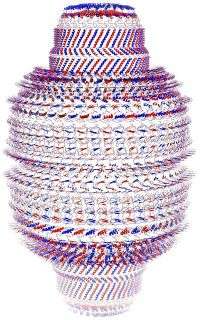
Model of the vault derived by UCLA researchers, with applications to drug delivery (figure published in Nov. 27, 2007, PLoS Biology). Credit: UCLA

Researchers at UCLA's California NanoSystems Institute, the David Geffen School of Medicine at UCLA and the Howard Hughes Medical Institute have modeled the structure of the largest cellular particle ever crystallized, suggesting ways to engineer the particles for drug delivery.

The research study, which focuses on new engineered nanomaterial vaults for use as a drug-therapy vehicle, appears in the Nov. 27 edition of the peer-reviewed, open-access journal PLoS Biology, published by the Public Library of Science.

The team of researchers at UCLA is led by David Eisenberg and Leonard H. Rome of the departments of biological chemistry at the Geffen School of Medicine and the California NanoSystems Institute and associate researchers Daniel H. Anderson, Valerie A. Kickhoefer and Stuart A. Sievers. Eisenberg, Anderson and Sievers are also members of the Howard Hughes Medical Institute and the UCLA–U.S. Department of Energy Institute for Genomics and Proteomics.

Vaults are large, barrel-shaped particles found in the cytoplasm of all mammalian cells; they may function in innate immunity. As naturally occurring nanoscale capsules, vaults may be useful to engineer as therapeutic delivery vehicles. For the study, the team of researchers proposed an atomic structure for the thin outer shell of the vault.

Using X-ray diffraction and computer modeling, the research team developed a draft atomic model for the major vault protein, which forms the shell-like enclosure of the vault.

"Our draft model is essentially an atomic-level vault with a completely unique structure, like a barrel with staves. It is unlike any other large structure found in nature," Rome said. "The outside of the vault structure is like an eggshell — a continuous protective barrier with no gaps."

The shell is made up of 96 identical protein chains — each made of 873 amino acid residues — folded into 14 domains. Each chain forms an elongated stave of half the vault, as well as the cap of the barrel-like shell.

"These nanostructured vaults offer a human-friendly nanocontainer, like a molecular-level C-5A transport jet, with a cargo hold large enough to encompass a whole ribosome with its hundreds of proteins and nucleic acids, or enough drugs to control a cell," Eisenberg said.

The construction of the draft atomic model lays the foundation for further studies of vaults and will guide vault engineering projects focused on the targeted release of vault contents for drug delivery.

Source: University of California - Los Angeles


print this article email this article download pdf blog this article bookmark this article     Stumble it Digg this share on Facebook retweet share on Reddit add to delicious
Rate this story - 4.4 /5 (16 votes)


November 27, 2007 all stories

Comments: 0

4.4 /5 (16 votes)
  • Stumble this up

  • Digg this

  • share this

  • hide
  • Related Stories

  • Plasmonic whispering gallery microcavity paves the way to future nanolasers
    created Jan 24, 2009 | popularity not rated yet | comments 0
  • Scientists cool gas by laser bombardment
    created Sep 02, 2009 | popularity not rated yet | comments 0
  • Researchers design unique method to induce immunity to certain STDs
    created Apr 30, 2009 | popularity not rated yet | comments 0
  • Student open-source software brings personal finance to the iPhone (Video)
    created Feb 03, 2009 | popularity not rated yet | comments 0
  • Sandia Lab weighs in on new definition for kilogram
    created Feb 28, 2008 | popularity not rated yet | comments 0


Other News

Judge says seals can stay in California cove (AP)

Judge says seals can stay in California cove

Biology / Ecology

created 16 hours ago | popularity 4 / 5 (1) | comments 0

(AP) -- The seals can stay and play at a La Jolla swimming cove.


Rasberry crazy ant

Rapacious Rasberry ants march north

Biology / Plants & Animals

created Nov 13, 2009 | popularity 4.3 / 5 (7) | comments 10

Poor Texas. First it was killer bees, then fire ants. Now, it's the Rasberry ants.


Ancient penguin DNA raises doubts about accuracy of genetic dating techniques

Ancient penguin DNA raises doubts about accuracy of genetic dating techniques

Biology / Evolution

created Nov 10, 2009 | popularity 4.8 / 5 (22) | comments 12

Penguins that died 44,000 years ago in Antarctica have provided extraordinary frozen DNA samples that challenge the accuracy of traditional genetic aging measurements, and suggest those approaches have been ...


Striped skunk

Skunk's Strategy Not Just Black and White

Biology / Plants & Animals

created Nov 10, 2009 | popularity 4.3 / 5 (4) | comments 4

Predators with experience of skunks avoid them both because of their black-and-white coloration and their distinctive body shape, according to UC Davis wildlife researcher Jennifer Hunter. The study was published ...


What is the meaning of 'one'? Evolutionary biologists argue for new meaning of 'organismality'

Biology / Evolution

created Nov 09, 2009 | popularity 4.8 / 5 (6) | comments 3

Rice University evolutionary biologists David Queller and Joan Strassmann argue in a new paper that high cooperation and low conflict between components, from the genetic level on up, give a living thing its "organismality," ...