New research to decode the genetic secrets of prolific potato pest
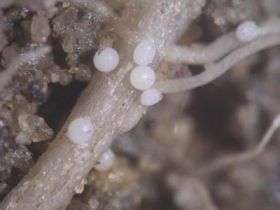
The full weight of a consortium of world-leading scientists – including those who helped decode the entire human genome – is being thrown at a parasitic worm less than 1mm long.
The potato cyst nematode (PCN), Globodera pallida, attacks potato crops all over the world and is particularly devastating in developing countries where the potato is a subsistence crop. A £1.7 million project led by the University of Leeds to fully sequence its DNA, hopes to shed light on the mechanisms that make the tiny worm such a successful parasite – and lead to methods to sustainably manage this pest.
The research, funded by the Biotechnology and Biological Sciences Research Council (BBSRC), draws together experts from the University of Leeds, the Wellcome Trust Sanger Institute, Rothamsted Research and SCRI, Scotland’s leading centre for crop research.
“Although there is partial resistance in some potato varieties, it is very difficult to breed this resistance into commercial ones - so we’re tackling the problem from a different perspective,” says Dr Peter Urwin from Leeds’ Faculty of Biological Sciences. “If we can find out exactly how this worm works so efficiently, it should lead to measures that will help the potato plant to withstand attack.”
The worm invades the roots of the potato plant and injects a substance causing the plant to create a unique cell from which it feeds via a specialised tube. By doing this, the nematode stunts root growth and deprives the potato plant of essential nutrients, which leads to lower quality, smaller crops.
Says Dr Urwin: “This tiny parasite has evolved many clever mechanisms that we hope to be able to understand more fully through this research. We have no idea what this injected substance is or how it manages to persuade the plant to create the feeding cell. In addition, its eggs can remain viable in the soil for up to twenty years, with hatching triggered by sensing chemicals released by potato roots nearby. Because of this, once a field is infected, it’s almost impossible to get rid of them.”
G. pallida is an international problem, affecting the world’s two major potato growing regions – the Ukraine and Idaho, USA – as well as 18 countries in the EU and 55 countries world wide. The widespread cultivation of potato varieties such as Maris Piper, which whilst naturally resistant to other PCNs, are not resistant to G. pallida, suggests that the significance of the worm is likely to increase.
UK farmers spend in excess of £50 million a year in efforts to manage the pest. Infestations are currently treated with toxic chemicals, which do not enter the food chain, but are expensive to apply and can make soil sterile, killing other living organisms within it.
Dr Urwin says that controlling G. pallida is essential to maintain the competitiveness of UK potato industry, which together with processing and retail markets is worth some £3 billion per year. “We think that consumers are more likely to support UK production that avoids pesticide residues and environmental harm and that is soundly based on a sustainable approach,” he says.
The team hope to complete the sequencing by 2012.
Source: University of Leeds


