Most distant cosmic explosion was a star collapsing into a black hole
, it begins burning helium. The ashes of helium burning, such as carbon and oxygen, also get burned. The end result of this fusion is iron. Iron cannot be used for nuclear fuel. Without fuel, the star no longer has the energy to support its weight. The core collapses. If the star is massive enough, the core will collapse into a black hole. The black hole quickly forms jets; and shock waves reverberating through the star ultimately blow apart the outer shells. Gamma-ray bursts are the beacons of star death and black hole birth. Image Credit: Nicolle Rager Fuller/NSF")
It came from the edge of the visible universe, the most distant explosion ever detected. In this week's issue of Nature, scientists at Penn State University and their U.S. and European colleagues discuss how this explosion, detected on 4 September 2005, was the result of a massive star collapsing into a black hole.
The explosion, called a gamma-ray burst, comes from an era soon after stars and galaxies first formed, about 500 million to 1 billion years after the Big Bang. The universe is now 13.7 billion years old, so the September burst serves as a probe to study the conditions of the early universe.
"This was a massive star that lived fast and died young," said David Burrows, senior scientist and professor of astronomy and astrophysics at Penn State, a co-author on one of the three reports about this explosion published this week in Nature. "This star was probably quite different from the kind we see today, the type that only could have existed in the early universe."
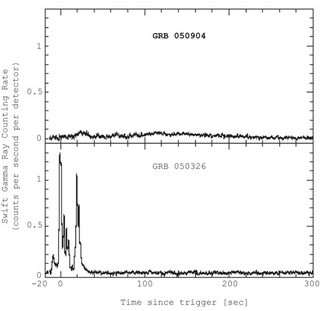
The burst, named GRB 050904 after the date it was spotted, was detected by NASA's Swift satellite, which is operated by Penn State. Swift provided the burst coordinates so that other satellites and ground-based telescopes could observe the burst. Bursts typically last only 10 seconds, but the afterglow will linger for a few days.
GRB 050904 originated 13 billion light years from Earth, which means it occurred 13 billion years ago, for it took that long for the light to reach us. Scientists have detected only a few objects more than 12 billion light years away, so the burst is extremely important in understanding the universe beyond the reach of the largest telescopes.
"Because the burst was brighter than a billion suns, many telescopes could study it even from such a huge distance," said Burrows, whose analysis focuses mainly on Swift data from its three telescopes, covering a range of gamma-rays, X-rays, and ultraviolet/optical wavelengths, respectively. Burrows is the lead scientist for Swift's X-ray telescope.
The Swift team found several unique features in GRB 050904. The burst was long, lasting about 500 seconds; and the tail end of the burst exhibited multiple flares. These characteristics imply that the newly created black hole didn't form instantly, as some scientists have thought, but rather it was a longer, chaotic event.
Closer gamma-ray bursts do not have as much flaring, implying that the earliest black holes may have formed differently from ones in the modern era, Burrows said. The difference could be because the first stars were more massive than modern stars. Or, it could be the result of the environment of the early universe when the first stars began to convert hydrogen and helium (created in the Big Bang) into heavier elements.
GRB 050904, in fact, shows hints of newly minted heavier elements, according to data from ground-based telescopes. This discovery is the subject of a second Nature article by a Japanese group led by Nobuyuki Kawai at the Tokyo Institute of Technology.
GRB 050904 also exhibited time dilation, a result of the vast expansion of the universe during the 13 billion years that it took the light to reach us on Earth. This dilation results in the light appearing much redder than when it was emitted in the burst, and it also alters our perception of time as compared to the burst's internal clock.
These factors worked in the scientists' favor. The Penn State team turned Swift's instruments onto the burst about 2 minutes after the event began. The burst, however, was evolving as if it were in slow-motion and was only about 23 seconds into the bursting. So scientists could see the burst at a very early stage.
Only one quasar has been discovered at a greater distance. Yet, whereas quasars are supermassive black holes containing the mass of billions of stars, this burst comes from a single star. The detection of GRB 050904 confirms that massive stars mingled with the oldest quasars. It also confirms that even more distant star explosions---perhaps from the first stars, theorists say--can be studied through a combination of observations with Swift and other world-class telescopes.
"We designed Swift to look for faint bursts coming from the edge of the universe," said Neil Gehrels of NASA Goddard Space Flight Center in Greenbelt, Md., Swift's principal investigator. "Now we've got one and it's fascinating. For the first time we can learn about individual stars from near the beginning of time. There are surely many more out there."
Swift was launched in November 2004 and was fully operational by January 2005. Swift carries three main instruments: the Burst Alert Telescope, the X-ray Telescope, and the Ultraviolet/Optical Telescope. Swift's gamma-ray detector, the Burst Alert Telescope, provides the rapid initial location and was built primarily by the NASA Goddard Space Flight Center in Greenbelt and Los Alamos National Laboratory and constructed at GSFC. Swift's X-Ray Telescope and UV/Optical Telescope were developed and built by international teams led by Penn State and drew heavily on each institution's experience with previous space missions. The X-ray Telescope resulted from Penn State's collaboration with the University of Leicester in England and the Brera Astronomical Observatory in Italy. The Ultraviolet/Optical Telescope resulted from Penn State's collaboration with the Mullard Space Science Laboratory of the University College-London. These three telescopes give Swift the ability to do almost immediate follow-up observations of most gamma-ray bursts because Swift can rotate so quickly to point toward the source of the gamma-ray signal.
Source: Penn State


