‘High Q’ Nanowires May be Practical Oscillators
November 27th, 2007 ‘High Q’ Nanowires May be Practical Oscillators

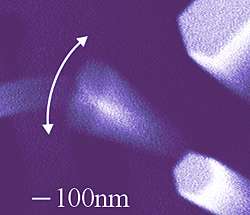
Electron micrograph of a NIST-grown nanowire with a high “quality factor” vibrating more than 1 million times per second. At lower right, a stationary nanowire shows the typical hexagonal shape of the gallium nitride structures. Credit: S. Tanner, CU/JILA

Nanowires grown at the National Institute of Standards and Technology (NIST) have a mechanical “quality factor” at least 10 times higher than reported values for other nanoscale devices such as carbon nanotubes, and comparable to that of commercial quartz crystals. Because a high Q factor indicates a capacity for stable vibrations, the nanowires might be used as oscillators in nano-electromechanical systems for future nano-sensors and communications devices.

“We think the most interesting thing about these wires is the very high quality factor observed for such a small object,” says NIST researcher and co-author Kris Bertness, who grew the nanowires.

NIST has developed a unique way of growing hexagonal gallium nitride (GaN) nanowires featuring low defect density and high luminescence intensity. In a new paper, researchers at NIST and the University of Colorado at Boulder report high Q factors in wires that are 30 to 500 nanometers in diameter and 5 to 20 micrometers long, vibrating between 400,000 and 2.8 million times per second. (For comparison, the quartz crystals used in watches usually vibrate about 32,000 times a second.)

The nanowires vibrated when placed on a piezoelectric device stimulated by an electrical signal. The nanowires also oscillated when excited directly by an electron beam, apparently due to the GaN material’s intrinsic piezoelectric ability to covert voltage to mechanical force.

Q measures the damping of oscillations in a mechanical system as a function of frequency—the higher its Q, the longer a bell rings after being struck. Ordinarily, Q factors of mechanical resonators tend to drop as their diameters shrink. But GaN nanowires have a number of properties that may boost their Q and make them suitable as practical oscillators. They have extremely flat and smooth surfaces (irregularities have reduced performance in other oscillators.)

GaN also has a resonant frequency similar to silicon (commonly used in microelectronics) but is less susceptible to some sources of “noise.” Finally, GaN has high heat capacity and thermal conductivity, reducing sensitivity to temperature fluctuations. Another practical advantage is that NIST’s GaN nanowires are grown on silicon, making them compatible with existing microelectronics processing methods.

To measure the resonance properties of the nanowires, researchers observed clumps of nanowires using a scanning electron microscope. As the frequency of the applied signal was varied across a range, the nanowires seen in micrographs appear to blur or fan out at or near the resonance frequency.

For the nanowire shown in the image, the Q value (about 38,000) is at least 10 times higher than previously reported values for other GaN nanowires, carbon nanotubes, and single-crystal silicon microstructures of similar surface-to-volume ratio. The researchers have measured Q values of more than 1 million in resonating GaN nanowires using feedback (like continuous striking of a bell to keep it ringing), as would occur in a real device.

Citation: S.M. Tanner, J.M. Gray, C.T. Rogers, K.A. Bertness and N.A. Sanford. 2007. High-Q GaN Nanowire Resonators and Oscillators. Applied Physics Letters. 91, 203117 (2007).

Source: NIST


print this article email this article download pdf blog this article bookmark this article     Digg this Stumble it share on Facebook share on Reddit add to delicious save to Yahoo! bookmarks
4.5/5 after 22 votes


November 27th, 2007 all stories
Nanotechnology / Nanophysics

Comments: 0
Rank: 4.5/5 after 22 votes

  • Stumble this up

  • Digg this

  • Share it:
  • share on Facebook
  • share on MySpace
  • share on Slashdot
  • rss-newsfeed
  • share on Google
  • share on Reddit
  • add to delicious
  • save to Yahoo! bookmarks
  • share on Windows Live
  • Add to Mixx!
Rating: 4.5/5 after 22 votes

  • Related Stories

  • Scientists demonstrate effect of confining dielectrics on semiconductor nanowire conductivity
    created May 05, 2009 | popularity not rated yet | comments 0
  • Research advances nanowire technology for large-scale applications
    created Feb 26, 2009 | popularity not rated yet | comments 0
  • New fabrication technique yields nanoscale UV LEDs
    created Jun 13, 2007 | popularity not rated yet | comments 0
  • New Fabrication Technique Yields Nanoscale UV LEDs
    created May 25, 2007 | popularity not rated yet | comments 0
  • Nanoscale 'Coaxial Cables' for Solar Energy Harvesting
    created Apr 23, 2007 | popularity not rated yet | comments 0

Tags


  • Physicists Demonstrate Quantum Memory with Matter Qubits
    Physicists Demonstrate Quantum Memory with Matter Qubits
    Physics / General Physics
    created Jul 03, 2009 | popularity 4.4 / 5 (17) | comments 1
  • 'Holey' Nanosheets for Wastewater Dye Removal
    Nanotechnology / Nanomaterials
    created Jul 01, 2009 | popularity 5 / 5 (5) | comments 1
  • Jellyfish Robot Swims Like its Biological Counterpart
    Jellyfish Robot Swims Like its Biological Counterpart
    Electronics / Robotics
    created Jun 26, 2009 | popularity 4.4 / 5 (8) | comments 1
  • Could Maxwell's Demon Exist in Nanoscale Systems?
    Could Maxwell's Demon Exist in Nanoscale Systems?
    Physics / General Physics
    created Jun 24, 2009 | popularity 4.4 / 5 (18) | comments 29
  • Living Safely with Robots, Beyond Asimov's Laws
    Living Safely with Robots, Beyond Asimov's Laws
    Electronics / Robotics
    created Jun 22, 2009 | popularity 4.6 / 5 (53) | comments 40
  • Other News

    Nano Measurement in the 3rd Dimension

    Nano Measurement in the 3rd Dimension

    Nanotechnology / Nanophysics

    created 1hour ago | popularity 3 / 5 (1) | comments 0

    From the motion sensor to the computer chip - in many products of daily life components are used whose functioning is based on smallest structures of the size of thousandths - or even millionths - of millimetres. ...


    A 'quantum of sol' -- how nanotechnology could hold the key to a solar-powered future

    A 'quantum of sol' -- how nanotechnology could hold the key to a solar-powered future

    Nanotechnology / Nanomaterials

    created Jun 30, 2009 | popularity 3.9 / 5 (16) | comments 17

    (PhysOrg.com) -- A new generation of 'nano-structured' millimetre-sized solar cells that could convert the sun's energy to electricity more than twice as efficiently as current technology, is the subject of ...


    Australian researchers are set to begin human trials of a tiny nano-cell that acts as a "Trojan horse" against cancer

    Hi-tech 'Trojan horse' can kill cancer cells: researchers

    Nanotechnology / Bio & Medicine

    created Jun 29, 2009 | popularity 4.7 / 5 (12) | comments 7

    Australian researchers are set to begin human trials of a tiny nano-cell that acts as a "Trojan horse" against cancer cells, a breakthrough they say may curb the need for debilitating chemotherapy.


    'Holey' Nanosheets for Wastewater Dye Removal

    Nanotechnology / Nanomaterials

    created Jul 01, 2009 | popularity 5 / 5 (5) | comments 1

    (PhysOrg.com) -- Researchers have discovered that extremely thin sheets of nickel oxide with hexagonally shaped holes can absorb hazardous dyes from wastewater nearly as well as the best traditional methods, but are recyclable. ...


    Harnessing Nanoparticles To Track Cancer Cell Changes

    Nanotechnology / Bio & Medicine

    created Jul 03, 2009 | popularity not rated yet | comments 1

    The more dots there are, the more accurate a picture you get when you connect them. Cancer researchers adopting that philosophy have developed a new imaging technology that could give scientists the ability to simultaneously ...