Global warming sends salamanders packing
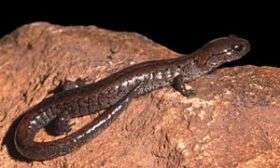
A genetic study of the salamander family that encompasses two-thirds of the world's salamander species shows that periods of global warming helped the amphibians diversify and expand their range from North America into Europe and Asia, where pockets of them are still found today.
Interestingly, while one period of warming allowed some salamanders to move northward into Asia via an arctic land bridge, the next warming period may have facilitated their return to North America.
The global warming that spurred the dispersal and evolution of these salamanders, however, took place in the distant past, over the course of tens of thousands or even millions of years, allowing the slow-moving salamanders time to seek suitable habitat farther north. This contrasts to today's warming, which may amount to a similar 6-8 degree Celsius rise, but in just a few hundred years.
"Now, we are dealing with very fast global warming. These animals will not be able to track the warming because they disperse very slowly. If you have a very fast period of global warming like we are having now, the most likely scenario is that they go extinct," said study coauthor David Vieites, a post-doctoral researcher in the Museum of Vertebrate Zoology at the University of California, Berkeley.
Vieites, along with amphibian expert David Wake, UC Berkeley professor of integrative biology, and Mi-Sook Min of South Korea's Seoul National University, published their findings this week in the early online edition of the journal Proceedings of the National Academy of Sciences.
Their study attempted to answer an enigma of the plethodontid, or so-called lungless, salamanders. These amphibians, which breathe through moist skin rather than via lungs, are represented by more than 380 known species and make up 68 percent of all salamander species worldwide. While 98 percent of all plethodontid species occur in North, Central and northern South America, they're also found in two isolated spots in Europe and Asia. One group lives in southern France, northern Italy and the island of Sardinia, while a second species (Karsenia koreana) was discovered by Vieites and Wake three years ago in South Korea.
The salamanders' existence in Europe "has been a mystery for many, many years. How did these animals get there when everybody else is in America?" Vieites said.
The researchers sought answers in the salamanders' genes. Sequencing three nuclear genes in each of 43 salamander species, including all northern hemisphere plethodontid genera, the researchers combined the genetic data with information on global climate change during the past 100 million years to assemble a plausible scenario for the origin of and dispersal of plethodontids.
They propose that the plethodontid family arose in North America during the mid-Jurassic period, the Age of the Dinosaurs, about 180 million years ago. Though these salamanders spread across the entire continent, the researchers found no evidence that they originated in the Appalachian Mountains, as some scientists proposed because of the large number of distinct salamander species there.
Then, about 110 million years ago, North America was split in two by a mid-continental seaway that also split the plethodontids into eastern and western branches. The researchers said that during a prolonged period of global warming in the late Cretaceous period, around 80 million years ago, representatives of the western branch of the family moved north into Asia over the Bering Sea land bridge, where they probably diversified into numerous Asian species.
A second, rapid warming period about 40-50 million years ago generated by volcanic eruptions set the salamanders in motion again, they said, and sent the creatures farther west into Europe as well as back into North America to establish a genetically separate population in California. Hence the close relationship between the California and southern European salamanders, both of which belong to the supergenus Hydromantes, and their relationship to the Korean Karsenia salamander.
Today, the European and Asian populations have shrunk to the two outposts in Italy and Korea, though Vieites suspects more salamanders remain to be discovered.
"If this scenario is correct, then we expect to find more Karsenia's or cryptic lineages somewhere in China or Asia," Vieites said. "That is kinda cool; it suggests we don't know a lot about diversity in that area."
Vieites noted, for example, that five years ago, scientists discovered a completely new family of frogs in India.
"That part of the world probably holds very interesting new lineages yet to be discovered," he said.
Source: UC Berkeley, by Robert Sanders


