By growing 3D tumors, researcher develops realistic cancer growth models
November 27, 2007
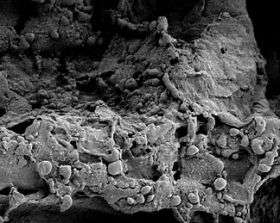
A scanning electron microscope image of a cell-seeded PLG scaffold. Credit: Claudia Fischbach-Teschl
Scientists can only develop new cancer drugs or search for cures by testing their theories on the real thing. Traditionally, they've done so by culturing cancer cells on petri dishes or plastic slides. But those cancer cells do not behave the way they do in the body. They only partially re-create the aggressive behavior of tumors in real patients.
That is the problem that drives Claudia Fischbach-Teschl, Cornell assistant professor of biomedical engineering, whose lab creates realistic experimental tumor models, which may then lead to better drug therapies or even a cure.
"We allow cells to grow in a 3D manner and to reorganize into tissue that better mimics their behavior and composition in the body," Fischbach-Teschl explained.
On temperature-, carbon dioxide- and humidity-controlled shelves in her lab at the Baker Institute for Animal Health, Fischbach-Teschl handles vials of pinkish, sugar-based liquids that contain what look like tiny, white floating globules. But when slid under a microscope, the beads can be seen to serve as holders, or scaffolds, of hundreds of cancer cells.
These 3D scaffolds, synthetically or naturally derived polymeric substances, act as harnesses for tumors cells as they grow, allowing the tumors to develop more closely to how they grow in the body than when maintained on flat plastic surfaces.
Fischbach-Teschl's work also involves trying to figure out why cancer cells are so able to adapt to the body's environment, why they are able to survive, and what biological secretions or proteins allow these cells to reproduce at a destructive rate.
Earlier this year in research published in Nature Methods, Fischbach-Teschl and colleagues, including David J. Mooney at Harvard University, showed that tumors grown in a 3D manner are resistant to cancer treatments, such as chemotherapy. They found the tumor models' behavior more aggressive than those grown on traditional glass slides.
Furthermore, an earlier generation of 3D tumor models, grown in what is known as a Matrigel culture, is limited in its ability to develop such characteristics. Instead, the Cornell scientists grew tumors in synthetic, porous scaffolds made of a lab-created polymer called poly(lactide-co-glycolide) (PLG). The PLG scaffolds, which look like tiny, white, flat sponges, allow the tumors to grow much more aggressively than in the Matrigel.
By then injecting the tumors into mice for in-vivo analysis, the researchers discovered that the tumors pregrown in the PLG scaffolds developed into bigger and more aggressive tumors. They also were able to analyze distinct biological functions of the cells, such as the presence of secretions that might point to the cancer cells' ability to survive.
The purpose of Fischbach-Teschl's research is to gain a fundamental understanding of cancer cell behavior that can be used to develop more effective anti-cancer drug therapy.
Fischbach-Teschl collaborates with groups in four different Cornell colleges (Weill Cornell Medical College and the Colleges of Veterinary Medicine, Human Ecology and Engineering) on various projects, including one with mechanical engineering researchers and other scientists to study bone metastasis.
The scientists hypothesize that biomechanical and structural effects of the bone mediate the migration of tumors cells to different sites, not just the primary tumor.
"Using their knowledge in the regulation of bone physiology and our approach on cancer biology, we'll gain a better understanding of how interactions between bone and tumor cells may contribute to bone metastasis," she said.
Source: Cornell University
-
Using the body's own immune system in the fight against cancer
20 hours ago |
3 / 5 (2) |
1
-
Short fasting cycles work as well as chemotherapy in mice
19 hours ago |
4.7 / 5 (13) |
2
-
CD97 gene expression and function correlate with WT1 protein expression and glioma invasiveness
Feb 07, 2012 |
not rated yet |
0
-
Metabolic profiles essential for personalizing cancer therapy
Feb 07, 2012 |
4 / 5 (1) |
0
-
Scientists use an old theory to discover new targets in the fight against breast cancer
Feb 07, 2012 |
5 / 5 (2) |
0
-
Engineers build first sub-10-nm carbon nanotube transistor
Feb 01, 2012 |
4.9 / 5 (33) |
30
-
Something old, something new: Evolution and the structural divergence of duplicate genes
Jan 31, 2012 |
4.6 / 5 (7) |
1
-
The hidden nanoworld of ice crystals: Revealing the dynamic behavior of quasi-liquid layers
Jan 30, 2012 |
5 / 5 (4) |
1
-
Stock market network reveals investor clustering
Jan 27, 2012 |
3.9 / 5 (23) |
8
-
Of microchemistry and molecules: Electronic microfluidic device synthesizes biocompatible probes
Jan 26, 2012 |
5 / 5 (2) |
0
-
Is Everyday Technology Killing Us?
Feb 08, 2012
-
Exercise and weight loss
Feb 08, 2012
-
Why do we have head aches? Our brains can't feel anything.
Feb 07, 2012
-
"The end of diseases" by David Agus, interview from Daily Show with Jon Stewart
Feb 04, 2012
-
Oncolytic adenovirus
Feb 04, 2012
-
Nutrition label stuffs and diets
Feb 02, 2012
- More from Physics Forums - Medical Sciences
More news stories
Starve a virus, feed a cure? Findings show how some cells protect themselves against HIV
A protein that protects some of our immune cells from the most common and virulent form of HIV works by starving the virus of the molecular building blocks that it needs to replicate, according to research published online ...
3 hours ago |
5 / 5 (1) |
0
|
Injured boomers beware: Know when to see doctor
(AP) -- It happened to nurse Jane Byron years after an in-line skating fall, business owner Haralee Weintraub while doing "men's" push-ups, and avid cyclist Gene Wilberg while lifting a heavy box.
4 hours ago |
5 / 5 (1) |
0
FDA-approved drug rapidly clears amyloid from the brain, reverses Alzheimer's symptoms in mice
Neuroscientists at Case Western Reserve University School of Medicine have made a dramatic breakthrough in their efforts to find a cure for Alzheimer's disease. The researchers' findings, published in the journal Science, show t ...
Medicine & Health / Neuroscience
Feb 09, 2012 |
4.9 / 5 (56) |
15
|
Green tea found to reduce disability in the elderly
(Medical Xpress) -- A lot of research has been done over the past several years looking into the health benefits of green tea. As a result, scientists have found that regular consumption of the beverage leads ...
Teen school drop-outs three times as likely to be on benefits in later life
Teen school drop-outs are almost three times as likely to be on benefits in later life as their peers who complete their schooling, indicates research published online in the Journal of Epidemiology and Community Health.
Feb 06, 2012 |
not rated yet |
13
Scientists discover molecular secrets of 2,000-year-old Chinese herbal remedy
For roughly two thousand years, Chinese herbalists have treated Malaria using a root extract, commonly known as Chang Shan, from a type of hydrangea that grows in Tibet and Nepal. More recent studies suggest that halofuginone, ...
New method to examine batteries -- MRI from the inside
There is an ever-increasing need for advanced batteries for portable electronics, such as phones, cameras, and music players, but also to power electric vehicles and to facilitate the distribution and storage of energy derived ...
Google might launch Drive for cloud storage soon
(PhysOrg.com) -- Google's next big move, according to the Wall Street Journal, is a cloud storage service called Drive. Hardly first to the plate, Google is simply catching up to introducing its cloud reposi ...
Lab study raises questions over nano-particle impact
Tests involving chickens have raised questions about the impact on health from engineered nano-particles, the ultra-fine grains commonly used in drugs and processed foods, scientists said on Sunday.
A mitosis mystery solved: How chromosomes align perfectly in a dividing cell
Although the process of mitotic cell division has been studied intensely for more than 50 years, Whitehead Institute researchers have only now solved the mystery of how cells correctly align their chromosomes during symmetric ...
Researchers find extensive RNA editing in human transcriptome
In a new study published online in Nature Biotechnology, researchers from BGI, the world's largest genomics organization, reported the evidence of extensive RNA editing in a human cell line by analysis of RNA-seq data, demons ...