Computer simulation predicts Voyager 2 will reach major milestone in space in late 2007-early 2008
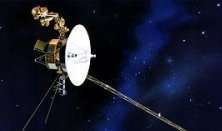
November 27, 2007 An artist's concept of Voyager 1.

An artist's concept of Voyager 1.

Using a computer model simulation, Haruichi Washimi, a physicist at UC Riverside, has predicted when the interplanetary spacecraft Voyager 2 will cross the “termination shock,” the spherical shell around the solar system that marks where the solar wind slows down to subsonic speed.

According to Washimi’s simulations, the spacecraft is set to cross the termination shock in late 2007-early 2008. To make this forecast, Washimi and his colleagues used data from Voyager 2 and performed a global “magneto-hydrodynamic simulation” – a method that allows for precise and quantitative predictions of geomagnetic disturbances caused by solar activities.

Because Voyager 2’s crossing of the shock is expected to be an abrupt and relatively brief event, scientists are working to ensure that the most is made of the opportunity. With an idea of when the spacecraft will cross the shock, they are better able to maximize coverage of the crossing.

Study results appear in the Dec. 1 issue of The Astrophysical Journal.

“Washimi’s model has predicted the location of a boundary that is approximately 90 times farther from the sun than is the Earth, to within a few percent,” said Gary Zank, the director of the Institute of Geophysics and Planetary Physics and one of the coauthors of the research paper. “This is truly remarkable given the enormous complexity of the physics involved, the temporal and spatial scales involved, and the variability of the solar wind conditions.”

The solar wind – a stream of charged particles ejected by the sun in all directions – travels at supersonic speeds when it leaves the sun, until it eventually encounters the interstellar medium made up of plasma, neutral gas and dust.

At the termination shock, located at 7-8.5 billion miles from the sun, the solar wind is decelerated to less than the speed of sound. The boundary of the termination shock is not fixed, however, but wobbly, fluctuating in both time and distance from the sun, depending on solar activity.

“This is the first time the termination-shock position has been forecast in this way,” said Washimi, the lead author of the research paper and a scientist at the Institute of Geophysics and Planetary Physics. “After it crosses this boundary, Voyager 2 will be in the outer heliosphere beyond which lies the interstellar medium and galactic space. Our simulations also show that the spacecraft will cross the termination shock again in the middle of 2008. This will happen because of the back and forth movement of the termination-shock boundary. This means Voyager 2 will experience multiple crossings of the termination shock. These crossings will come to an end after the spacecraft escapes into galactic space.”

Voyager 2 was launched Aug. 20, 1977. It visited four planets and their moons in the course of its journey into space. Its sister spacecraft Voyager 1, which was launched Sept. 5, 1977, crossed the termination shock in December 2004 – earlier than Voyager 2 because of a shorter trajectory. Both spacecraft are currently operational, but power sources have degraded and some of the instrumentation no longer works optimally. In the future, the spacecraft will encounter their next milestone in space: the heliopause, which is the boundary where the interstellar medium brings the solar wind to a halt.

Source: University of California - Riverside


print this article email this article download pdf blog this article bookmark this article     Stumble it Digg this share on Facebook retweet share on Reddit add to delicious
Rate this story - 4.7 /5 (62 votes)

Rank Filter

Move the slider to adjust rank threshold, so that you can hide some of the comments.


Display comments: newest first

  • earls - Nov 28, 2007
    • Rank: not rated yet
    Dare I say there's a lot riding on this.
  • Reaper6971 - Nov 28, 2007
    • Rank: not rated yet
    Dare... dare
  • am_Unition - Nov 28, 2007
    • Rank: not rated yet
    And there is, methinks.

    What kind of direct observation data do we have on interstellar dust densities outside the heliosphere? Intragalactic magnetic field strength? Boundary conditions at the heliopause? How/if intragalactic magnetic fields and interglactic dust regulate star output or cycles?
  • eschaton - Nov 29, 2007
    • Rank: not rated yet
    I wish they included what information they expected to get from this. I think about all they can get from these crafts any more is telemetry data.

November 27, 2007 all stories

Comments: 4

4.7 /5 (62 votes)
  • Stumble this up

  • Digg this

  • share this

  • hide
  • Related Stories

  • Fantastic Voyage
    created Nov 02, 2009 | popularity not rated yet | comments 0
  • STEREO Reveals the Anatomy of a Solar Storm in 3D
    created Apr 28, 2009 | popularity not rated yet | comments 0
  • The Surprising Shape of Solar Storms (w/Video)
    created Apr 14, 2009 | popularity not rated yet | comments 0
  • Researchers See the 'Dark Side' of the Sun
    created Jan 26, 2009 | popularity not rated yet | comments 0
  • NASA spacecraft ready to explore outer solar system
    created Oct 06, 2008 | popularity not rated yet | comments 0


  • hide
  • Relevant PhysicsForums posts

  • The shape of our solar system's orbits.
    created Nov 07, 2009
  • Above or Below the Line of Nodes
    created Nov 07, 2009
  • Supernova vs. Nova?
    created Nov 07, 2009
  • Supernova's Gamma Rays and Comets
    created Nov 06, 2009
  • More from Physics Forums - General Astronomy

Other News

Scientists seek safe carbon dioxide storage for 'greener' power generation (w/ Video)

Space & Earth / Environment

created 12 minutes ago | popularity not rated yet | comments 0

The U.S. Department of Energy (DOE) has announced plans to fund research at the University of Alabama at Birmingham (UAB) School of Engineering on technologies that would help reduce greenhouse gas emissions through the capture ...


Antarctica glacier retreat creates new carbon dioxide store

Antarctica glacier retreat creates new carbon dioxide store

Space & Earth / Earth Sciences

created 3 hours ago | popularity 5 / 5 (1) | comments 1

Large blooms of tiny marine plants called phytoplankton are flourishing in areas of open water left exposed by the recent and rapid melting of ice shelves and glaciers around the Antarctic Peninsula. This ...


Success in 'space elevator' competition (AP)

Success in 'space elevator' competition (Update 3)

Space & Earth / Space Exploration

created Nov 05, 2009 | popularity 4.3 / 5 (33) | comments 53

(AP) -- A robot powered by a ground-based laser beam climbed a long cable dangling from a helicopter on Wednesday to qualify for prize money in a $2 million competition to test the potential reality of the ...


In a Galaxy Far, Far Away...

In a Galaxy Far, Far Away...

Space & Earth / Astronomy

created Nov 06, 2009 | popularity 4.8 / 5 (5) | comments 15

(PhysOrg.com) -- Astronomers have published the discovery of the farthest known object in the cosmos: a star that exploded when the universe was only 630 million years old -- only 4.6% of its current age. ...


'Dropouts' pinpoint earliest galaxies

'Dropouts' pinpoint earliest galaxies

Space & Earth / Astronomy

created Nov 06, 2009 | popularity 4.2 / 5 (10) | comments 13

Astronomers, conducting the broadest survey to date of galaxies from about 800 million years after the Big Bang, have found 22 early galaxies and confirmed the age of one by its characteristic hydrogen signature ...