Cleanup method uses activated carbons to anchor toxins to bottom of the bay
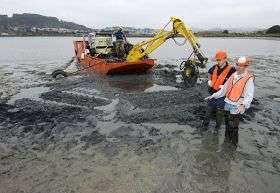
Imagine a Brita filter big enough to clean up San Francisco Bay. Richard Luthy, chair of Stanford's Department of Civil and Environmental Engineering, has a plan to clean polluted sediment at Hunters Point in San Francisco with activated carbon—the same technology in many water filters. Luthy proposes to sequester dangerous toxins by mixing activated carbon, a type of carbon with a large surface area, into the bay's contaminated sediment.
Luthy, the Silas H. Palmer Professor of Civil Engineering, has discovered that certain toxins in mud stick so well to activated carbon that they are rendered much less harmful—like flies stuck to a fly strip. Luthy and his team want to apply this technique to contaminated waterways. They recommended their technique to the U.S. Navy, which is responsible for the cleanup at Hunters Point.
"This technique is radical because we are changing the chemistry of the sediment rather than digging up the mud and hauling it away," Luthy said.
There are a lot of toxins in the bay, but Luthy's work concerns PCBs, polychlorinated biphenyls. PCB is a long-lived industrial chemical and probable carcinogen. It has been banned since 1979, but the PCBs already in the environment show no signs of leaving. "Bacteria don't destroy them, and humans don't have an easy way to deal with them in our bodies," Luthy said.
The PCBs at Hunters Point, San Francisco's only Superfund site, oozed into the bay from contaminated soil in the nearby naval shipyard landfill. Although erosion from the landfill deposited PCBs into the bay, they don't mix well with water and instead attach themselves to the sediment on the mud flats. Since this land was leased to many different companies after the Navy ceased active operations there in 1974, it is impossible to point the finger of blame at one party, Luthy said. The Navy built a retaining wall around the landfill and recently excavated it, so no further PCBs can leak into the bay from this site
Like mercury, PCBs get into our bodies through fish. Small marine creatures, such as worms and clams, eat contaminated sediment and accumulate PCBs in their fatty tissues. When fish eat the clams and worms, the toxins concentrate even further in fish fat. So by the time the PCBs get to us, at the top the food chain, they are highly concentrated.
The land at Hunters Point will eventually be transferred to the city of San Francisco, but a 2002 bill requires it to be cleaned up first. At its current contamination levels, it is not safe for the city's planned use, which includes a new stadium for the San Francisco 49ers. Dredging, or scooping up, the contaminated sediment and dumping it elsewhere is currently a favored method for dealing with sediment contamination, but, as Luthy and other scientists wrote in a National Research Council committee statement released this July, it does not always work.
The dredge usually cannot get every inch of the sediment. And leaving behind just a small amount of contaminated sediment could actually make matters worse, Luthy said. The bottom few inches of sediment are sometimes more contaminated than what is taken away, since the lower, older layers of sediment could date back to days when PCBs were still in widespread use. Because the worms and clams live only in the top layer, organisms in that body of water could ultimately end up with higher levels of PCBs in their systems.
Even when dredging does work, "it's like a shell game; you have to put the contaminated sediment somewhere," Luthy said. "We have to learn how to solve our environmental problems where they are, and not ship the problems off somewhere else."
Luthy found that PCBs stick most readily to carbon particles naturally present in the aquatic environment and thought he might enhance this natural process by giving PCBs extra carbon to stick to. Luthy and his team members tested this theory in the lab by mixing soil from various polluted sites around the country, including Hunters Point, with activated carbon, a kind of porous carbon with extra surface area for the molecules of PCB to stick to. They found that a clam left in a mixture of contaminated sediment and activated carbon for a month absorbed one-tenth the amount of PCBs in its fatty tissues as a clam that sat in contaminated soil with no carbon. The researchers then marked PCBs with radioactive labels and mixed them with activated carbon. When they fed this radioactive mixture to the clam, they saw that 98 percent of the radioactivity passed right through it; the PCBs were so tightly bound to the carbon that they could no longer enter the food chain.
The Department of Defense funded a study for Luthy to move his technique from the lab to the bay. In one test, Luthy and his team members dumped more than 1,100 pounds of activated carbon onto about 400 square feet of the muddy flats in South Basin, an inlet just south of the naval shipyard. They mixed the carbon into the bay's sediment using an Aquamog, a machine normally used as a big weed whacker for marine vegetation, which Luthy described as a giant rototiller attached to a barge. Luthy's team tested the water to make sure they were not kicking up extra PCB contamination with their mixing, a step Luthy said is an important part of the field test for any contaminated locale.
Seven months later, after the carbon and PCBs had had plenty of time to find each other, they put mesh cages containing clams in the mud-carbon mixture. After another month, they saw 50 percent less PCBs in these clams compared with clams left in untreated dirt. So Luthy felt confident recommending his technique to the Navy: "It's not some wacko idea of a professor," he said. "You could get real environmental contractors out there doing this."
Luthy does not think adding extra carbon to our waterways will significantly affect the local environment—field tests here have shown no major changes in the local organisms six months after carbon addition, and more tests are being done 18 months after mixing. However, Luthy is worried that the recent oil spill in the San Francisco Bay may have diminished the pool of healthy organisms that could repopulate Hunters Point once it is cleaned up.
It is hard to know how well this technique will translate into healthier fish, because fish will not stay put like clams and could be eating contaminated organisms from other waterways, Luthy said. But he sees smaller organisms, such as clams and worms, serving as the canaries in the coal mine for our bay: If their toxin levels go down, those of fish and humans will eventually follow suit.
Source: Stanford University


