Early Land Animals Could Walk and Run Like Mammals, New Study Finds
Salamanders and the tuatara, a lizard-like animal that has lived on Earth for 225 million years, were the first vertebrates to walk and run on land, according to a recent study by Ohio University researchers.
After studying the creatures at the Toledo Zoo, Stephen Reilly, associate professor of biological sciences, and doctoral student Eric McElroy determined that they use both forms of locomotion, which are energy-saving mechanisms generally believed to be important only in fast-running animals such as mammals and birds.
The research was published in the March 8 issue of the journal Proceedings of the Royal Society B: Biological Sciences. Andrew Odum, curator of herpetology at the Toledo Zoo, and Valerie Hornyak, head herpetology keeper, were co-authors of the study.
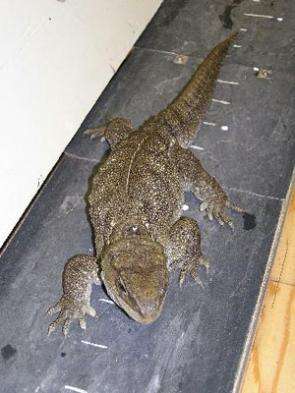
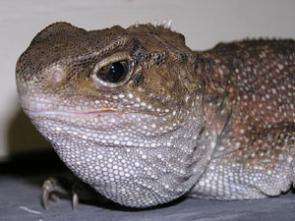
Tuataras, which are usually about 1 to 2 feet long, look like large lizards with green or brown scales and short spikes on their backs. They have unique anatomical features that are somewhere between those of lizards and birds. The critters are found only in New Zealand, where the cool climate is ideal for these animals that can’t survive in temperatures above 25 degrees Celsius (77 degrees Fahrenheit). The animals can grow as old as 100 years, and live mostly off of insects, eggs and small birds. Fossil records show that the tuatara lived on Earth as early as 225 million years ago and hasn’t changed significantly over time.
“Tuataras are the oldest living models of early tetrapods (four-legged animals) still alive today; that’s what makes them so interesting,” Reilly said.
In the recent study, the tuataras and salamanders walked and ran on a trackway with an integrated plate that measured the force with which the animals hit the ground with each step. From videotapes and the force measurements, the researchers could tell when the animals were walking or running. The difference is not obvious in these critters, which tend to move with a slow, lumbering gait. That’s led scientists to believe that the primitive animals could only walk.
But force data used to study the movement of these creatures’ center of mass showed otherwise. In walking, the center of mass vaults up and over the limbs with each step. In running, the center of mass dips with each step, and tendons and joints in the legs act as biological springs. Mammals such as humans, dogs and horses can use both mechanisms to conserve up to 50 percent of their energy needed to walk and run.
When studying salamanders and tuataras, the researchers spotted the telltale vault and dip of center of mass movements in different strides – confirmation that the creatures mechanically walk and run. Because they are the oldest living examples of four-legged animals, the new findings suggest that both energy saving mechanisms appeared when the first vertebrates moved onto land, Reilly explained. In comparison to previous research on other vertebrates, this also suggests that all terrestrial vertebrates – except for turtles, which are limited by their shell – can walk and run.
The researchers also showed, however, that walking and running in tuataras occur at the same speed and use about the same amounts of energy. Reilly believes that this could be a pre-adaptation in these primitive animals that have not evolved the need for speed, unlike other animals.
The research, which was funded by the National Science Foundation and the Research Challenge Program at Ohio University, also shows for the first time a clear difference in locomotor mechanics between “lumbering” animals with clumsy, ungraceful gaits and “cursorial” animals that move fast and smoothly. In lumbering animals, up and down movements dominate the mechanical energy of locomotion. These movements are smoothed out in cursorial animals such as in dogs and horses, where more energy is shifted to forward movement, and the center of mass oscillates relatively less with each step.
Reilly and McElroy were interested in tuataras not only because they are a “living fossil,” but also because tuataras are a threatened species, according to the World Conservation Union.
“Tuataras only survive on a few small islands off New Zealand, and I would really like to study their locomotor behavior in the wild,” Reilly said. “Given their status as the world’s oldest known living tetrapod, knowing more about how these animals move in nature is critical to our understanding of vertebrate evolution.”
Source: Ohio University, by CHRISTINA DIERKES


