Holiday wishes from the Hubble Space Telescope
November 29, 2007 Holiday wishes from the Hubble Space Telescope

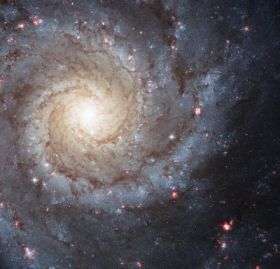
In the new Hubble image of the galaxy M74 we can also see a smattering of bright pink regions decorating the spiral arms. These are huge, relatively short-lived, clouds of hydrogen gas which glow due to the strong radiation from hot, young stars embedded within them; glowing pink regions of ionized hydrogen (hydrogen that has lost its electrons). These regions of star formation show an excess of light at ultraviolet wavelengths and astronomers call them HII regions. Credit: NASA, ESA, and The Hubble Heritage (STScI/AURA)-ESA/Hubble Collaboration

Messier 74, also called NGC 628, is a stunning example of a 'grand-design' spiral galaxy that is viewed by Earth observers nearly face-on. Its perfectly symmetrical spiral arms emanate from the central nucleus and are dotted with clusters of young blue stars.

In the new Hubble image we can also see a smattering of bright pink regions decorating the spiral arms. These are huge, relatively short-lived, clouds of hydrogen gas which glow due to the strong radiation from hot, young stars embedded within them; glowing pink regions of ionized hydrogen (hydrogen that has lost its electrons). These regions of star formation show an excess of light at ultraviolet wavelengths and astronomers call them HII regions.

Tracing along the spiral arms are winding dust lanes that begin very near the galaxy’s nucleus and follow along the length of the spiral arms. These spiral arms are not actually static ‘arms’ like spokes on a wheel. They are in fact density waves and move around the galaxy’s disc compressing gas – just as sound waves compress the air on Earth – creating a new generation of young blue stars.

Messier 74 is located roughly 32 million light-years away in the direction of the constellation Pisces, the Fish. It is the dominant member of a small group of about half a dozen galaxies, the Messier 74 galaxy group. In its entirety, it is estimated that Messier 74 is home to about 100 billion stars, making it slightly smaller than our Milky Way.

The spiral galaxy was first discovered by the French astronomer, Pierre Méchain, in 1780. Weeks later it was added to Charles Messier’s famous catalogue of deep-sky objects. Of all the objects in Messier’s catalogue, number 74 has the lowest surface brightness. It is so difficult for amateur astronomers to spot through a telescope that it has been given the nickname 'The Phantom Galaxy'.

This Hubble image of Messier 74 is a composite of Advanced Camera for Surveys’ data taken in 2003 and 2005. The filters used to create the colour image isolate light from blue, visible, and infrared portions of the spectrum, as well as emission from ionized hydrogen.

A small segment of this image used data from the Canada France Hawaii Telescope/Gemini Observatory telescope to fill in a region which Hubble did not image.

Source: Hubble Information Centre


print this article email this article download pdf blog this article bookmark this article     Stumble it Digg this share on Facebook retweet share on Reddit add to delicious
Rate this story - 4.2 /5 (24 votes)


November 29, 2007 all stories

Comments: 0

4.2 /5 (24 votes)
  • Stumble this up

  • Digg this

  • share this

  • hide
  • Related Stories

  • NGC 4710 galaxy: Baffling boxy bulge (w/ Video)
    created Nov 18, 2009 | popularity not rated yet | comments 0
  • Hubble Image Showcases Star Birth in M83, the Southern Pinwheel
    created Nov 05, 2009 | popularity not rated yet | comments 0
  • Exceptionally deep view of strange galaxy
    created Feb 05, 2009 | popularity not rated yet | comments 0
  • 'Missing link' galaxies discovered
    created Nov 25, 2008 | popularity not rated yet | comments 0
  • Caltech astronomers describe the bar scene at the beginning of the universe
    created Jul 29, 2008 | popularity not rated yet | comments 0


  • hide
  • Relevant PhysicsForums posts

  • Primary Mirror grinding
    created 3 hours ago
  • dark energy can escape black holes.
    created 12 hours ago
  • Are there green, purple and pink stars?
    created Nov 22, 2009
  • Sideral question
    created Nov 21, 2009
  • More from Physics Forums - General Astronomy

Other News

New computer-developed map shows more extensive valley network on Mars

New computer-developed map shows more extensive valley network on Mars

Space & Earth / Space Exploration

created 3 hours ago | popularity 4.7 / 5 (3) | comments 0

New research adds to the growing body of evidence suggesting the Red Planet once had an ocean.


Spitzer Telescope Observes Baby Brown Dwarf

Spitzer Telescope Observes Baby Brown Dwarf

Space & Earth / Astronomy

created 2 hours ago | popularity 4.8 / 5 (5) | comments 0

(PhysOrg.com) -- NASA's Spitzer Space Telescope has contributed to the discovery of the youngest brown dwarf ever observed -- a finding that, if confirmed, may solve an astronomical mystery about how these ...


Supervolcano eruption -- in Sumatra -- deforested India 73,000 years ago

Supervolcano eruption -- in Sumatra -- deforested India 73,000 years ago

Space & Earth / Earth Sciences

created 5 hours ago | popularity 4.3 / 5 (4) | comments 0

A new study provides "incontrovertible evidence" that the volcanic super-eruption of Toba on the island of Sumatra about 73,000 years ago deforested much of central India, some 3,000 miles from the epicenter, ...


Cassini Sends Back Images of Enceladus as Winter Nears

Cassini Sends Back Images of Enceladus as Winter Nears

Space & Earth / Space Exploration

created 1hour ago | popularity 4.5 / 5 (2) | comments 0

(PhysOrg.com) -- NASA's Cassini spacecraft has sailed seamlessly through the Nov. 21 flyby of Saturn's moon Enceladus and started transmitting uncalibrated temperature data and images of the rippling terrain. ...


The Crab Nebula: A Cosmic Icon

The Crab Nebula: Energy for 100,000 Suns

Space & Earth / Astronomy

created 2 hours ago | popularity 4.7 / 5 (3) | comments 0

(PhysOrg.com) -- A star's spectacular death in the constellation Taurus was observed on Earth as the supernova of 1054 A.D.