Scientists make first observation of Airy optical beams
November 29th, 2007 By Lisa Zyga Scientists make first observation of Airy optical beams

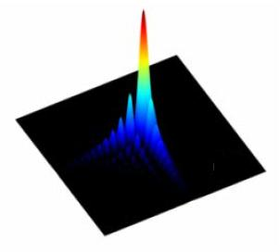
Schematic of a 2D Airy packet. Image Credit: Georgios Siviloglou, et al.

Scientists have made the first observation of an unusual class of optical waves called Airy beams. Unlike most types of light waves, Airy beams have the ability to resist diffraction over long distances, and can also freely accelerate during propagation.

The researchers, Georgios Siviloglou, John Broky, Aristide Dogariu, and Demetrios Christodoulides from CREOL-University of Central Florida (UCF), hope that these unusual features may enable Airy beams to be used in applications such as particle manipulation and in nonlinear media. The group’s study, published in a recent issue of Physical Review Letters, reports the observation of Airy beams in both one- and two-dimensional configurations.

Airy beams take their name from the “airy integral,” introduced by Sir George Biddell Airy in the 1830s to explain optical caustics such as those appearing in a rainbow. Airy beams were initially predicted in 1979 by two scientists, Michael Berry and Nandor Balazs, within the context of quantum mechanics. The scientists theorized the existence of a free particle described by the Schrödinger equation that could exhibit an Airy wave packet that doesn’t spread out as it propagates—in other words, it is diffraction-free. Remarkably, an Airy wave packet has the unusual ability to freely accelerate even in the absence of an external stimulus.

“We are not sure why this absolutely fascinating prediction went unnoticed for so long given the fame of Michael Berry,” Christodoulides told PhysOrg.com. “We think that it is partly due to the fact that it was initially published in a relatively ‘obscured’ journal. The second issue has to do with experimental implementation. It is only very recently that we realized that exponentially truncated Airy beams have a Gaussian power spectrum and can thus be easily synthesized from standard Gaussian beams.”

The UCF researchers noted that other two-dimensional diffraction-free light waves exist, such as the so-called Bessel beam, which is generated by a conical superposition of plane waves. Due to their non-diffracting nature, Bessel beams theoretically convey an infinite power. However, lack of space and power causes the beams to truncate and therefore diffract during propagation.

In contrast to Bessel beams and other non-spreading waves, Airy beams do not result from conical superposition. Rather, the researchers generated Airy beams by using a computer-controlled spatial light modulator, which modulated the phase of a Gaussian beam, which was then imaged on a CCD camera. The scientists used different phase masks to generate either one- or two-dimensional Airy beams.

The researchers observed that the local intensity features of the Airy beams tended to freely accelerate. This is because these beams are analogous to the probability wave function of a quantum mechanical particle when observed in a free-falling reference frame. Despite the beam’s center of mass remaining constant, the beam’s local intensity features follow a bent parabolic trajectory over distances up to 25-30 cm before experiencing diffraction. By contrast, a normal Gaussian beam of the same size would have expanded 24 times in this distance.

“These beams have the ability to freely accelerate or self-bend during propagation while remaining invariant in shape,” Christodoulides explained. “Light is known to travel along straight paths. In contrast, in our case, the intensity features of Airy waves, follow parabolic or ballistic trajectories, very much like those of a projectile (fired from a canon) moving under the action of gravity.”

The scientists explained that, due to the ability to separately adjust the x and y parameters of Airy beams, the acceleration of the non-diffracting beam can be controlled. The researchers also suggested that a slightly different technique for generating one-dimensional Airy wave packets may lead to the first observation of non-dispersing Airy pulses in optical fibers. Further, non-diffracting Airy beams may also be useful for particle manipulation or in nonlinear media.

“These beams are highly asymmetric in their intensity,” said Christodoulides. “There are several applications in probing where this may be desirable. In addition, the fact that the main lobe of these beams (which conveys more than 50% of the beam’s energy) does not travel along straight paths can be used to ‘push’ particles sideways through radiation pressure.”

More information: Siviloglou, G. A., Broky, J., Dogariu, A., and Christodoulides, D. N. “Observation of Accelerating Airy Beams.” Physical Review Letters 99, 213901 (2007).

Copyright 2007 PhysOrg.com.
All rights reserved. This material may not be published, broadcast, rewritten or redistributed in whole or part without the express written permission of PhysOrg.com.


print this article email this article download pdf blog this article bookmark this article     Digg this Stumble it share on Facebook share on Reddit add to delicious save to Yahoo! bookmarks
4.5/5 after 90 votes

Rank Filter

Move the slider to adjust rank threshold, so that you can hide some of the comments.


Display comments: newest first

  • Ragtime - Dec 01, 2007
    • Rank: 1 / 5 (4)
    By Aether Wave Theory (AWT) the probability wave function of a quantum mechanical particle is autofocusing due the metamaterial behavior of vacuum foam, which gets dense after introducing of energy by the same way, like the soap foam during shaking. By such way, the particle wave spreads inside of blob of more dense vacuum, which is autofocusing it like tiny gravitational lens. This phenonema is making the particle wave selfhealing and non-diffracting by the same way, like the Airy (Bessel) beams studied.

    Note that the standard Schrodinger equation of free particle always leads to the difracting wave solution, so that the Schrodinger equation itself cannot describe the quantum mechanics behavior of free particle exactly.
  • earls - Dec 01, 2007
    • Rank: 5 / 5 (2)
    AWT more like AFT, Another Failed Theory. When are you going to come to grips with the fact that reality is dictated by those most in tune with it? ie. not you. So the next time you have inclination to relate something to your absence of discipline, please don't. Thanks.
  • Valentiinro - Dec 02, 2007
    • Rank: 2 / 5 (1)
    Okay, don't be silly now. You don't get to dictate reality by being in tune with it. Reality is already real.
  • out7x - Dec 24, 2007
    • Rank: 1 / 5 (1)
    "optical caustics" fancy gibberish for dispersion.

November 29th, 2007 all stories
Physics / General Physics

Comments: 4
Rank: 4.5/5 after 90 votes

  • Stumble this up

  • Digg this

  • Share it:
  • share on Facebook
  • share on MySpace
  • share on Slashdot
  • rss-newsfeed
  • share on Google
  • share on Reddit
  • add to delicious
  • save to Yahoo! bookmarks
  • share on Windows Live
  • Add to Mixx!
Rating: 4.5/5 after 90 votes

  • Related Stories

  • Plasmonic whispering gallery microcavity paves the way to future nanolasers
    created Jan 24, 2009 | popularity not rated yet | comments 0
  • Light throws a curve ball
    created Sep 29, 2008 | popularity not rated yet | comments 0
  • Physicists hope to tie light beams in knots
    created Sep 12, 2008 | popularity not rated yet | comments 0
  • NIST releases preview of much-anticipated online mathematics reference
    created Jun 27, 2008 | popularity not rated yet | comments 0
  • Business booms at world's biggest sperm bank
    created May 15, 2009 | popularity not rated yet | comments 0

Tags


  • Physicists Demonstrate Quantum Memory with Matter Qubits
    Physicists Demonstrate Quantum Memory with Matter Qubits
    Physics / General Physics
    created Jul 03, 2009 | popularity 4.4 / 5 (17) | comments 1
  • 'Holey' Nanosheets for Wastewater Dye Removal
    Nanotechnology / Nanomaterials
    created Jul 01, 2009 | popularity 5 / 5 (5) | comments 1
  • Jellyfish Robot Swims Like its Biological Counterpart
    Jellyfish Robot Swims Like its Biological Counterpart
    Electronics / Robotics
    created Jun 26, 2009 | popularity 4.4 / 5 (8) | comments 1
  • Could Maxwell's Demon Exist in Nanoscale Systems?
    Could Maxwell's Demon Exist in Nanoscale Systems?
    Physics / General Physics
    created Jun 24, 2009 | popularity 4.4 / 5 (18) | comments 29
  • Living Safely with Robots, Beyond Asimov's Laws
    Living Safely with Robots, Beyond Asimov's Laws
    Electronics / Robotics
    created Jun 22, 2009 | popularity 4.6 / 5 (52) | comments 40
  • Other News

    Scientists create first electronic quantum processor

    Scientists create first electronic quantum processor

    Physics / General Physics

    created Jun 28, 2009 | popularity 4.8 / 5 (53) | comments 40

    A team led by Yale University researchers has created the first rudimentary solid-state quantum processor, taking another step toward the ultimate dream of building a quantum computer.


    Science journals

    How to Spot an Influential Paper Based on its Citations

    Physics / General Physics

    created Jul 04, 2009 | popularity 4 / 5 (9) | comments 5

    (PhysOrg.com) -- At first it may seem that the number of citations received by a published scientific paper is directly related to that paper's quality of content. The higher the quality, the more people read ...


    Fermilab's CDF observes Omega-sub-b baryon

    Fermilab's CDF observes Omega-sub-b baryon

    Physics / General Physics

    created Jun 29, 2009 | popularity 4.7 / 5 (17) | comments 7

    (PhysOrg.com) -- At a recent physics seminar at the Department of Energy’s Fermi National Accelerator Laboratory, Fermilab physicist Pat Lukens of the CDF experiment announced the observation of a new particle, ...


    New insights, and a new angle, on high-temperature superconductivity

    New insights, and a new angle, on high-temperature superconductivity

    Physics / Superconductivity

    created Jun 29, 2009 | popularity 4.8 / 5 (13) | comments 6

    (PhysOrg.com) -- A Princeton-led research team has revealed surprising information about how electron behavior influences the conduction of electricity in a class of high-temperature superconductors. An increased ...


    The art of invisibility and the perfect cat's eye

    The art of invisibility and the perfect cat's eye

    Physics / Optics & Photonics

    created Jun 30, 2009 | popularity 4 / 5 (8) | comments 6

    (PhysOrg.com) -- In recent years scientists have explored the impossible by developing invisibility or 'cloaking' devices, but can the same technology also help make things more visible?