Venus: Earth’s twin planet?
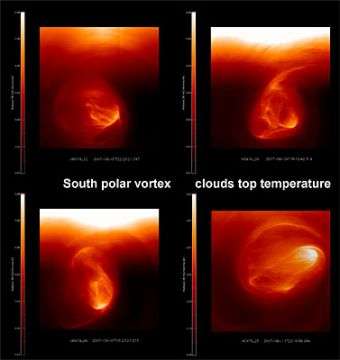
ESA’s Venus Express has revealed Venus as never before. For the first time, scientists are able to investigate from the top of its atmosphere, down nearly to the surface. They have shown it to be a planet of surprises that may once have been more Earth-like, and still is, to a certain extent.
The latest results from the mission were presented today at a press conference held at ESA headquarters in Paris, and will appear in the 29 November issue of the scientific journal Nature.
Permanently covered in clouds, Venus has been a mystery for centuries. Although it is the planet nearest to Earth, it has proved extraordinarily difficult to study because of its curtain of clouds that obscures our view of its surface.
Venus has approximately the same mass as the Earth yet it is a hellish place where surface temperatures are over 400°C and the surface pressure is a hundred times that on Earth. The key to understanding Venus lies in its atmosphere, which is much thicker than Earth’s.
“Today’s results focus on the different science themes Venus Express is covering,” says Dmitri Titov, Venus Express science coordinator from the Max-Planck-Institute for Solar System Research, Germany. “An important first set of results concerns the complex dynamics and structure of Venus’s atmosphere, studied with a whole suite of instruments.”
Titov added, “The spacecraft has revealed the structure and movements of the atmosphere, from its upper reaches to just above the surface, and has obtained the best global map of atmospheric temperatures to date. This is already improving our understanding of the global dynamics and the meteorology of Venus.”
“It is worthwhile mentioning the amazing 3D images of the south polar vortex, the fine details of clouds, some very Earth-like, and hazes, precise wind measurements, and the nicest views ever of the phenomena that make Venus glow in space at infrared wavelengths,” added Håkan Svedhem, ESA’s project scientist for Venus Express.
A second set of results concerns both the atmosphere’s composition and its chemistry. Venus Express has taken compositional profiles of the atmosphere around the planet, and unambiguously confirmed the presence of lightning which can have a strong effect on the composition of the atmosphere itself.
The challenge for scientists now is to match those readings of the atmosphere’s composition with known gases, because they behave differently in the extraordinarily high-pressure environment on Venus than they do on Earth or Mars. “We are only at the beginning of this work,” says Titov, “but we know new surprises are waiting for us.”
A third set of results is about the processes by which the atmosphere of Venus is escaping into space. This is driven by the solar wind – a stream of electrically charged particles given out by the Sun. As the solar particles collide with electrically charged particles near Venus, they energise the gases, stripping them forever from the planet.
Venus Express has provided giant leaps in the understanding of all these phenomena, and found how Venus loses water due its interaction with the solar wind. New measurements of heavy water in the atmosphere are also providing new clues on the history of water on the planet and its overall climate evolution.
However, not all mysteries are solved yet. One key answer that scientists would still like to know is just how active the volcanoes of Venus are. “The contribution of volcanoes to the atmosphere could be enormous. Not knowing leaves a huge hole in our understanding of the climate,” says Fred Taylor, a Venus Express interdisciplinary scientist, University of Oxford, UK.
For a planet that was once thought to resemble Earth, to one that was thought to be completely dissimilar, the tables have turned again. Thanks to Venus Express, Taylor now describes Venus as “Earth’s twin, but separated at birth.”
Source: ESA


