The Strange Case of the Disappearing Quasiparticles
In the “standard model” of condensed matter physics, elementary energy carriers are called quasiparticles. Understanding when and how these energy carriers fail to perform their mission opens doors to new phenomena and may lead to new and important discoveries in the atomic nano-world of condensed matter materials.
In the March 9 issue of Nature, a collaboration of scientists from the U. S. Department of Energy’s Brookhaven National Laboratory, Oak Ridge National Laboratory, the National Institute of Standards and Technology (NIST), and Johns Hopkins University describe their discovery of the point at which the quasiparticles are no longer well-defined energy carriers in a Bose quantum spin liquid. A quantum spin liquid can be thought of as a “sea” of electrons in which the electrons’ spins are not frozen into place, as they would be in, say, a ferromagnet. This discovery could have far-reaching implications, for example, in the study of high-temperature superconductors.
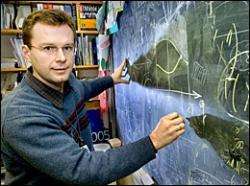
“Although the quantum-liquid state has been studied for roughly a century, it continues to fascinate physicists,” said Brookhaven’s Igor Zaliznyak, the lead scientist in this work. “In some systems, the very existence of quasiparticles cannot be taken for granted. We have demonstrated that at higher energies, Bose quasiparticles ‘disappear’ because they decay.”
The study of quasiparticles, which govern the properties of “quantum liquids,” was pioneered by Russian Nobel-Prize-winning physicist Lev Davidovich Landau. There are two types of quasiparticles, Bose and Fermi, depending on their spin characteristics. Physicists around the globe are exploring the properties of each type. The experiments detailed in the Nature article were conducted using the triple-axis neutron spectrometer at the NIST research reactor in Gaithersburg, MD. They confirmed that in a Bose quantum spin liquid found in a particular quantum magnet, quasiparticle decay leads to their disappearance, as was first predicted by Landau for another exotic quantum system - -superfluid helium-4.
“Landau proposed that at some energy, the quasiparticles break down,” Zaliznyak said. “But the extent of the phenomenon in real materials hasn’t been clear. In experiments at the NIST reactor, we have shown Landau’s proposal to be true for a quantum spin liquid. Above twice the minimum excitation energy, known as the spin gap, Bose quasiparticles in a quantum magnet cease to function as energy carriers.”
The discovery of quasiparticle breakdown in a quantum spin liquid may have important implications, particularly in the world of high-temperature superconductors, where, according to some influential theories, the main players are spin excitations.
Source: Brookhaven National Laboratory


