Beetle dung helps forests recover from fire
November 29, 2007
Tyler Cobb says these beetles and their droppings are an integral part of a forest's recovery following a fire.
Armed with a pair of tweezers and a handful of beetle droppings, University of Alberta forestry graduate Tyler Cobb has discovered why the bug-sized dung is so important to areas ravaged by fire.
Cobb, now the curator of Invertebrate Zoology at the Royal Alberta Museum, studied the burned-out area of Chisholm, the northern Alberta hamlet which was partially lost to wildfire during the blazing summer of 2001. By studying a certain species of fire-loving beetles hard at work in the burned and decaying trees, he was able to determine that the insects' droppings play a vital role in replenishing soil nutrients that help plants regenerate after a fire.
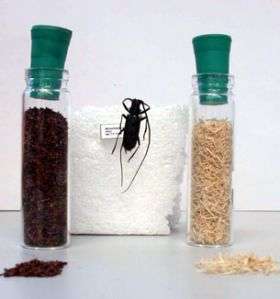
Cobb, while earning his PhD in the U of A Faculty of Agricultural, Life and Environmental Sciences, worked with about 10 grams of beetle dung - 50 to 60 beetles can produce just a handful - over two years, slowly teasing it apart with tweezers and chemically analyzing the contents and using it for experiments to pinpoint the benefits to soil.
Beetle droppings - known in the scientific world as frass - are crucial to forests recovering from fire. The tiny piles of droppings, found at the bases of trees, resemble cones of sawdust, and they help nourish the forest floor by increasing microbial activity in the soil. This process can also determine which kinds of trees grow back.
"This means that rather than being considered a pest or a nuisance, these beetles are in fact very important to helping burned forests recover," Cobb said. He is concerned, though, because salvage logging is taking the beetles out of the forest before they can do their job. The insects lay their eggs in the dead trees, and the larvae are subsequently destroyed when the wood is processed at sawmills.
"That population is being removed from the salvage site and that takes away the mechanism by which the nutrients are returned to the soil."
Salvage logging should be delayed after a fire to allow the beetles to complete their life cycle, Cobb said. "In theory, if you delayed logging for two years, these beetle populations could survive." Another option, he added, is to leave some burned timber - perhaps 10 to 25 per cent - as-is.
Though he intensively studied the frass of only one beetle species, Cobb says that dead wood-associated beetles are found throughout the world, and that without their valuable back-end contributions, forests damaged by fire and other disturbances will be worse off.
"Forest management activities that threaten these species could have widespread ecological impacts. Wherever you've got forest you've got a beetle community essentially dedicated to this decomposition process, which is critical to the overall health of the forest."
Source: University of Alberta
-
Engineers build first sub-10-nm carbon nanotube transistor
Feb 01, 2012 |
4.9 / 5 (32) |
30
-
Something old, something new: Evolution and the structural divergence of duplicate genes
Jan 31, 2012 |
4.6 / 5 (7) |
1
-
The hidden nanoworld of ice crystals: Revealing the dynamic behavior of quasi-liquid layers
Jan 30, 2012 |
5 / 5 (4) |
1
-
Stock market network reveals investor clustering
Jan 27, 2012 |
3.9 / 5 (23) |
8
-
Of microchemistry and molecules: Electronic microfluidic device synthesizes biocompatible probes
Jan 26, 2012 |
5 / 5 (2) |
0
More news stories
A mitosis mystery solved: How chromosomes align perfectly in a dividing cell
Although the process of mitotic cell division has been studied intensely for more than 50 years, Whitehead Institute researchers have only now solved the mystery of how cells correctly align their chromosomes during symmetric ...
1 hour ago |
5 / 5 (2) |
0
|
The proteins ensuring genome protection
Researchers from the University of Geneva (UNIGE), Switzerland, have discovered the crucial role of two proteins in developing a cell 'anti-enzyme shield'. This protection system, which operates at the level of molecular ...
1 hour ago |
5 / 5 (2) |
0
|
Researchers find extensive RNA editing in human transcriptome
In a new study published online in Nature Biotechnology, researchers from BGI, the world's largest genomics organization, reported the evidence of extensive RNA editing in a human cell line by analysis of RNA-seq data, demons ...
1 hour ago |
5 / 5 (3) |
0
|
Entire genome of extinct human decoded from fossil
(PhysOrg.com) -- In 2010, Svante Pääbo and his colleagues presented a draft version of the genome from a small fragment of a human finger bone discovered in Denisova Cave in southern Siberia. The ...
Feb 07, 2012 |
4.7 / 5 (58) |
48
|
Why are there so few fish in the Earth's oceans?
(PhysOrg.com) -- A Stony Brook University researcher has found that, contrary to popular belief, there are not plenty of fish in the sea.
Feb 08, 2012 |
4.3 / 5 (17) |
27
|
Lab study raises questions over nano-particle impact
Tests involving chickens have raised questions about the impact on health from engineered nano-particles, the ultra-fine grains commonly used in drugs and processed foods, scientists said on Sunday.
Iran blocks email, restricts net access: reports
Iran has further restricted access to the Internet and blocked popular email services for the past few days, in a move a top lawmaker said could "cost the regime dearly," media reports said on Sunday.
Salvage workers begin pumping fuel from Italian shipwreck
Salvage workers Sunday began pumping fuel from the shipwrecked Italian cruise liner Costa Concordia, a day ahead of schedule, officials said.
Scientists discover molecular secrets of 2,000-year-old Chinese herbal remedy
For roughly two thousand years, Chinese herbalists have treated Malaria using a root extract, commonly known as Chang Shan, from a type of hydrangea that grows in Tibet and Nepal. More recent studies suggest that halofuginone, ...
New method to examine batteries -- MRI from the inside
There is an ever-increasing need for advanced batteries for portable electronics, such as phones, cameras, and music players, but also to power electric vehicles and to facilitate the distribution and storage of energy derived ...
Starve a virus, feed a cure? Findings show how some cells protect themselves against HIV
A protein that protects some of our immune cells from the most common and virulent form of HIV works by starving the virus of the molecular building blocks that it needs to replicate, according to research published online ...